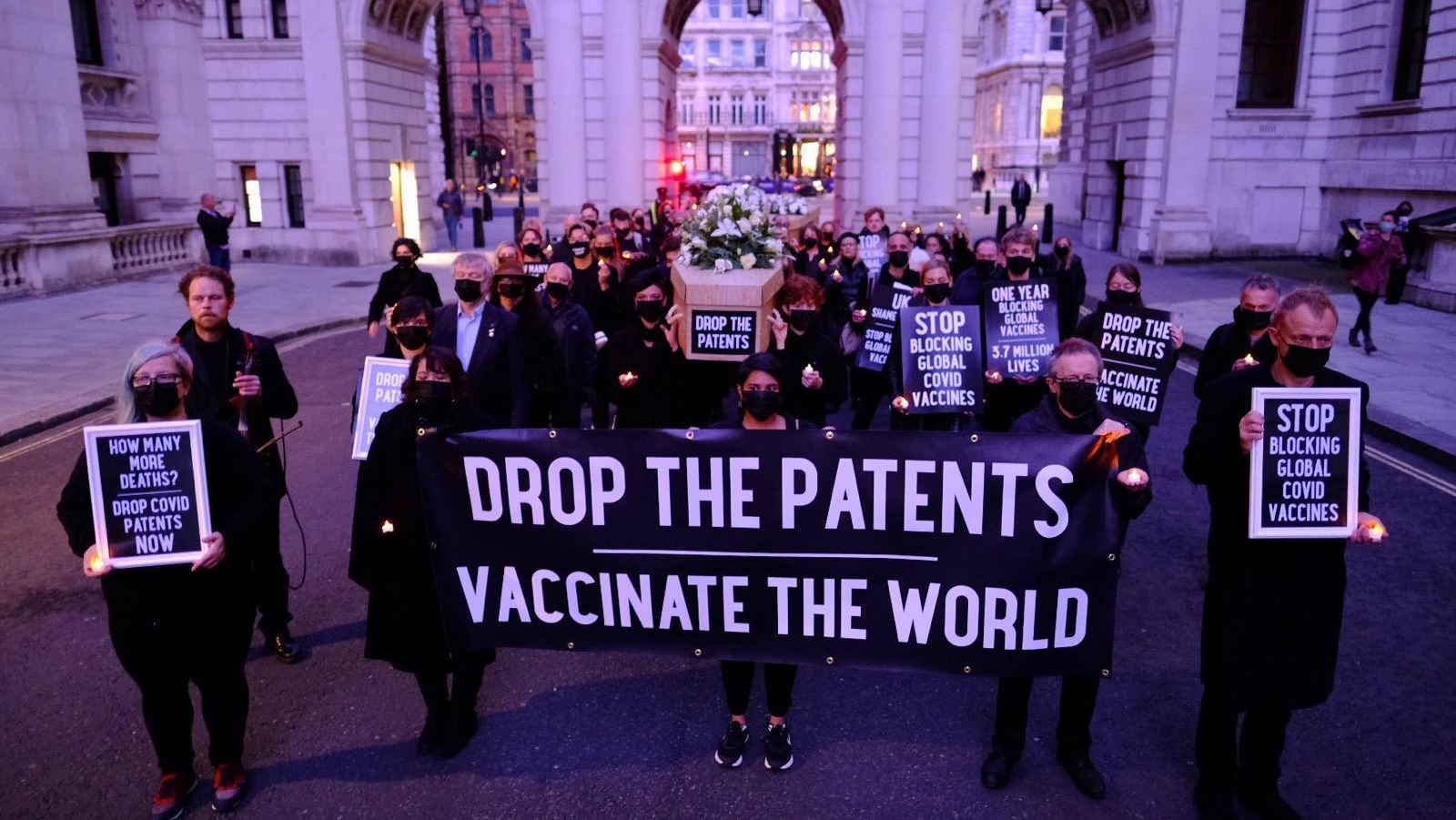
Above photo: A protest against the UK government’s refusal to back the TRIPS waiver proposal held in London on October 12. Jess Hurd/ Global Justice Now.
Big Pharma thrives on profiting from publicly funded innovation.
But Public Pharma can take back control and put health over profit.
Big pharma loves to present itself as the driving force of medical breakthroughs – an industry tirelessly pushing the boundaries of science to deliver life-saving treatments. Yet, behind the grand narratives of “innovation”, the truth is far more calculated. Rather than committing to the expensive, high-risk process of true scientific discovery, pharmaceutical giants like Sanofi, Johnson & Johnson (J&J), Roche, Pfizer, Bristol-Myers Squibb (BMS), Merck, and AstraZeneca have refined a more strategic and profitable approach: let others take risks, then swoop in to take the rewards.
Innovation centers: scouting, not discovering
Many pharmaceutical corporations boast of their global innovation centers strategically placed in Boston, San Francisco, London, Paris, and Shanghai. These are often presented as cutting-edge research and development (R&D) hubs. Still, in reality, they function more like scouting networks, not developing breakthrough treatments but identifying promising startups and academic projects that big pharma can later acquire or co-opt. Sanofi, J&J, and Roche use these centers to monitor university labs, biotech firms, and AI-driven drug discovery platforms, waiting for promising drug candidates to emerge before moving in. Merck and AstraZeneca concentrate heavily on AI-driven partnerships, outsourcing the discovery phase to machine-learning firms like BenevolentAI rather than leading internal drug discovery efforts.
By avoiding the uncertainty intrinsic to drug discovery research and the financial resources that come with it and focusing on surveillance and extraction over genuine collaboration, these innovation centers help consolidate corporate control over knowledge and medical technologies.
Strategic partnerships: let biotech firms do the heavy lifting
Rather than committing to expensive in-house research, many pharmaceutical companies opt to let smaller, more innovative biotech firms handle the high-risk early stages of drug discovery. Pfizer and Merck only entered the mRNA vaccine race after BioNTech and Moderna had already developed the foundational technology. J&J and AstraZeneca waited until smaller firms had demonstrated the commercial viability of AI-powered drug development before striking partnerships of their own. Sanofi, Roche, and BMS have followed the same pattern, acquiring rights to RNA-based therapies, cancer treatments, and gene-editing technologies only when the most uncertain phases of development have already been completed.
While these collaborations are often presented as innovation accelerators, the structure of such partnerships is organized in a way that big pharma can claim ownership over medical advances at the end without being accountable for their risks or development trajectories. It is an exploitative research ecosystem in which smaller firms shoulder the scientific and financial burden while large corporations reap the rewards, while the public pays twice: first through subsidizing early research and again through inflated drug prices.
Acquisitions: buying innovation instead of creating it
The most egregious example of big pharma’s risk-averse model is its reliance on acquisitions rather than internal research. The process follows a familiar playbook. Smaller biotech firms take on the risk of developing novel therapies, invest years into early-stage clinical trials, and prove their treatments have market potential. A major pharmaceutical corporation comes in at the final stage. It acquires the small company for exorbitant prices – up to billions – reaping the profits without committing to long-term scientific progress. Bristol-Myers Squibb’s acquisition of Celgene, Pfizer’s purchase of Seagen, and Roche’s acquisition of Genentech all exemplify this strategy.
It undermines the sustainability of independent biotech innovation and concentrates power in the hands of a few dominant firms. It encourages the development of niche blockbuster drugs at the expense of broader therapeutic research and ultimately narrows the scope of innovation to what aligns with big pharma’s commercial logic.
Licensing deals: profiting without investing
When outright acquisitions aren’t an option, big pharma depends on licensing agreements to secure exclusive rights to promising drugs without committing to their early-stage development. Merck’s licensing deal with Kelun-Biotech allowed it to enter the antibody-drug conjugate cancer therapy market without investing in research. AstraZeneca struck a similar agreement with Daiichi Sankyo, ensuring it could profit from ADC drugs without taking on the financial risk of their development. Sanofi, J&J, and Roche frequently strike licensing agreements for RNA therapies, gene-editing technologies, and immunotherapies, gaining access to new treatments only after someone else has done the groundwork.
The long-term consequences of such deals can be deeply damaging, leading to restrictive pricing, limited manufacturing rights, tight IP control, and, most likely, the inaccessibility of life-saving treatments. Licensing also distorts R&D priorities, encouraging biotech firms to pursue what can be licensed quickly rather than what is most needed for public health.
The systemic impact of big pharma’s model
Big pharma’s use of innovation centers, strategic partnerships, acquisitions, and licensing deals reflects a coherent strategy. Not a scatter of bad practices, but a tightly integrated system of corporate extraction. This model prioritizes financial returns over therapeutic needs, short-term shareholder value over long-term public health. It distorts the direction of pharmaceutical R&D, funneling public funds and early-stage innovation into private monopolies, which then use their control to set high prices, limit access, and concentrate power. The cumulative result is a pharmaceutical landscape where even publicly funded breakthroughs become unaffordable for the public, and where the health priorities of entire populations are subordinated to corporate profitability.
This isn’t simply a case of market failure, but a predictable outcome of a system designed to privatize benefits while socializing risk. To build a pharmaceutical ecosystem that truly serves public health, we need not only to critique big pharma’s extractive practices but to design and invest in alternatives that work differently at every level. Public pharma offers a structural alternative that still recognizes the importance of innovation hubs, collaboration, growth, and knowledge sharing, but does so under public ownership, with public interest as the core mandate.
Public pharma innovation centers: from surveillance to stewardship
Rather than acting as corporate scouting hubs, public innovation centers can be transparent, mission-driven institutions that focus on unmet health needs. Their mandate is not to secure future acquisitions but to advance scientific knowledge, share data openly, and develop affordable medicines. They can maintain close ties with universities and communities, directing R&D toward neglected diseases and health equity.
Examples of a similar approach can already be seen in the world: Statens Serum Institut (Denmark) combines research, manufacturing, and public health strategy under one roof. Its vaccine development is guided by public health priorities and national preparedness, rather than market size. Unlike private “innovation centers”, it develops treatments even when profit margins are low or nonexistent.
Public pharma strategic partnerships: from exploitation to collaboration
Public Pharma can still collaborate with smaller biotech firms, academic groups, and tech innovators, but under terms that preserve public ownership, ensure knowledge sharing, and protect the public interest. These partnerships can be long-term and mission-oriented, with built-in mechanisms to keep resulting products affordable and accessible.
Such a possibility is illustrated by Fiocruz (Brasil), which has formed partnerships with local and international universities and technology developers, including for COVID-19 vaccine production. These partnerships focus on technology transfer and capacity building, not IP capture. Public benefit is built into every stage of the agreement.
Public pharma acquisitions: from corporate consolidation to public expansion
Instead of allowing biotech firms to be absorbed by monopolistic corporations, public agencies can step in to acquire or co-develop promising technologies and ensure they remain within the public domain. These acquisitions wouldn’t be about market control, but about securing strategic knowledge, expanding public production capacity, and insulating the supply chain from commercial disruptions.
The Pasteur Institute of Dakar in Senegal, for instance, is expanding its vaccine capabilities with public investment. Rather than being sold off to multinationals, it is receiving international support – including from the EU and WHO – to scale production while retaining public ownership and regional access guarantees.
Public pharma licensing deals: from IP lock-up to open access
Public pharma can develop new models for licensing that explicitly reject exclusivity. Instead, it can promote open licenses, patent pooling, and technology transfer agreements that maximize global access. Licensing terms can be crafted to guarantee affordability, local production, and global equity.
For example, the Medicines Patent Pool (MPP), supported by UN agencies and governments, is a working model of how licensing can be done in the public interest. Public Pharma initiatives could go even further, using MPP-style mechanisms not just for HIV-1 or COVID-19 drugs, but across the full spectrum of (essential) medicines.
Public pharma for Europe: reclaiming collective power
A growing political movement is now pushing for public pharmaceutical alternatives at the regional level. The Public Pharma for Europe (PPfE) coalition, made up of civil society organizations, patients, health workers, academics, and activists, calls for creating publicly owned pharmaceutical infrastructures across Europe. Its aim is simple but transformative: to put governments, not corporations, back in control of drug research, production, and distribution.
By removing the profit motive from the heart of pharmaceutical development, the PPfE Coalition envisions a model where public money serves a public purpose. It proposes the creation of new institutions, such as a publicly funded European Salk Institute, to coordinate non-commercial research and produce medicines free from corporate patents and price gouging.
For too long, the pharmaceutical system has operated under the logic of neoliberal capitalism, treating medicines as commodities and public health as a secondary concern. The results are clear: innovation pipelines shaped by market value, not medical need; soaring drug prices; monopolized access; and scientific advances locked behind patents. Public Pharma could offer the opposite. It is a vision of medicine as a public good, driven by democratic values, collective investment, and global solidarity. It restores transparency, accountability, and long-term planning to drug development, all while ensuring that life-saving treatments remain accessible to everyone.
The time for half-measures has passed. Scaling up public pharmaceutical capacity – regionally, nationally, and globally – is not just a political choice. It is an ethical imperative and a public health necessity.
People’s Health Dispatch is a fortnightly bulletin published by the People’s Health Movement and Peoples Dispatch. For more articles and to subscribe to People’s Health Dispatch, click here.