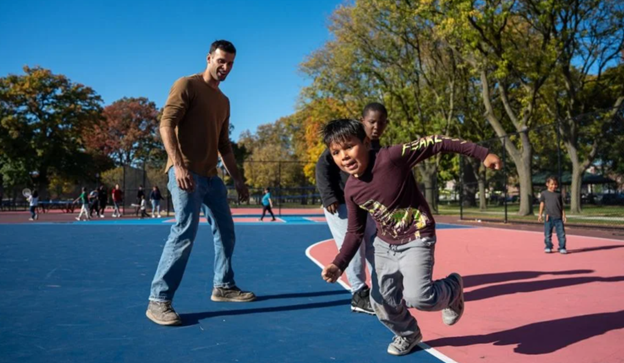
Above photo: Clark Park Coalition maintenance manager Zachary Benavides (left) plays soccer with young parkgoers including Clarence Spotted Wolf (right). Brayan Gutierrez / Planet Detroit.
Southwest Detroit’s Clark Park evolved from a site of drug activity and violence into a vibrant neighborhood hub.
Driven by grassroots initiatives and city collaborations, the transformation highlights the power of community-centered policing – and sparks debate over police roles in public spaces.
One afternoon in the late 1980s, longtime Southwest Detroit resident Deb Sumner and her neighbors in Hubbard Farms gathered at Clark Park to discuss community improvements. Their meeting was interrupted by a gunshot overhead, forcing them to crawl through the park and take cover in the YMCA building. For Sumner, it was a pivotal moment.
“I said, ‘This is not going to happen again,’” Sumner recalls. “We’ll take it into our own hands.”
For decades, the park on Vernor Highway has reflected both the challenges and triumphs of the surrounding neighborhood. Once plagued by drug activity, violence, and neglect, the park is now a thriving community hub thanks to grassroots efforts, city partnerships, and a unique approach to public safety that blends community accountability with selective police engagement. Yet tensions remain over the role of law enforcement, raising questions about what it means to create a safe and welcoming public space.
Twice, Sumner and others mobilized to save the park, forming the Clark Park Coalition in 1991 to introduce youth sports and educational programs and preserve its historic ice rink. Today, Clark Park is a model of community-led revitalization — a forested urban oasis in Southwest Detroit where families gather to play sports, cool off at the splash pad, or enjoy a peaceful retreat.
The park has largely shed its troubled past. In the 1980s, crack cocaine fueled drug dealing and gang turf wars in the area. By 2008, the park faced near-closure as the city struggled to pay utility bills, mow the grass, or maintain amenities. Benches were absent, paths were unlit, and play equipment was sparse.
Community efforts led by advocates like Sumner brought resources to Clark Park. The Detroit Police Department launched a Neighborhood Police Officer program in 2014 to improve safety and foster community engagement.
Anthony Benavides, director and cofounder of the Clark Park Coalition, says he’s gauging residents’ feelings about police in the park.
Clark Park is a beloved community hub, though incidents still occur.
“Most people I’ve spoken with feel safer with police here,” Benavides says. “I know people have trauma with the police. But the more activities and eyes you have in the park, the less you rely on the police.”
Between 2016 and 2024, there were 135 police calls associated with Clark Park, according to records obtained by Planet Detroit from the Detroit Police Department through the Freedom of Information Act.
“Special attention” is the most frequent category, logging 28 calls. The category means the park was marked for officers to visit while driving by, according to a spokesperson for the Detroit Police Department. EMS or medical-related calls appear 20 times. This category includes heart problems, chest pain, or a fall with serious hemorrhage. Disturbance, assault and battery, and investigation account for 26 calls total.
These numbers do not account for multiple calls for the same incident. For example, on Sept. 28, 2019, DPD received four calls within 6 minutes for an unconscious person.
According to the DPD records, there was one reported rape in 2017, and one reported kidnapping in 2019.
Calls for conflict resolution after recent violence
Courtney McCarty, a Southwest resident of eight years, was at the park’s sandboxes enjoying the spring weather with her children when another park goer calmly informed her of a gunshot.
McCarty, who was with a group of other mothers and their children on March 18, left around 6 p.m., about 20 minutes after police say a man was shot in a dispute on the basketball court. Jackson Vidaurri, a spokesperson for the Detroit Police Department, says the suspect, Demetrius Walton, 51 of Detroit, is alleged to have gone to his vehicle before returning to the argument and shooting the victim, a male in his 20s, and fleeing the scene.
The shooting was non-fatal and the victim was privately transported to a local hospital and listed in stable condition. Officers were able to identify the suspect and arrest him the same day, Vidaurri says.
The Wayne County Prosecutor’s Office charged Walton with assault with intent to murder, assault with intent to do great bodily harm less than murder, felonious assault with a dangerous weapon, and felony firearm counts. Walton stood mute at his March 20 arraignment and a plea of not guilty was entered on his behalf. A trial in the case is scheduled for June.
McCarty says she still appreciates the park despite the incident.
“This was a reactive fight, it wasn’t this faceless villain being violent for the sake of being violent,” she says.
The proximity to Clark Park was “huge” in her decision to move to the area, and she says she loves the diversity and community feel.
“I do feel pretty safe still, but there is a piece of me that looks over at the basketball courts and I have a moment that I didn’t have before, of a little uncertainty,” McCarty says.
She says she’s unsure if having more police in the park is right for the community, and suggested a conflict de-escalation campaign or signs to be put up around the sports areas.
“I wonder if there’s an opportunity for the community to reflect on: this is not who we want to be, and this is a safe place,” McCarty says.
Cinco de Mayo arrests highlight divide over police
The neighborhood police program, launched by former Detroit Police Chief James Craig, aims to improve policing by assigning community officers who build relationships with residents and have a personal connection to the area.
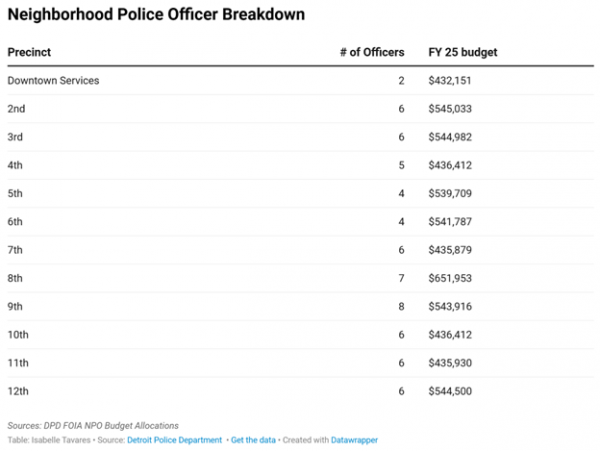
Officers receive a 2.5% step increase to their salary when they become NPOs, according to a DPD NPO Community Outreach Strategic Plan. The NPO budget increased by $1.9 million citywide from fiscal 2024 to 2025. This year, the 4th Precinct received $436,412 for its NPO program, up by over $19,000 since 2024.
Additionally, the mayor’s office approved $986,235 in health department funds to support community violence intervention in fiscal 2025.
Neighborhood police officers are assigned to precincts after an interview process and must maintain good discipline records, according to Cmdr. Shelley Holderbaum of the 4th Precinct, which includes Clark Park. In Southwest Detroit, two Spanish-speaking Hispanic officers recently joined the program. Officers often attend community events at churches, schools, and parks.
Nationally, community policing programs have drawn criticism, with detractors arguing they attempt to “whitewash” systemic racialized violence in policing. Critics say the programs are costly public relations efforts that fail to reduce crime or provide meaningful community services.
Holderbaum says she believes the program shows promise in Southwest Detroit. The 4th Precinct had the lowest crime rate and the fewest 911 calls in the city in 2024. Robberies, sex crimes, and non-fatal shootings declined from 2023 in the 4th Precinct, although homicides rose, mirroring a citywide trend, Holderbaum said at a September 2024 Board of Police Commissioners meeting.
Homicides, nonfatal shootings, robberies, and carjackings are down citywide from 2024 so far this year, Deputy Chief Arnold Williams said at an April 10 Board of Police Commissioners meeting.
Holderbaum, a Hubbard Farms resident and 25-year police veteran, says she remembers when the park was far less safe.
“It really wasn’t a great place to be,” she says. “I used to run in the park and think, ‘I better be able to outrun them.’” She says families now thank her for making the park feel safe again: “It’s hard work, but I wouldn’t trade my job for anything.”
Officer Alexis Kellogg joined the neighborhood police program in 2020 after six years on midnight patrol, describing the switch as going “from special ops to the Peace Corps.” Growing up across the street from Clark Park in the 1980s, Kellogg calls it her “whole world,” recalling frequent volunteering despite the park’s gang presence.
“If you weren’t in the gang, you just lived your life,” she says. She emphasizes that Clark Park’s revitalization stands out because it’s driven by the community. “Clark Park has always been special because it’s citizen-driven, with neighbors taking care of that space,” Kellogg says.
The police department budget totaled $441,850,719 in fiscal 2025, which ends June 30, for the year. Along with over $5 million in community engagement, including 116 community policing programs, over $80,000 was appropriated for the citizens patrol, which includes 18 groups across the city, and more than $27 million in communications operations.
Detroit’s ShotStoppers program, a community violence intervention program where community groups define and roll out their own violence reduction strategy, achieved 30% to 70% declines in homicides and shootings in late 2023 and early 2024 in the geographic areas where the program was enacted, according to the mayor’s office.
Some Southwest Detroit residents say they feel less secure when police are present at community events. In July 2024, residents and groups including SW Fest, Garage Cultural, Detroit Will Breathe and the Coalition for Police Transparency and Accountability held a hearing at Clark Park to address concerns about police actions at recent events.
Xavier Cuevas, a Detroit photographer, spoke at the hearing last summer about his experience of police heavy-handedness at last year’s Cinco de Mayo parade. Cuevas says he was at a licensed venue when police told people inside to leave, citing a public safety concern.
Cuevas says he walked a few blocks away and was arrested for failure to disperse. The charge against Cuevas was dismissed Jan. 31, 2025, according to 36th District Court records.
“Point three miles or so away from the place that I was told to disperse, I got arrested for failure to disperse,” Cuevas says. “It’s kind of funny if it wasn’t so egregious.”
A few weeks later, officers “abruptly interrupted” auditions for SW Fest held at Garage Cultural, the organization’s director Amelia Duran says. More than 10 officers showed up in “full force over an alleged parking complaint” at 10:30 p.m., she says.
“There I was, pleading for them to back down so my youth could disperse safely, pleading for them to understand why their presence invoked fear and violence on us,” Duran says. “And yet they stood for over an hour provoking us, mocking, and ridiculing us.”
Cuevas says there is a pattern of increased police presence during community gatherings in Southwest.
Holderbaum says DPD’s actions were necessary to ensure public safety and compliance with regulations. The department prioritized public safety, she says during the July hearing.
hais Plascencia, a longtime Southwest resident with multigenerational ties to the neighborhood, says she would “love” to see more police in the park, on foot, horse or bike.
“I personally have really never had bad influences with police officers,’’ says Plascencia. “The Cinco de Mayo stuff, that was not the best thing that we could possibly have done,” referring to Detroit police department’s detaining and ticketing of eight people during the 2024 parade, as reported by BridgeDetroit.
When there’s an issue – a loose wild dog or someone experiencing a bad drug reaction – Benavides of the Clark Park Coalition says he gives the police a call. “They treat them like human beings and get them the help they need,” he said.