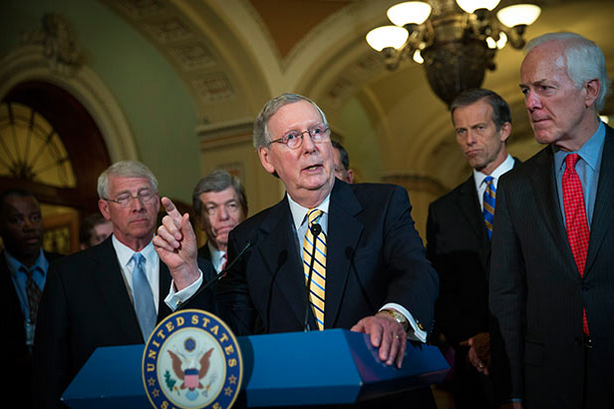
Senate Majority Leader Mitch McConnell (R-Kentucky) speaks on Capitol Hill in Washington, April 21, 2015. After more than a decade of wrenching national debate over the intrusiveness of government intelligence agencies, a bipartisan wave of support has gathered to sharply limit the federal government’s massive sweeps of phone and internet records. (Photo: Doug Mills/The New York Times)
A revolution came to Washington in the wee hours of Saturday morning, just after the stroke of midnight. After 15 years of congressional deference to mass surveillance, Congress finally took action – ironically, by failing to take action – and did its job to check and balance executive power.
On May 23, after a hard-fought congressional debate, the Senate effectively allowed portions of the notorious Patriot Act to expire as previously scheduled, appropriately rejecting a compromise branded as the Freedom Act.
It is the first time Congress has meaningfully checked and balanced the national security agencies since 2001. It will not be the last.
Where Did This Come From?
Congress approved the Patriot Act in 2001 with neither debate nor an understanding of what it entailed. Since then, it has accepted – from both the Bush and the Obama administrations – secret legal interpretations contorting statutes into mass surveillance programs recently held illegal by a federal appellate court, as well as lies under oath by senior officials aiming to hide domestic spying programs from congressional and public oversight.
The American people have never gone along quietly.
During the Bush administration, years before the Edward Snowden revelations amplified mass outrage in 2013, nearly 500 cities and eight states issued official declarations decrying mass surveillance. Cities from Lexington, Massachusetts toBisbee, Arizona (including others in between like New York City, Los Angeles andDallas), and states as politically diverse as California and Idaho raised their voices.
Since the Snowden revelations, Americans from coast to coast have taken action to challenge domestic spying. We have taken action online, from online petitions shaming the absent chair of a crucial congressional oversight committee, to campaigns promoting mass encryption to force constitutional compliance on the agencies technologically, despite their disdain for legal limits. We have taken action in the streets, outside NSA headquarters, outside the White House, at rallies on Capitol Hill and in our state legislatures. We have fought back with music, sculpture,DJ mixes, poetry and comedy.
While the domestic phone metadata program’s days may be numbered, this drama is just beginning. Hawks may force another Senate vote on Section 215 on the eve of the phone dragnet’s expiration. Beyond their desperate effort to save the program, the Freedom Act’s rejection paves the way for further surveillance reform to address other legal authorities under which unconstitutional and ineffective domestic spying will continue even after this authority finally expires.
What Happened?
Congressional allies of the intelligence agencies failed to muster enough votes to extend Section 215 in the face of opposition, including a dramatic bipartisan filibuster initiated by Sen. Rand Paul (R-Kentucky).
The Freedom Act, proposed as a compromise after negotiation with the administration (which launched a failed 11th-hour blitz to ram it through) fell three votes short of the required minimum to force a vote. Senate Majority Leader Mitch McConnell (R-Kentucky) then tried to force votes on a short-term reauthorization without proposed reforms, which several senators from both parties flatly rejected.
While the Freedom Act would have imposed some limits on domestic spying, the compromise it embodied was profoundly unambitious. The bill was built in relative secret, without nearly enough public input, and ignored most of the issues raised by the Snowden disclosures two years ago.
Having failed to sustain either the proposed compromise or several short-term reauthorization attempts proposed by the Senate majority leader, Congress need not waste further time considering whether to resuscitate Section 215. A federal appellate court recently ruled that its prior incarnation was illegal, anyway, reducing another potential vote to bickering over “yesterday’s news.”
The political shift indicates a direction for future reform.
Who Wins and Who Loses?
The most obvious losers are the NSA and FBI. After 15 years of breaking already permissive laws, yet not congressional blank checks, the agencies must finally start complying with constitutional limits.
Within the agencies, senior leaders of the intelligence establishment also emerge looking like clowns. Section 215 survived this long only because agency officials – including Director of National Intelligence James Clapper and former NSA Director Michael Hayden – lied under oath to evade oversight. The Senate’s decision to end a program that senators learned about from whistleblowers, instead of those officials, further discredits their legacies.
Even if they remain above the law by evading the prosecution for perjury sought by multiple members of Congress, their careers will be defined by congressional and judicial rejection of illegal programs they built in secret.
To the extent intelligence officials are clowns, the many congressional leaders from both parties who supported them are stooges. Establishment Democrats and Republicans alike uncritically accepted lies, deferred to them and went along with the Beltway consensus – in sharp contrast to their populist colleagues who proved willing to uphold their oath of office to “defend the Constitution against all enemies, foreign and domestic.”
Several winners also emerged from this drama.
Congressional rejection of mass spying vindicates several principles at once, including transparency, oversight, checks and balances, the separation of powers and constitutional rights enshrined in the First and Fourth Amendments. Each of those values is cherished across the political continuum, making them especially powerful during a presidential election year.
Senator Paul is another clear winner. He demonstrated leadership, surged among the crowded GOP field of 2016 presidential hopefuls and effectively seized control of the Senate from the majority leader. With its senators leading both the surveillance/secrecy/corruption caucus, as well as the competing constitutional/privacy/accountability caucus, Kentucky could also claim victory.
The US Constitution may be the most important winner. By proxy, “We the People of the United States” actually scored two victories at once.
Narrowly, the expiration of Patriot Act Section 215 advances Fourth Amendment privacy interests. Even though mass surveillance will continue for now under other legal authorities, one program through which our government monitors phone calls and tracks everyone’s behavior, regardless of wrongdoing, will end.
More broadly, this vote begins a long-overdue process of limiting executive powers, expanded during a period of seeming emergency, which grew entrenched despite proving ineffective as well as constitutionally offensive. In this sense, congressional assertiveness supports democracy in a long-running battle to avoid the erosion from within foreseen by both Alexis de Tocqueville and President and Supreme Allied Commander Dwight Eisenhower.
What Comes Next?
With reformers having triumphed in Congress, the debate over surveillance reform must expand. Further reforms are necessary to enable an adversarial process and greater transparency at the secret Foreign Intelligence Surveillance Court, and also to limit other legal authorities – like Executive Order 12333 and FISA Section 702 – used to justify unconstitutional domestic surveillance.
It’s a good thing that a bipartisan measure, the Surveillance State Repeal Act (HR 1466), is poised to do exactly that. Rep. Mark Pocan (D-Wisconsin) and Rep. Thomas Massie (R-Kentucky) introduced the SSRA to force the agencies to justify the expansion of any powers from a constitutional baseline, rather than one contrived by a decade of executive lies.
Congress has long abandoned its role of checking and balancing runaway executive power, but the Senate’s recent vote suggests an overdue awakening. Members should heed the political wind, and embrace bipartisan calls for aggressive limits as the starting point for comprehensive surveillance reform.