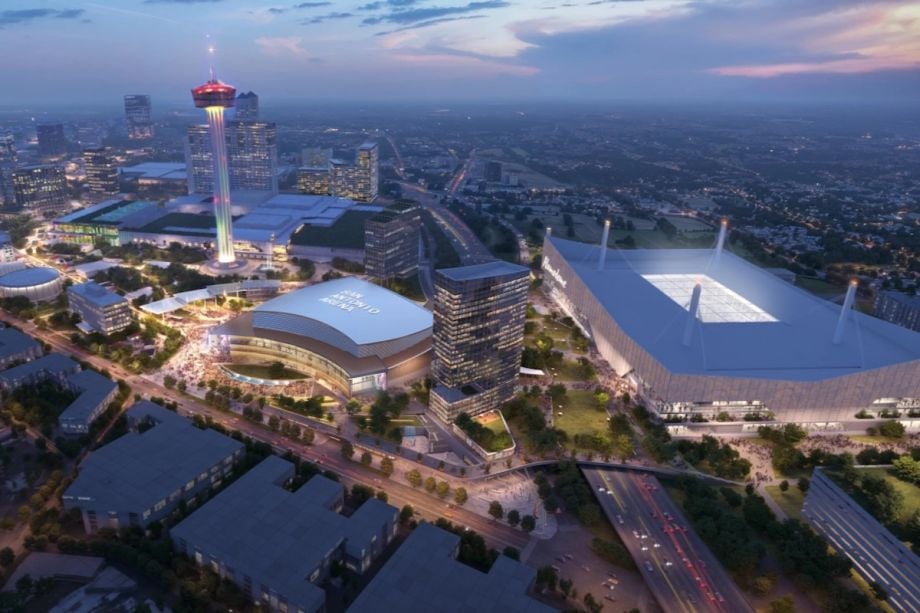
Above photo: A rendering of what a proposed Project Marvel entertainment district could look like. City of San Antonio.
Plans for a sports and entertainment district promise to return the Spurs downtown.
But history and public scrutiny raise urgent questions about who truly benefits.
In 2025, the familiar story of sports-and-entertainment megaprojects plays out once more. On one side are the skeptics, wary of whether millions in public funds truly benefit everyday San Antonians; on the other are the enthusiasts, captivated by glossy renderings and big promises.
In September 2024, Project Marvel was covered by media for the first time — a new vision to return the Spurs to downtown, near the Alamodome, reshaping the area into a sprawling entertainment and mixed-use district.
The city’s 2002-built Frost Bank Center, previously known as the AT&T (and SBC) Center, opened at a cost of approximately $175–190 million, financed via hotel and car-rental tax increases alongside a Spurs contribution of $28.5 million. Promised as a transformative development in the historically Black East Side, that vision never materialized fully — today it remains isolated, encircled by surface parking and lacking neighborhood life.
San Antonio’s economy remains heavily tourism-driven. Two years ago, our hospitality industry generated a staggering $21.5 billion in economic impact (24% above pre-pandemic levels) and contributed $277 million in taxes to the city, amounting to 17 % of its General Fund expenditures. The River Walk and the Henry B. Gonzalez Convention Center, which hosts hundreds of events every year, are linchpins in this ecosystem, with tourism supporting more than 130,000 jobs and injecting over $13 billion into the local economy.
Against that backdrop, Project Marvel could supercharge downtown’s appeal — but only if structured for broad community benefit.
Mayor Gina Ortiz Jones –San Antonio’s first Filipina, veteran and openly gay mayor – inherited the deal with her election this year and has rightly questioned its transparency. Its rollout has been troubling: rushed public workshops (a record number of workshops during June), inconsistent presence across districts, and reduced forums to performative town halls rather than inclusive dialogue. Such superficial processes are unacceptable when public dollars — and trust — are on the line.
The question at the core: Who will benefit from Project Marvel? Multiple city council briefings reveal serious cost concerns. These are currently pegged around $1.3–1.5 billion, with the city potentially paying $489 million plus tax increases to secure the Spurs’ return, plus Bexar County being asked to contribute another $311 million.
Doubts have only heightened as the city’s economic study was conducted by CSL, which shares staff with Spurs ownership. In response, Mayor Jones called council to approve an independent economic impact study — a prudent step toward fiscal transparency and unbiased analysis, though ultimately unsuccessful.
Meanwhile, residents at recent town halls suggested repurposing Frost Bank Center into public-serving facilities: an indoor water park, trade schools, or housing for seniors and unhoused neighbors. These voices echo broader skepticism rooted in decades of unfulfilled promises
Missing Pieces For Equitable Planning And Investment
This moment reveals several truths:
-
Equitable development can’t be rushed. Authentic, community‑centered visioning demands time, intention, and meaningful engagement — not token input sessions.
-
San Antonio can model what inclusive planning looks like, but only if public resources are stewarded with real accountability.
-
Mayor Jones is right to demand due diligence. Asking for independent analysis that supports transparency is essential — but still insufficient.
-
San Antonio needs an upgrade of tools and processes to put forward a deal that is not just viable, but just.
To restore trust and deliver true value, San Antonio must:
-
Institutionalize equity frameworks. A Racial Equity Impact Assessment, or REIA, should be a mandatory step for major public projects like Project Marvel. REIA goes beyond financial feasibility, asking: Who gains? Who loses? Whose community is being uplifted, and whose is being sidelined or burdened?
-
Launch ongoing, inclusive community engagement, prioritizing historically disinvested neighborhoods. Input needs to be substantive, not ceremonial.
-
Use disaggregated data to guide equitable outcomes — economic, racial, spatial.
-
Negotiate a Community Benefits Agreement. Such an agreement must enshrine affordable housing, local hiring, community-wealth building, minority business opportunities, anti-displacement protections and civic access.
-
Demand transparent, third-party fiscal modeling, conducted at arm’s length from investors, to ensure public accountability.
Cities like Minneapolis, Seattle and Oakland are already testing these equity frameworks and achieving more accountable development. Research consistently shows that mega-events and arenas rarely deliver promised economic windfalls and often deliver spotlight rather than shared prosperity.
This is the time to ask not whether Project Marvel is viable, but whether it’s just. San Antonio must define success not by how many tourists walk the River Walk, but by how deeply a project serves its entire city, especially its historically marginalized neighborhoods.
To our civic leaders: Slow down, get it right. We deserve a deal that reflects our values: intelligent, inclusive, equitable.