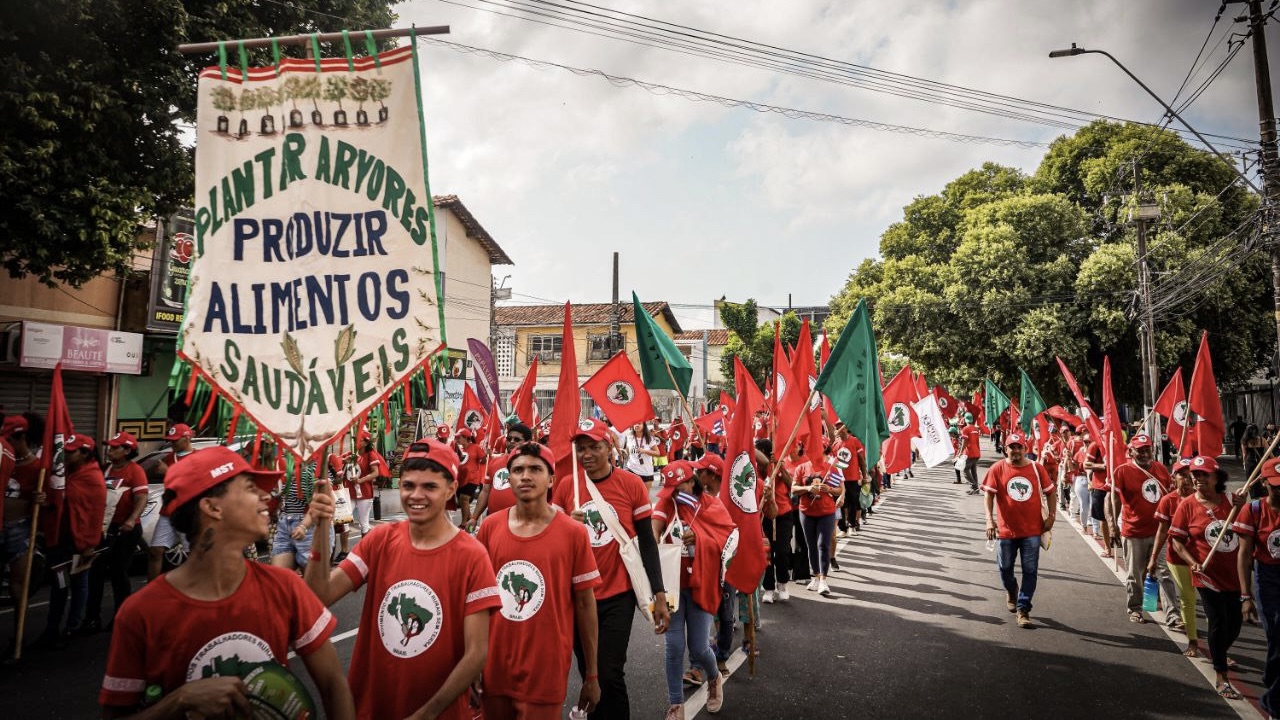
Above photo: The march is part of the People’s Summit program, running parallel to the official negotiations at COP30. Laís Alana / MST.
The march was part of a historic gathering.
That gives a voice to the people who were not heard in the official COP30 spaces.
The streets of Belém were occupied, according to organizers, by more than 70,000 people on Saturday, November 15, for the historic Global Climate March. Unlike the official COP30 spaces, the march brought together the diversity of peoples and demands from civil society in defense of climate justice.
With the force of the motto “We are the answer”, the tens of thousands of members of people’s movements held signs such as “Agribusiness is fire”, “There is no climate justice without popular agrarian reform” and “environmental collapse is capitalist”.
They covered 4.5 kilometers to Aldeia Cabana, a symbolic space representing struggle and resistance in the Amazon region, in homage to the Cabanagem Revolt and on the day that also marks the Proclamation of the Republic.
“Workers from around the world walk through the streets of Belém to say that the true republic we believe in is one that guarantees workers’ rights, that cares for nature, thinking of future generations, and knows how to defend our country’s sovereignty. We protest here around the environmental agenda, but also around other agendas that are urgent,” points out Ayala Ferreira, who is part of the national leadership of the Landless Workers’ Movement (MST) and the political commission of the People’s Summit.
The march is part of the People’s Summit program, an autonomous gathering parallel to COP30, built by more than 1,100 organizations. The mobilization brought the main popular demands, such as demarcation of traditional communities’ areas, more conservation units in the country, investment in renewable energy, strengthening of family agriculture, restoration of mangroves and improvement of urban sanitation, among others.
Dyneva Kayabi, from the leadership of the Coordination of Indigenous Organizations of the Brazilian Amazon (Coiab), highlighted the urgency of demarcating indigenous lands to guarantee climate justice.
“Without demarcation, there is no life, no education, no health. We are the answer, because without us, we don’t have clean air, standing forest, living rivers and we don’t have mother earth completely preserved.”
With much creativity, blocks of popular movements presented artistic performances such as the Funeral of Fossil Fuels, which called on the population to reflect on the end of the oil era and the urgency of a just and democratic energy transition.
From the leadership of the Movement of People Affected by Mining, Elane Barros, from Maranhão, defended the fight for a new mineral model for Brazil, which prioritizes popular sovereignty, social control and sustainable management of natural resources.
“All the peoples of the world meet here to announce that climate justice will only be possible if it includes and has peoples as protagonists. We need to have sovereignty in mining, in food and in all their decisions,” she notes.
Ministers and parliamentarians participated in the mobilization and gave official speeches in front of São Brás Market, including ministers Marina Silva (Environment) and Sônia Guajajara (Indigenous Peoples) and PSOL deputies Chico Alencar (RJ), Sâmia Bomfim (SP), Talíria Petrone (RJ), Tarcísio Motta (RJ).