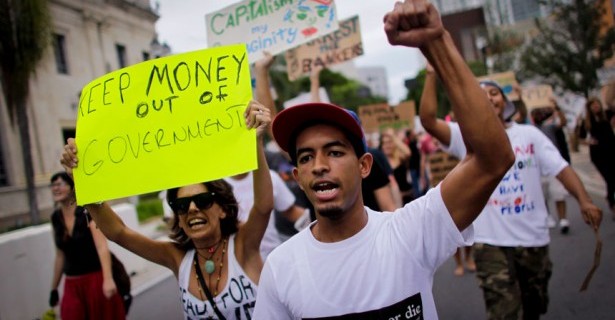
Above: ‘Occupy was not about hope. It was about power.’ (Joe Raedle/Getty)
How Occupy invigorated a generation’s fight for survival.
‘There is a general unrest in my generation. We are the most diverse and the most underrepresented; we are the most educated and the most unemployed. Our values are not reflected in the systems that govern our lives.’
For In These Times’ December 2013 cover feature, “Generation Hopeless?”, the magazine asked a number of politically savvy people, younger and older, to respond to an essay by 22-year-old Occupy activist Matthew Richards in which he grapples with what the movement meant and whether Occupy’s unfulfilled promises are a lost cause or the seeds of the different world whose promise he glimpsed two years ago. Here is Kirin Kanakkanatt’s response:
I came to Occupy Ohio University as an environmentalist. I played my part, I answered questions about fracking and mountain top removal. I even spoke on greening urban space. I came angry and hungry.
We took turns explaining that our occupation was about drawing a connection between what was happening on Wall Street to what was happening on campus. We wanted to make sure that folks understood that Occupy was about taking back space that belonged to us and that our encampment was more about representing that lack of “space” for students in our university. We got our favorite professors to come and give lectures and donate their class time. Slowly but surely, we each started to rethink public education.
Occupy was about rethinking the spaces we inhabit. These spaces are beyond parks and lawns and state capitols. These spaces are in leadership in history books, in racial profiles, in standardized tests, in pre-existing conditions, in credit scores and loan distributions. Occupy was about shifting the conversation to make people understand that we are many and they are few. They have leveraged the resources they had at hand to gain control. It is up to us to do the same.
Occupy was not about hope. It was about power.
Richards maintains that we are the screwed generation and therefore we are the hopeless generation. I would like to flip that on its head. There is a general unrest in my generation. We are the most diverse and the most underrepresented; we are the most educated and the most unemployed. Our values are not reflected in the systems that govern our lives. Our generation is facing an adversary the likes of which the world has never seen. We may not always get it right, but we get it. We get that we are fighting for our lives.
We are brave enough to dream, we are brave enough to stumble and build, we are brave enough to occupy spaces where we were told we don’t belong because we are brave enough to hope.
Kirin Kanakkanatt, 24, a queer Asian Pacific Islander and climate justice activist, was project director for the National Student Power Convergence 2013.
Kirin Kanakkanatt, 24, a queer Asian Pacific Islander and climate justice activist, was project director for the National Student Power Convergence 2013.