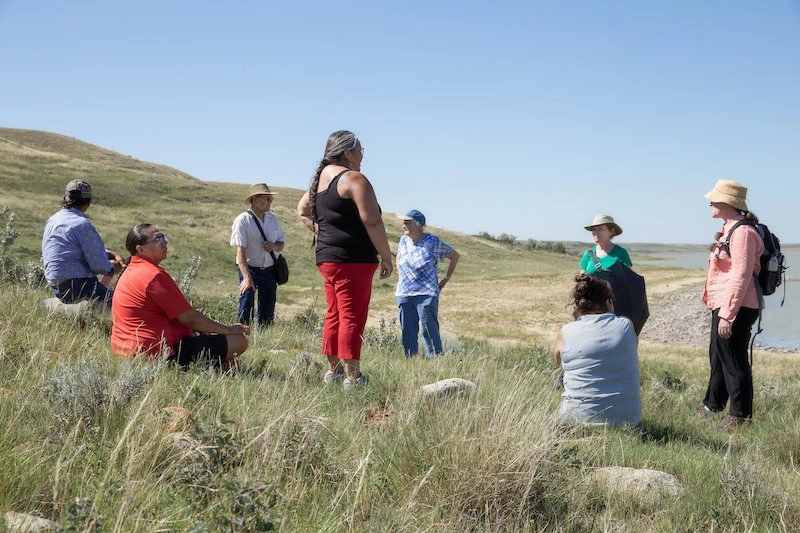
Above photo: Members of the Treaty Land Sharing Network.
June is National Indigenous History month in Canada.
June 21 is designated as National Indigenous Day.
Since the final report of the Truth and Reconciliation Commission was published in 2015, with its 94 Calls to Action, much more attention has been focused on recognizing the harms of colonization. Still, many of us wonder how we can involve ourselves in reconciliation in a meaningful, sincere, way. Reconciliation means much more than setting aside a month or a day to support and learn about Indigenous history. While gestures are important, how do we apply reconciliation in our own lives?
How does a settler, a farmer, whose ancestors were part of colonization, work to advocate for the treaty rights of Indigenous Peoples? Indigenous Peoples signed treaties with the understanding that their lands would be shared, not surrendered. Of course, colonizing nations acted as if the lands had been surrendered – removing access to the land for Indigenous Peoples.
So now – with several generations of settler farmers and ranchers working the land, what does reconciliation look like? How can the true spirit of land treaties be respected?
Sometimes grassroots ideas are seeded, and quietly begin to grow.
Such is the case with the Treaty Land Sharing Network in Saskatchewan, a unique effort to explore the possibilities of stewarding land with Indigenous Peoples.
Though none of the 94 Calls to Action directly mention land or how it might form part of reconciliation efforts, some farmers, ranchers and other landholders began exploring ways of recognizing the importance of land to the survival of Indigenous Peoples.
As the Calls to Action of the Truth and Reconciliation Commission continue to be part of public discourse, some community-based progressive voices have begun to wonder how they might engage within their own communities to carve out a different way forward, one that tries to recognize the wrongs of the past and the inherent and treaty rights of the Métis and Indigenous Nations. A group of settler farmers, in collaboration with Indigenous neighbours, are attempting to establish a way forward in rural Saskatchewan.
Enter the Treaty Land Sharing Network (TLSN). The creation of this unique network is attributed to the efforts of seven women, most of whom are still involved. One of these, Valerie Zink, who was raised in a settler farm family in Alberta and is the Coordinator of the TLSN.
“Our vision is for First Nations and Métis Peoples throughout Treaty territories to safely exercise their rights, responsibilities, and relationships with land,” explained Zink in a recent email communication. “We want to normalize the integration of Indigenous land use alongside agriculture, and to uphold our responsibilities as grassroots people to implement Treaty agreements and share land for mutual benefit.”
In 2018, several landholders began exploring how they, as settlers, might advocate to right Canada’s relationship with Indigenous Nations. Land is fundamental to Indigenous ways of life, yet on the prairies more than 85 per cent of the land is privately-owned or leased. Reserve land is but a small fraction of the land base and is not sufficient to sustain their cultural survival or livelihoods.
“The idea initially came in response to the privatization of crown land in Saskatchewan and the recognition that land access was becoming increasingly difficult and also increasingly dangerous for Indigenous people”, added Zink.
“After the Gerald Stanley trial, there were a lot of farmers in Saskatchewan who wanted to do something concrete to uphold treaty responsibilities and address the explosion of racism and violence toward Indigenous people around the Stanley trial,” Zink went on to explain. “At a time when ‘No Trespassing’ signs were proliferating in Saskatchewan, a group of landholders came together to move forward in a different direction and actively welcome Indigenous people to access land to practice their way of life and to exercise their inherent rights.”
Guiding Principles of the Treaty Land Sharing Network:
- Indigenous Peoples hold both Inherent and Treaty Right to move freely throughout these territories and to use and steward the plants and animals
- Access to land is critical for the cultural survival and livelihood of Indigenous People.
- As Treaty people, settlers have a responsibility to share the land they currently steward and work to actively remove barriers to safe access.
- It is critical for settlers to engage in ongoing learning together to deepen their practice of the Treaty relationship, even when this work requires them to set aside their own ways of doing things, challenges their perceptions, and feels uncomfortable.
As discussions continued, and linkages were created, a few events were held on farms in Treaty 4 (Saskatchewan) to advance ideas of the network. The issues that created additional urgency to organize the network were the continued violence against Indigenous people, property rights and the sale of Crown Lands.
The Gerald Stanley trial which took place following the shooting of Indigenous youth Colton Boushie was a catalyst for some. In the wake of the controversial trial and ensuing tensions, the Saskatchewan government amended trespassing legislation making it that much more restrictive. The tension in rural Saskatchewan meant that Indigenous Peoples did not feel safe venturing onto any rural lands.
Members of the small land sharing network worked to gather seed funding to continue organizing events, communicating the existence of the network, and making connections with Indigenous communities.
In 2021, the TLSN was publicly launched, with members sharing land in Treaty 4 (Saskatchewan). Then, in 2024, the TSLN launched its network with members from Treaty 6 (Alberta).
The initial years of TLSN are chronicled in articles by Briarpatch magazine as well as the Canadian Cattlemen, among a few others. There is also a webinar on the workings of the network.
Today the network has managed to acquire sustainable funding for a coordinator, the creation and managing of a website and an online directory of farm participants and land locations, the organizing of events, and the making of signs that can be staked noting that landholders are members of the TLSN. Instead of ‘No Trespassing’ signs you can now see signs stating: ‘Indigenous Land Users Welcome’.
The network now covers 59 locations with 40,000 acres, primarily farms and some conservation areas. The TLSN organizes educational events, and hosts students from local high schools and universities who want to learn about the Network and efforts at Reconciliation. The TLSN also advocates against the sale of Crown Lands that could, if kept in Crown hands rather than sold off to the private sector, become part of reconciliation.
So far, the TSLN is a unique and rare network that attests to how innovative reconciliation efforts can happen when individuals begin exploring ways to move forward collaboratively. There are no similar networks in other parts of Canada or in other countries where reconciliation is underway, though there are initiatives based on Indigenous community land trusts which support landback. The TSLN is based on sharing the use of land, while community land trusts seek to return land to Indigenous communities. Both are seen as important initiatives toward reconciliation.