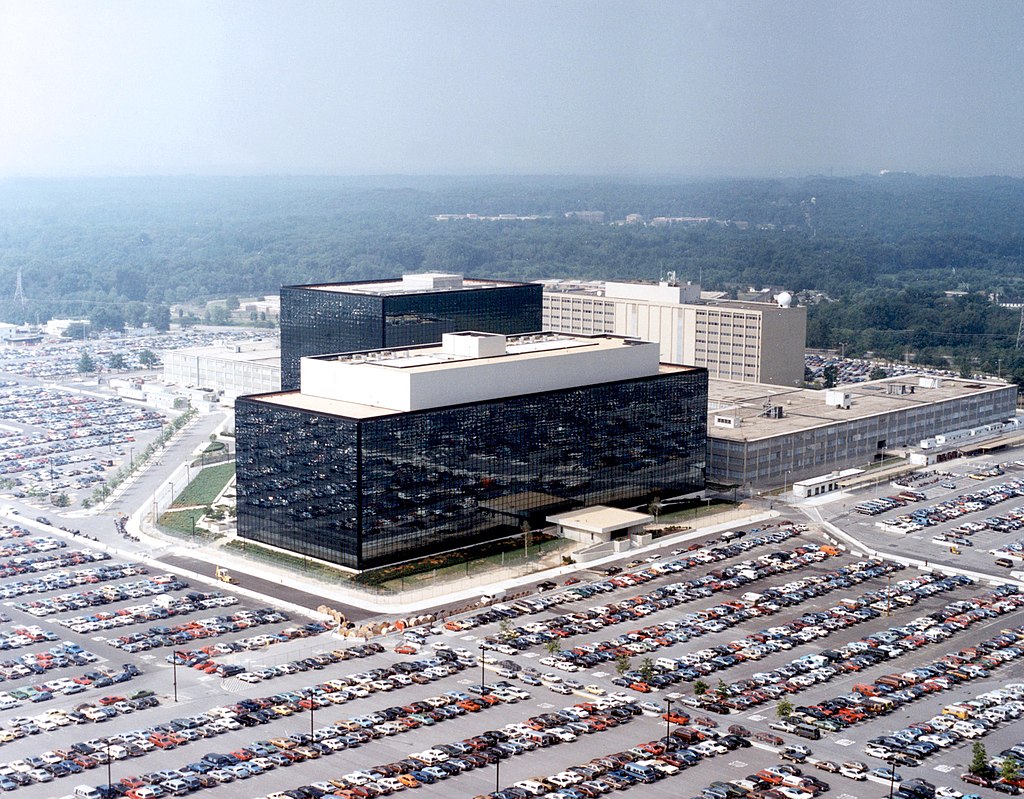
Above photo: National Security Agency headquarters, Fort Meade, Maryland. NSA, Wikimedia Commons, Public domain.
A memo from the Veteran Intelligence Professionals for Sanity.
The U.S. has weaponized intelligence agencies against U.S. citizens for political reasons. Today’s collection and exploitation of information on Americans goes beyond anything VIPS has seen and should stir every U.S. citizen who cares about privacy under the Constitution.
June 2, 2025
Memorandum For:
The President
Vice President
Director Of National Intelligence
Director, F.B.I.
Secretary Of Defense
From: Veteran Intelligence Professionals For Sanity (VIPS)
Subject: Absent Fourth Amendment, Turnkey Tyranny
Ref A: NSA Insiders Reveal What Went Wrong, Jan. 7, 2014
Ref B: Curbs On Surveillance State Urged, March 5, 2015
Ref C: Allegations Of Hacking Election Are Baseless, Dec. 12, 2016
Mr. President:
Each of us swore to “support and defend the Constitution of the United States against all enemies foreign and domestic.” In essence, this is why we address this Memorandum to you and those of your subordinates with purview over U.S. surveillance.
The Framers knew from personal experience why personal freedom had to be guaranteed by the U.S. Constitution. That is why they used the clearest of language in the Fourth Amendment: “The right of the people to be secure against unreasonable searches shall not be violated.” They decided not to tolerate British soldiers in American homes. Today’s intrusive surveillance bears a resemblance to that soldier listening to our every word. The freedom we inherited from the Founders is now at stake.
You need no reminder of how you, too, were a victim of abuses of the Fourth Amendment. Thanks to our two former NSA Technical Directors and two senior analysts, VIPS was the first to use incontrovertible technical evidence to expose the fairy tale that “Russia hacked the DNC.”
We did that even before you took office, in a Memorandum of Dec. 12, 2016.
We write you again in an attempt to ensure that you are fully aware that such abuses continue. Indeed, they seem about to take a giant leap forward. We are also posting this Memorandum, convinced that our right to privacy, precious though it is, is now precarious, and that all Americans need to know this before it erodes further.
*****
Collecting and connecting information on people enables an understanding of who a person is and in what activities they engage. Typically, such efforts have been focused on criminals and those persons seen as real or possible enemies of the government.
Over recent years, however, we have seen the U.S. Government weaponize intelligence agencies to focus on American citizens for political reasons, as you are well aware from personal experience. Many such activities are unconstitutional and violations of other law.
Congressional and judicial oversight has been ineffective. Indeed, no one in government has been prosecuted for engaging in the exploitation of information illegally collected on American citizens. No one.
It Is About to Get Worse
Current government initiatives to collect and exploit information about Americans goes beyond anything we have ever seen and should serve as a rallying cry for every American citizen who cares about privacy under the Constitution. U.S. intelligence agencies of the U.S. Government are pooling collection methods and exploitation technology such as Artificial Intelligence to acquire the most powerful capability in history to collect knowledge on American citizens.
A recent article in The Intercept has disclosed the following:
“THE EVER-GROWING MARKET for personal data has been a boon for American spy agencies. The U.S. intelligence community is now buying up vast volumes of sensitive information that would have previously required a court order, essentially bypassing the Fourth Amendment…
The Office of the Director of National Intelligence is working on a system to centralize and ‘streamline’ the use of commercially available information, or CAI, like location data derived from mobile ads, by American spy agencies, according to contract documents reviewed by The Intercept. The data portal will include information deemed by the ODNI as highly sensitive, that which can be ‘misused to cause substantial harm, embarrassment, and inconvenience to U.S. persons.’ The documents state spy agencies will use the web portal not just to search through reams of private data, but also run them through artificial intelligence tools for further analysis…
The ODNI has previously defined ‘sensitive’ CAI as information ‘not widely known about an individual that could be used to cause harm to the person’s reputation, emotional well-being, or physical safety.’ Procurement documents reviewed by The Intercept make clear the project is designed to provide access to this highest ‘sensitive’ tier of CAI.”
Such activity by governments in the past has been aimed at controlling populations. In our country such activity is unconstitutional inasmuch as it requires no court warrant.
Normally such intelligence-gathering activities are classified. But the current effort is focused on ‘commercially acquired information.’ It is considered ‘sensitive,’ but not classified, opening the door to sharing personal data with just about anyone, whether or not there is a lawful, legitimate need.
It is critical that Americans understand the extent of information the Government is gathering on them. A partial list would include:
- Who you are
- Where you are
- With whom you associate
- How much money you have
- What your debts are
- What you are doing
- Your politics
- Your beliefs and expressed thoughts
- Your medical profile
- Your doctors
- Your friends and family
- Your investments
- What you like and dislike
- Whom you love
Turnkey Tyranny: When married with the information from government, including from the classified sources the government already has, the last vestiges of privacy U.S. citizens enjoy will be forever gone. What the government is doing constitutes a general search prohibited by the Fourth Amendment.
The Lawful Exploitation of Massive Information
Regarding more efficient and entirely legal collection and exploitation of electronic data (both content and metadata), we must look to both technology and the law as guideposts for the path forward. The good news is that an effective solution already exists. It has been demonstrated; it simply needs to be implemented.
While privacy experts believe personally identifiable information (PII) should be protected under the Fourth Amendment, its constitutionality has not been addressed by either Congress or the Federal judicial branch.
What is not widely known is this: sophisticated technology enables us (1) to employ a robust, knowledge-centric capability to manage rapidly very large amounts of information with high efficiency. This allows us (2) to prevent information identifying any innocent entity – person, place, or thing – from being revealed to law enforcement or national security authorities, UNLESS there is fact-based suspicion meeting probable cause criteria defined by a duly constituted court of law.
Bottom line: Neither security nor privacy need to be sacrificed. With available technology and officials hewing to the law, it is possible to observe the spirit and letter of the Constitution and the law.
Protecting the Innocent
Whether data identifying an entity is captured or otherwise copied and stored by commercial entities or by the government to protect national security or prevent crime, it must be immediately encrypted. Such data must remain encrypted until such time as probable cause criteria under the Fourth Amendment are met as determined by a judge. The approval process to unmask an identity need not be cumbersome or time consuming, as we shall explain later in this document.
The encryption used for such purposes – whether commercial or developed by the government must be of the highest quality. Under no circumstance can decryption algorithms be available to Executive Branch intelligence or law enforcement agencies. Decryption keys should be stored and held by an organization within the Judicial Branch. This will help to ensure that all three branches of government are responsible for the proper implementation and integrity of the unmasking process and associated software. The intent is to ensure that the right of privacy afforded the innocent is protected to the maximum degree possible, in keeping with the Fourth Amendment of the Constitution.
Some argue that encryption of the identifying information associated with innocent entities will interfere with the effective or timely exploitation of data, but this is not the case. Relationships between people and organizations form the core of human behavior and afford security professionals an excellent means of identifying suspicious behavior. By keying on the metadata associated with all types of communications, it is a simple, fast process using software to ascertain and track the group of people with whom a known “bad guy” is associated.
Mapping Relationships
Simply put, when a “bad guy” calls or emails a person one time, the communication can be deemed of no consequence. But if the “bad guy” communicates with that same person three or more times, investigators should notify the court to request that the Personally Identifiable Information associated with that person be revealed to enable further investigation. In this way, the spirit and letter of the law of evidentiary procedure is honored. This puts the entire process on a firm Fourth Amendment footing, which, sadly, cannot be said of many of the procedures used today by U.S. intelligence and law enforcement.
It is highly useful to use a relational graph to depict relationships of two or more entities. But, absent data showing probable cause, software is needed to protect privacy. This can be done by an (already demonstrated) anonymization technique that represents entities as dots without any identifying information. Those dots are randomly generated for processing and reference purposes only, until evidence of probable cause is discovered. Such evidence is then submitted to the court and, upon approval, the true identity of the entity can be revealed.
In this way, both suspected entities and innocent entities can be shown in relationships across all sources of data without violating any Fourth Amendment rights and without endangering national security.
Business Rules to Enable Timely Court Approval
Many are unaware of the imaginative thinking behind ways to use sophisticated technology to handle huge volumes of data so effectively – and legally. Thus, there is understandable concern that the court approval process required by the Fourth Amendment might be so cumbersome as to thwart opportunities to apprehend spies, murderers, and other criminals. This need not be the case.
It is not difficult to devise various scenarios and other criteria to be defined by the court(s) and then to implement them in software as business rules such that a computer system could automatically decide whether probable cause criteria had been met. If they are met, an automated response containing a decryption key could be sent to the requester, allowing the identifying information associated with the entity or entities involved to be revealed to authorized intelligence analysts or investigators. Such transactions between an executive branch agency and the Judiciary could be accomplished in a matter of seconds via modern computerized (and secure) information systems.
Complicated cases could be addressed through an “electronic court” enabled by collaboration software over a secure network connection between the court and analysts or investigators. This would allow presentation of multimedia evidence, like relationship graphs, textual content, maps, whatever may be necessary to demonstrate that the evidence meets probable cause criteria.
This process could take just minutes to get a court ruling. FISA and other court judges may need to be “on call,” but this litigation process need not take long even in complicated cases.
In Sum
The approach outlined above features the availability of existing technology able to perform optimal analysis of huge data and harvest the clues and relationships that can be extracted from it. It also enables those of us who treasure our privacy not to abide having another British soldier nearby, so to speak, listening and watching.
This is the first of two Memoranda on this critical issue. The next one, coming soon, will provide more detail on methodology available to make security and privacy compatible within the law. It will also include some recent history regarding how it is that Americans find themselves in such parlous danger of completely losing what is left of their Fourth Amendment rights. (Spoiler: Think avarice.)
Signed
J. Kirk Wiebe, former Senior Analyst, SIGINT Automation Research Center, NSA
William Binney, former Technical Director, World Geopolitical & Military Analysis; Co-founder of the SIGINT Automation Research Center.
Edward Loomis, former Chief, SIGINT Automation Research Center, and former Technical Director at NSA
PREPARED UNDER AUSPICES OF AD HOC STEERING GROUP, VETERAN INTELLIGENCE PROFESSIONALS FOR SANITY
- Marshall Carter-Tripp, Foreign Service Officer (ret.) and Division Director, State Department Bureau of Intelligence and Research
- Bogdan Dzakovic, former Team Leader of Federal Air Marshals and Red Team, FAA Security (ret.) (associate VIPS)
- Graham E. Fuller, Vice-Chair, National Intelligence Council (ret.)
- Philip Giraldi, C.I.A., Operations Officer (ret.)
- Matthew Hoh, former Capt., USMC, Iraq & Foreign Service Officer, Afghanistan (associate VIPS)
- James George Jatras, former U.S. diplomat and former foreign policy adviser to Senate leadership (Associate VIPS)
- Larry Johnson, former C.I.A. Intelligence Officer & former State Department Counter-Terrorism Official (ret.)
- John Kiriakou, former C.I.A. Counterterrorism Officer and former senior investigator, Senate Foreign Relations Committee
- Karen Kwiatkowski, former Lt. Col., U.S. Air Force (ret.), at Office of Secretary of Defense watching the manufacture of lies on Iraq, 2001-2003
- Linda Lewis, WMD preparedness policy analyst, USDA (ret.)
- Douglas Macgregor, U.S.A. (ret.) (associate VIPS)
- Ray McGovern, former U.S. Army infantry/intelligence officer & C.I.A. analyst; C.I.A. Presidential briefer (ret.)
- Todd Pierce, MAJ, U.S. Army Judge Advocate (ret.)
- Scott Ritter, former MAJ., USMC, former UN Weapon Inspector, Iraq
- Coleen Rowley, F.B.I. Special Agent and former Minneapolis Division Legal Counsel (ret.)
- Lawrence Wilkerson, Colonel USA, ret.), Distinguished Visiting Professor, College of William and Mary (associate VIPS)
- Sarah G. Wilton, CDR, USNR, (Retired)/DIA, (Retired)
- Robert Wing, U.S. Department of State, Foreign Service Officer (former) (associate VIPS)
- Ann Wright, Col., U.S. Army (ret.); Foreign Service Officer (resigned in opposition to the war on Iraq)