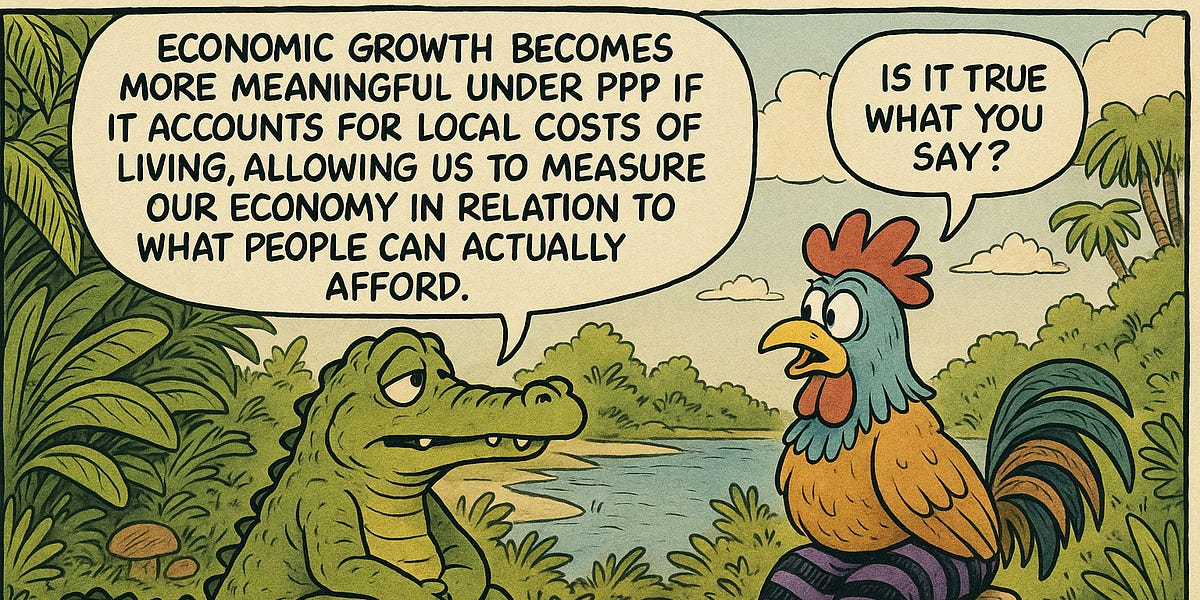
Above photo: Even an inquisitive chicken knows what question to ask.
The recent presentation of the 2025 Pacific Update at the University of South Pacific hosted by Australia National University on Gross National Disposable Income (GNDI), introduced a revised approach to economic measurment for the Pacific Island Countries (PICs). Delivered by Professor Stephen Howes, in collaboration with Dr. Rubiat Chowdhury, the presentation argued that GNDI is a more accurate measure of income for the region than the widely used Gross Domestic Product (GDP).
The failure of GDP as a national accounting metric is evident, and we should all agree that GDP has been a failure for Developing Countries and regions, particularly Pasifika. Behind the curtain of GDP is a system of measurement that has been designed to be obfuscating, and even those working within National Accounts are confused and silenced by the inclusion of some revisions and the exclusion of others. If we want to understand the evolution of GDP, one has to understand the role of the US Bureau of Economic Analysis (BEA) and its leadership role in the OECD. For the Global South as a whole, the way to approach GDP is to view it as the twin fists of neocolonialism and debt, it is a closed accounting system that does not allow space for any mechanism to counter the OECD narrative.
It is for this singular reason that when Pacific Theological College was working on their Reweaving the Ecological Mat program, we focused on National Accounting Systems and created the Intemerate Equation. In the simplest and most elegant terms, we proposed a corrective to GDP by introducing a modulator based on environmental and social well-being, using self-determined indicators capable of attaining their own market value independent of OECD influence. This is what is now put into practice at Pasifika Communities University.
With GNDI, the central claim is that the unique economic structure of PICs—characterized by low domestic production and high external inflows—cannot be captured by GDP alone.
Stephen Howes’s presentation focused on three main points. First, that the Pacific is economically unique. Second, that the region experienced the fastest economic growth in the world during the 2010s when measured using GNDI. Third, that GNDI should become the preferred metric for assessing economic performance in the Pacific, given its inclusion of remittances, aid inflows, sovereign asset revenues such as the PNA’s fishing licenses, and foreign investment income.
While these claims are technically compelling, they require careful examination. One critical omission in the presentation is the issue of population density. The Pacific Islands region, including Papua New Guinea (PNG), comprises a population of approximately 18 million spread across a maritime area of nearly 25 million square kilometers of exclusive economic zones (EEZs). This extremely low population density presents challenges for infrastructure development, service delivery, and ecological governance. It also raises questions about how per capita metrics like GNDI or GDP are interpreted and whether they can meaningfully represent social or ecological well-being across dispersed populations. As we begin to explore this low population density, what we should be asking is why Pasifika people do not have the highest GDP per capita in the world, because the fact that they remain on the lower economic development index is not the result of Pacific Islanders but rather, the enforcers of economic governance that excludes Pasifika values.
Any revision of GDP must not be approached lightly. The risk is that PICs may be locking themselves into a revised metric without fully understanding the range of GDP indicators and their policy implications. A more rigorous presentation would have addressed GDP not only in nominal terms—which are more useful for assessing debt obligations and financial exposure—but also through the lens of Purchasing Power Parity (PPP). PPP accounts for price differentials between countries and is often used to compare living standards and real income. It is notably absent from Howes’s presentation. “Economic growth becomes more meaningful under PPP because it accounts for local costs of living, allowing us to measure our economy in relation to what people can actually afford.”
The logic of GNDI, as presented, is structurally closer to PPP than to nominal GDP. It attempts to account for income flows that affect people’s capacity to spend and live, rather than measuring only domestic production. But without explicit reference to PPP or the nominal vs. real distinction in GDP, the audience is left with a partial view of how GNDI fits within the broader landscape of national accounting.
Another issue is the framing of GNDI as an unproblematic improvement. If PICs adopt this metric without rethinking how data is collected, interpreted, and monetized, they may be entering into another cycle of extractive accounting. GNDI incorporates remittances, aid, and revenues from sovereign assets—but these data streams, once formalized in economic models, can also be subjected to valuation, securitization, and eventually commodification. There is a growing global trend toward turning data into financial instruments. Without explicit safeguards, these revised metrics may be used to justify new forms of financial speculation or market capture.
What is missing from the GNDI proposal is a discussion of data sovereignty. Pasifika cannot afford to reproduce the centralized, top-down systems of measurement that have long defined GDP. The design of economic indicators must be rooted in regional governance, with community-based processes of validation, and mechanisms for consent. Otherwise, metrics like GNDI will merely offer a more refined version of the same economic logic that has failed to deliver equitable or sustainable outcomes.
For GNDI to be useful, it must be placed within a framework of accounting that centers wellbeing, ecological interaction, and community-defined values. Without this anchoring, the revision of GDP will remain superficial. Yes, Pasifika needs better numbers, but we need to assert control over what is counted, how it is counted, and who benefits from the counting.