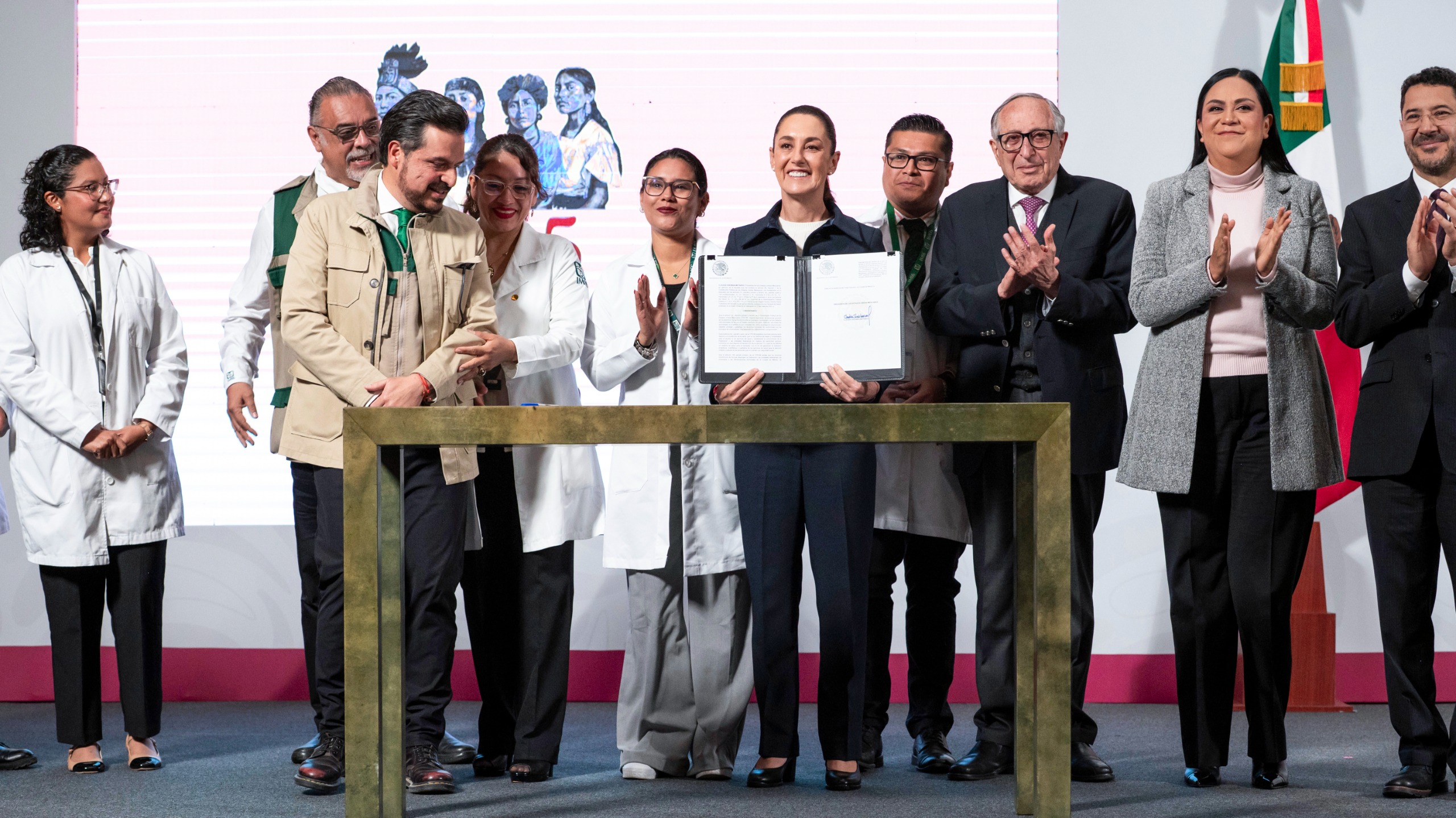
Above photo: Claudia Sheinbaum during the signing of a presidential decree ensuring integration of health services. Government of Mexico/X.
Mexico launches a national plan to expand domestic drug production and move toward a free, universal, and public healthcare system.
The first week of July could go down in history as a milestone in Mexico’s pursuit of health sovereignty. At a press conference held on Friday, July 4, President Claudia Sheinbaum, along with Health Secretary David Kershenobich and Alejandro Svarch, head of IMSS-Bienestar (a public agency providing healthcare services), announced an ambitious plan to boost domestic production of medicines and medical supplies, aiming to reduce the country’s reliance on imports.
The urgent need for such a policy shift was outlined during the mañanera – the daily press briefing hosted by Sheinbaum and her administration – recordings of which are available online. Currently, over 65% of the medicines and medical supplies used in Mexico are imported. According to Sheinbaum, the country spends nearly 300 billion Mexican pesos (approximately USD 16 billion) annually on these imports. Since a 2008 policy change ended purchasing preferences for domestically manufactured inputs, Mexico’s trade deficit in the health sector has only worsened.
“For us, it’s essential to increase production within Mexico, especially in the pharmaceutical sector, not only for economic reasons but also for sovereignty,” Sheinbaum said. “In a vulnerable situation like a future pandemic, we don’t want to depend on manufacturers the entire world will be competing for in order to ensure supplies.”
As Svarch explained during the press conference, the initiative includes incentives for the creation of new pharmaceutical plants in Mexico – initially in partnership with the private sector – as well as the expansion of existing facilities. To ensure consistent demand for these manufacturers, the government has already issued a decree mandating that public procurement of medical supplies prioritize companies based in Mexico. The initial investment, estimated at 10.5 billion pesos (approximately USD 570 million), will be funded by the domestic private sector, not by the government.
Dubbed the “Mexico Plan” for healthcare industrialization, the initiative also includes reforms to the country’s intellectual property regime. In addition to restructuring the agency responsible for patent approvals, there will be a strong emphasis on producing generic medications. Beyond bolstering health sovereignty, the Sheinbaum administration argues that localizing the production of medicines and medical equipment will accelerate economic development and lay the groundwork for a future free, universal, public healthcare system in Mexico.
Measures To Reclaim Sovereignty
Until 2008, pharmaceutical companies were required to maintain manufacturing facilities in Mexico in order to receive sanitary registration, a prerequisite for marketing medications and supplying products to the public sector. This regulation, known as the “plant requirement,” was revoked that year by former neoliberal President Felipe Calderón, on the grounds that eliminating the rule would reduce drug prices. In practice, the policy shift failed to lower medication costs and instead led to deeper market penetration by multinational pharmaceutical giants. Today, 14 of the world’s 15 largest pharmaceutical corporations operate in Mexico. Meanwhile, the market share of domestic companies in the sector has “fallen significantly,” said Alejandro Svarch during the press conference.
A presidential decree signed by President Sheinbaum on June 2 reinstates a preference for domestic firms in public healthcare procurement. According to the text: “In procurement processes for medicines, healthcare supplies, and medical devices, the Ministry of Health shall promote the participation of individuals or legal entities that demonstrate investments in the national production chain, such as local factories, laboratories, warehouses, or other relevant infrastructure.” Companies meeting these criteria will receive additional points in public tenders, giving them a competitive edge in the bidding process.
The same decree also established a Pharmaceutical Investment Promotion Committee. The new body will include representatives from the Secretariats of Health, Economy, and Anti-Corruption (Mexico’s secretariats are equivalent to ministries). The Health Secretariat will lead the committee, whose primary goal is to promote investment in pharmaceutical manufacturing infrastructure across the country.
Government officials emphasized that future facilities should focus primarily on producing generic drugs. “A generic medicine can cost several times less than a patented one,” Svarch noted, identifying 385 pharmaceutical products whose patents are set to expire soon. If these drugs are manufactured locally, the move could yield substantial savings for the government and the population. The administration’s strategy appears to avoid the use of compulsory licensing or patent waivers; instead, it aims to wait for the expiration of existing patents before ramping up domestic production.
At a previous press conference on May 29, President Sheinbaum indicated that the state-owned pharmaceutical laboratory Birmex would be tasked with facilitating partnerships with private firms to help expand Mexico’s domestic pharmaceutical industry.
Noting the limited role of Mexican firms in pharmaceutical production, often restricted to “cardboard packaging,” as he put it, Alejandro Svarch explained that the government intends to reverse this pattern. The plan includes tying negotiations with multinational companies for the procurement of high-cost medications to broader commitments: not just local production, but also investment in technical and scientific capabilities. “We want a more aggressive strategy so that the industry immediately begins relocating its processes,” said Eduardo Clark, Undersecretary for Integration and Development in the Health Sector.
Two components of the initiative remain less clear. No specific details have been released yet regarding planned reforms to the Mexican Institute of Industrial Property (IMPI), the agency responsible for patent approvals. Similarly, the proposed creation of training centers for skilled professionals in the pharmaceutical sector has yet to be formally outlined.
The 10.5 billion pesos (approx. USD 570 million) in planned initial investments will be distributed among four Mexican pharmaceutical companies. Laboratorios Kener will invest 5.1 billion pesos (approx. USD 275 million) to triple the capacity of its injectable drug facility by 2027 and begin producing CAR-T cell therapies for cancer treatment. Genbio will contribute 4 billion pesos (approx. USD 215 million) to establish a plasma fractionation plant. Alpharma BioGenTec will invest 800 million pesos (approx. USD 43 million) to develop biopharmaceutical and biotechnology infrastructure in collaboration with universities. Neolsym will allocate 500 million pesos (approx. USD 27 million) toward the production of active pharmaceutical ingredients (APIs) and other raw materials.
Alejandro Svarch noted that the project drew inspiration from Brazil’s Health Economic-Industrial Complex (CEIS). (While both models include public-private partnerships, the Brazilian approach is more heavily anchored in public laboratories.) Health Secretary David Kershenobich added that the ultimate goal is to create a robust “biopharmaceutical ecosystem” within Mexico.
Can Mexico Build A Universal Healthcare System?
Unlike Brazil, which has operated the Unified Health System (SUS) for over three decades, Mexico does not yet have a public, free, and universal healthcare system. Instead, healthcare in Mexico is fragmented among three main agencies: ISSSTE (serving public sector employees), IMSS (for private sector workers), and the recently created IMSS-Bienestar (serving the poorest segments of the population, especially the unemployed and informal workers who lack other forms of coverage). Private healthcare remains a significant part of the system.
This structure resembles Brazil’s pre-SUS era: a segmented model tied to the social security system, lacking coordination across institutions and not guaranteeing free care. Access is largely determined by contributions to social security. Former President Andrés Manuel López Obrador, who governed from 2018 to 2024, pledged to create a “Mexican Unified Health System” and took major steps to universalize the constitutional right to health. One of his first moves was to dismantle Seguro Popular, a neoliberal-era program that charged fees to citizens without formal social security coverage and was plagued by major corruption scandals.
In its place, IMSS-Bienestar was launched in 2023 under the leadership of Alejandro Svarch, intended as the foundation for a future universal system. Like Brazil’s SUS, IMSS-Bienestar is free at the point of care, requires no formal enrollment, and covers both primary and specialized services. According to López Obrador’s final government report, the program had already been rolled out in 23 of Mexico’s 32 states and was serving approximately 53 million people out of a national population of 129 million.
To further promote free access to medications, López Obrador also established the Megafarmacia del Bienestar, a pharmacy operated by the state-owned pharmaceutical company Birmex. Any citizen with a valid prescription from one of the country’s three main public healthcare agencies can obtain their prescribed medications free of charge if available – mirroring the principles of Brazil’s SUS.
Under President Claudia Sheinbaum, the push to “build a universal, free, high-quality, and equitable system” is focused on strengthening primary care, according to Ramiro López Elizalde, Undersecretary for Health Policies and Population Welfare. The administration also plans to promote “community participation” and accelerate the integration of hospitals, universities, and industry into the emerging national system. The recently announced pharmaceutical infrastructure initiatives are part of this broader strategy.
The Plan’s Contradictions
In an editorial published Saturday, July 5, the progressive newspaper La Jornada described the Sheinbaum administration’s plan to boost domestic pharmaceutical production as a “positive” step, but including some limitations. Chief among its concerns is the plan’s reliance on private Mexican capital, which is expected to provide the majority of the investment for implementation.
“The experience of recent decades shows the need to closely monitor the private sector, as it is a well-established fact that it will always act in pursuit of short-term profits, even when this comes at the expense of society as a whole,” the editorial warned.
The paper continued: “The country’s pharmaceutical sovereignty can only be fully restored with strong state involvement in training professionals, channeling investment into strategic areas of public health – which are not always the most profitable – fostering an industry aligned with national needs, and building a resilient supply chain capable of withstanding global crises and the political whims of Washington, which has used restrictions on vital supplies as a weapon against nations that challenge its hegemony.”
Originally written by Guilherme Arruda and published in Portuguese on Outra Saúde. Lightly edited for length and clarity.