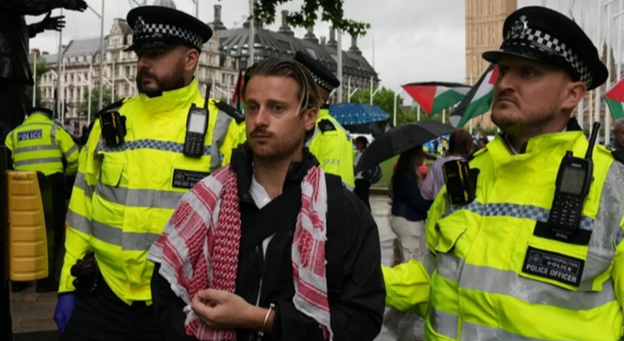
Above photo: Police escort a pro-Palestine activist for showing support for the banned group Palestine Action during a protest in London on 19 July 2025. AFP.
The Labour government moved to proscribe the group.
After members spray-painted two military planes at RAF Brize Norton.
A High Court Judge has ruled in favour of Palestine Action and granted the direct action group a judicial review to oppose the UK government’s ban on the pro-Palestine group.
Justice Martin Chamberlain ruled on Wednesday that he would grant Palestine Action’s co-founder, Huda Ammori, a judicial review after hearing submissions from her lawyer and the government.
The judge also dismissed an additional attempt to temporarily lift the suspension of the group and set the judicial review to take place in November 2025 over three days.
The ruling marks a setback for the government, which has faced criticism over its handling of the proscription and concerns that the ban on Palestine Action could be used to stifle criticism of Israel.
Commenting on the ruling, Ammori welcomed the judge’s decision and described Home Secretary Yvette Cooper’s decision to ban the pro-Palestine direct action group as an “abuse of power”.
“This landmark decision to grant a judicial review which could see the Home Secretary’s unlawful decision to ban Palestine Action quashed, demonstrates the significance of this case for freedom of speech, expression and assembly and rights to natural justice in our country and the rule of law itself,” she said in a statement.
“Spraying red paint on warplanes and disrupting Israel’s largest weapons manufacturer, Elbit Systems’ sites in the UK, is not terrorism, as the Home Office’s own intelligence assessment, presented as evidence in this case, acknowledges, saying ‘Palestine Action has not advocated violence’ and that the majority of its activities ‘would not be classified as terrorism’.”
In his ruling, Chamberlain said he ruled in favour of Ammori on the grounds that the ban on Palestine Action will impact Ammori’s freedom of expression and ability to protest Israel’s ongoing war on Gaza.
The High Court Judge also granted the Judicial Review on the grounds that Cooper did not consult before proscribing Palestine Action, arguing that the Home Secretary had a duty to consult the group before banning it.
“If, as the claimant says, the proscription order is likely to have a significant chilling effect on the legitimate political speech of many thousands of people, that would do considerable harm to the public interest,” Chamberlain told the High Court on Wednesday.
“Reports of the kind of police conduct referred to … are liable to have a chilling effect on those wishing to express legitimate political views. This effect can properly be regarded as an indirect consequence of the proscription order.
“I consider it reasonably arguable that the proscription order amounts to a disproportionate interference with the article 10 and article 11 (European convention of human rights) rights (freedom of expression and assembly, respectively) of the claimant and others.”
Chamberlain referred to the “deteriorating humanitarian situation in Gaza” and quoted a joint statement by UK Foreign Secretary David Lammy and foreign ministers from 27 other countries which said “the suffering of civilians in Gaza had reached new depths.”
During court proceedings, documents showed that the Home Secretary had received an assessment on 7 March that recommended the banning of the group three months before she took the decision.
A document compiled by Mi5’s Joint Terrorism Analysis Centre (JTAC) showed that the incident in RAF Brize Norton was not taken into consideration for its assessment.
It concluded that Palestine Action’s protests would not be classified as terrorism on the grounds that the group “primary uses direct action tactics” like “graffiti, petty vandalism, occupation and lock-ons” that led to minor damage to property.
But despite acknowledging that Palestine Actions tactics did not classify it as terrorism, JTAC still recommended the group should be banned, by citing three protests that constited alleged acts of terrorism.
Free speech concerns
Since Palestine Action was proscribed as a terrorist organisation, more than 200 people have been arrested – including priests, vicars and former magistrates – after they were deemed by police officers to have expressed support for the group.
Supporting the group is now a criminal offence, as is inviting or “recklessly” expressing “support for the group”.
Those found guilty can face up to 14 years in prison under the Terrorism Act 2000.
The designation puts Palestine Action on a par with al-Qaeda and the Islamic State group, among others.
Last Friday, Volker Turk, the UN high commissioner for human rights, said the proscription was “disproportionate and unnecessary” and called for the designation to be rescinded.
On 21 July, when the hearing opened, Ammori’s barrister, Raza Husein, said: “The proscription… renders the UK an international outlier in comparison to its partners in Europe and other parts of the world.”
Blinne Ni Ghralaigh, also representing Ammori, argued that the proscription of Palestine Action has had “real-time” effects on the British public.
Citing arrests that have occurred since Palestine Action was proscribed, Ni Ghralaigh highlighted the case of Laura Murton – a woman who was threatened with a terrorism arrest in Canterbury by an armed officer for holding a sign that read “Free Gaza”.
Justice Chamberlain, who was presiding over the hearing, responded to Ni Ghralaigh’s example and said the police were misapplying the law when shutting down legal pro-Palestine protests using terrorism laws. “This is obviously an officer who doesn’t understand the law at all,” he said.
Government lawyers also argued that a judicial review was “unnecessary”, as the group could challenge the ban through the Proscribed Organisations Appeal Commission (POAC).
Under Britain’s terror laws, any group designated as a terrorist organisation can submit an application to the home secretary.
The home secretary has 90 days to respond to the application. If the home secretary rejects the application, the group can apply to POAC.