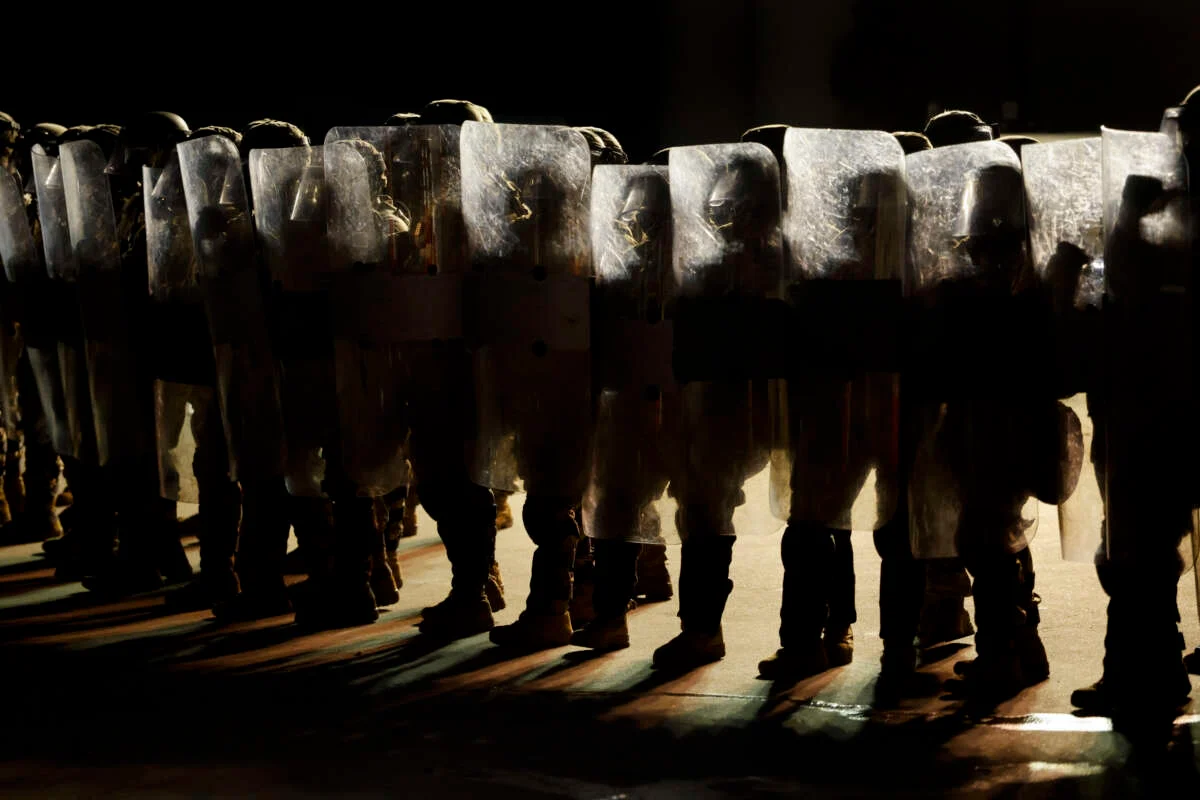
Above photo: U.S. National Guard stand outside the back entrance of the Edward R. Roybal Federal Building as demonstrators gather outside the building barricades to advocate for immigrant rights on Labor Day, September 1, 2025, in Los Angeles, California. Carlin Stiehl / Los Angeles Times via Getty Images.
Will His Word Be Final?
A court held that Trump “willfully” violated the Posse Comitatus Act by sending troops to enforce immigration law in LA.
Donald Trump appears fixated on “creating a national police force with the President as its chief,” U.S. District Judge Charles Breyer wrote, holding that Trump’s deployment of federal troops to Los Angeles to enforce the immigration laws was illegal. Trump has already sent troops to Washington, D.C., and has also set his sights on Oakland, San Francisco, Chicago, and Baltimore.
Trump will appeal the ruling. The appellate courts will determine whether he will be allowed to use the military as his personal police force, notwithstanding the clear command of the Posse Comitatus Act.
In his 52-page decision, Breyer ruled that defendants Trump, Defense Secretary Pete Hegseth, and the Department of Defense “willfully” violated the Posse Comitatus Act, a 1878 law that prohibits the use of the military to enforce domestic laws. The act now forbids the willful use of “any part of the Army, the Navy, the Marine Corps, the Air Force, or the Space Force as a posse comitatus [power of the county] or otherwise to execute the laws.” It only allows exceptions that are expressly authorized by the Constitution or act of Congress, such as the Insurrection Act, which Trump did not invoke.
Breyer concluded that, “at Defendants’ orders and contrary to Congress’s explicit instruction, federal troops executed the laws” in and around Los Angeles. “Defendants systematically used armed soldiers (whose identity was often obscured by protective armor) and military vehicles to set up protective perimeters and traffic blockades, engage in crowd control, and otherwise demonstrate a military presence.”
On June 7, without the consent of California Gov. Gavin Newsom, Trump issued an edict under 10 U.S.C. section 12406 to activate National Guard units for “the enforcement of Federal law and to protect Federal property, at locations where protests against these functions are occurring or are likely to occur based on current threat assessments and planned operations.”
In his edict, Trump also wrote that “To the extent that protests or acts of violence directly inhibit the execution of the laws, they constitute a form of rebellion against the authority of the Government of the United States.”
Not limiting his order to California, Trump deployed 2,000 National Guard troops to Los Angeles for 60 days at the discretion of Defense Secretary Pete Hegseth. That number was later increased to 4,000 and the defendants also mobilized 700 Marines to deploy to Los Angeles. Three months later, 300 members of the National Guard remain stationed in L.A.
“There were indeed protests in Los Angeles, and some individuals engaged in violence,” Breyer noted. “Yet there was no rebellion, nor was civilian law enforcement unable to respond to the protests and enforce the law.”
Newsom and the State of California filed this case on June 9, and Breyer then found that Trump, Hegseth, and the Department of Defense illegally deployed federal troops to L.A. The Ninth Circuit Court of Appeals overruled Breyer and held that the defendants had properly mobilized the troops under 10 U.S.C. section 12406, But the appellate court didn’t weigh in on the plaintiffs’ assertion that defendants violated the Posse Comitatus Act.
Facts Adduced At Trial
Breyer presided over a trial from August 11 to August 13 that dealt with the merits of the plaintiffs’ Posse Comitatus claim.
It was established at trial that in early June 2025, “ICE targeted ‘several locations in downtown LA and its immediate surroundings’ that are ‘known to have significant migrant populations and labour-intensive industries’ … Public protests quickly followed.” Breyer wrote that the L.A. Police Department and the L.A. County Sheriff’s Department “responded to these protests and maintained control of the situation.”
Nevertheless, the defendants deployed military forces to L.A. and they were put under the control of Task Force 51, which received training on the permissible scope of their activities under the Posse Comitatus Act. Their training materials said that “active-duty military personnel may not provide ‘direct, active assistance to civilian law enforcement authorities by performing law enforcement functions,’ unless a Constitutional or an Act of Congress exception specifically permits it.”
Task Force 51 was given a list of “Prohibited Law Enforcement Functions,” which included “active, direct”: (1) Pursuit, (2) Arrests, (3) Apprehension, (4) Search, (5) Seizure, (6) Security patrols, (7) Traffic control, (8) Riot control, (9) Crowd Control, (10) Evidence collection, (11) Interrogation, and (12) Acting as Informants. But Task Force 51 troops were orally instructed that 4 of 12 listed functions that were highlighted in red — security patrols, traffic control, crowd control, and riot control — “were subject to a so-called constitutional exception to the Posse Comitatus Act,” Breyer noted.
Moreover, the Defense Department instructed the Northern Command and Task Force 51 “that the President and Secretary’s June 7 memoranda created a constitutional exception to the Posse Comitatus Act and thereby authorized Task Force 51 to engage in the four functions listed in red,” Breyer added.
Task Force 51 troops and some Immigration and Customs Enforcement (ICE) agents wore camouflage uniforms, which made it difficult to differentiate them at a distance. Task Force 51 troops carried weapons with live ammunition.
“The presence of Task Force 51 deterred engagement by the public, especially by those who might have attempted to hinder or protest an arrest by ICE agents,” Breyer noted.
Breyer Rejects Trump’s Invention Of A “Constitutional Exception” To Posse Comitatus
The defendants argued that there is a “constitutional exception” to the Posse Comitatus Act, which gives the president inherent constitutional authority to protect federal property, personnel, and functions.
“Under this ‘constitutional exception,’ as Defendants call it, the President has inherent constitutional authority to protect federal property, federal personnel, and federal functions, so any actions that can be construed as such ‘protection’ are lawful in spite of the Posse Comitatus Act,” Breyer wrote. “This assertion is not grounded in the history of the Act, Supreme Court jurisprudence on executive authority, or common sense.”
The judge cited the defendants’ knowing contradiction of their own training manuals and their refusal to coordinate with state and local officials. Breyer noted that Trump, Hegseth, and the Department of Defense “‘coach[ed]’ federal law enforcement agencies as to what language to use when submitting requests for assistance in an attempt to circumvent the Act … These actions demonstrate that Defendants knew that they were ordering troops to execute domestic law beyond their usual authority. Whether they believed that some constitutional or other exception applied does not matter; ‘ignorance of the law is no excuse.’”
During the trial, Breyer was incredulous at the defendants’ arguments. “Are you saying because the president says it, therefore it is?,” the judge asked. “In other words, we’re going to see federal officers everywhere if the president determines there’s some threat to the safety of a federal agent.”
Breyer Issues A Narrow Injunction
Breyer issued an injunction forbidding the defendants from using the National Guard troops currently deployed to Los Angeles from enforcing the law. Defendants are not required to withdraw the 300 National Guard troops from L.A. And they are not prevented from using the troops for purposes consistent with the Posse Comitatus Act, such as protecting federal property.
Under Breyer’s order, Hegseth and the Department of Defense are enjoined from:
deploying, ordering, instructing, training, or using the National Guard currently deployed in California, and any military troops heretofore deployed in California, to execute the laws, including but not limited to engaging in arrests, apprehensions, searches, seizures, security patrols, traffic control, crowd control, riot control, evidence collection, interrogation, or acting as informants, unless and until Defendants satisfy the requirements of a valid constitutional or statutory exception, as defined herein, to the Posse Comitatus Act.
This order applies only to the defendants’ use of the National Guard in California, not nationally. Breyer stayed his injunction until September 12, 2025, ostensibly to provide the defendants an opportunity to appeal his ruling.
True to form, Trump reacted to the ruling by calling Breyer “a radical left judge.”
California Attorney General Rob Bonta, who filed the lawsuit, applauded Breyer’s decision. The ruling “affirms that President Trump is not King, and the power of the executive is not boundless,” Bonta said in a news release. He added:
For more than two months, the President has engaged in political theater, using National Guard troops and Marines as pawns to further his anti-immigrant agenda. In doing so, he trampled on one of the very basic foundations of our democracy: That our military be apolitical and the activities of troops on U.S. soil be extremely limited to ensure civil liberties and protect against military overreach.
But in light of the Supreme Court’s 2024 decision giving presidents monarchical powers, a ruling that reverses Breyer’s decision would not be surprising.
“The stakes are huge,” Eric J. Segall, a professor at Georgia State University College of Law, told the Los Angeles Times. “If this District Court decision is reversed by either the 9th Circuit or the Supreme Court or both … the Trump administration would go hog wild.”
Trump, who is already going hog wild on a near daily basis, could then militarize cities across the country and terrorize us all.
The legal tug-of-war on this front, however, is far from over: Today, the Attorney General of Washington, D.C., sued Trump, Hegseth, the Department of Defense, the U.S. Army, the Secretary of the Army, and the Justice Department, seeking an injunction for violation of the Posse Comitatus Act. The lawsuit calls Trump’s deployment of the National Guard to the streets of D.C. a “military occupation.”