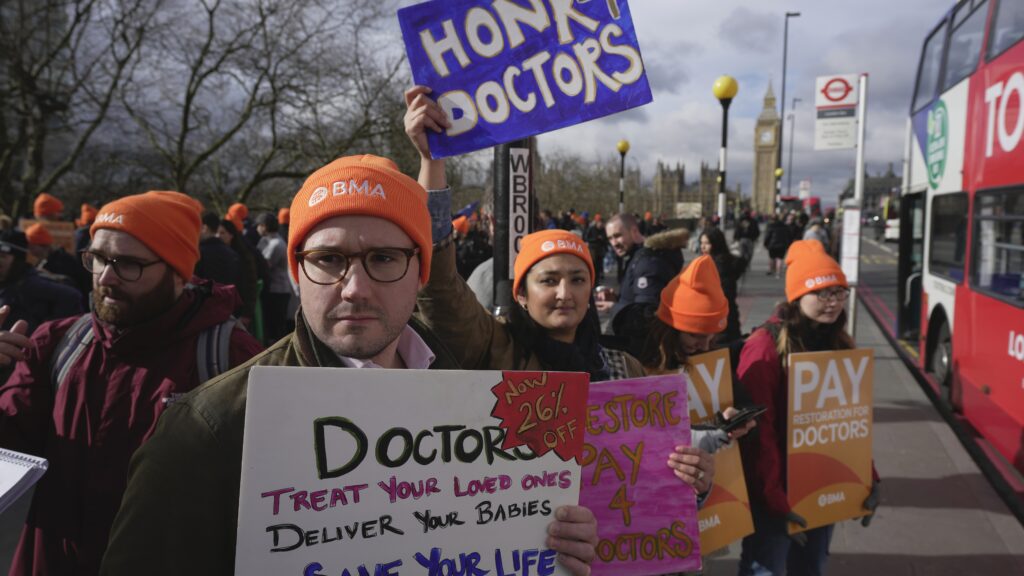
Above photo: Junior doctors take part in a strike on the picket line outside the St Thomas’ Hospital in London in 2024. Kin Cheung/AP.
If Kennedy does not resign for the good of public health, major medical societies should declare a limited strike.
On behalf of the misleadingly named Make America Healthy Again movement, Health and Human Services Secretary Robert F. Kennedy Jr. has launched an undisciplined assault on biomedical science and public health: defunding research at the National Institutes of Health, canceling mRNA vaccine studies, purging dedicated government scientists, gutting the Advisory Committee on Immunization Practices and potentially the U.S. Preventive Services Task Force, and trying to force millions off Medicaid. Kennedy’s recent actions have, in less than a year, substantially degraded the nation’s health security. The brouhaha between Kennedy and (now former) Centers for Disease Control and Prevention Director Susan Monarez is just the latest scene in this unfolding horror flick.
Physicians committed to promoting human health within a scientific frame need to start considering responses that would ordinarily be off the table. Major medical societies like the American Medical Association, American Academy of Family Physicians, American Academy of Pediatrics, and American College of Physicians need to show some brio. If Kennedy does not resign by Oct. 19, the beginning of National Health Education Week, they should collectively declare a limited physicians’ strike.
Americans like and trust their doctors (though not necessarily the health care system as a whole). They also depend upon physicians for disease prevention, care of acute and chronic conditions, and guidance. Physicians have a responsibility not only to inform current patients of the ongoing damage but also to defend future patients from the destructive forces that Kennedy has unleashed.
Physicians’ labor activism has a long history, with an uneven record of success. As a second-year medical student in 1980, I walked the picket line in support of residents at San Francisco General Hospital during a two-day work action. The strike was staged to protest nursing and support staff shortages that endangered patient care. The residents’ gambit was risky and morally fraught, but it worked: Critically ill patients continued to receive care, and the hospital upped its staffing levels, ensuring safer care well into the future.
Later, as a young physician-researcher, I studied the 1986 Ontario, Canada, doctors’ strike. The proximate cause of the dispute was the decision by the provincial parliament to enforce a federally mandated ban on so-called “balance billing” — opting out of the province-wide health insurance plan in order to bill more than the provincial fee-schedule allowed. Ontario physicians were divided over both the need to preserve this economic escape-valve and the propriety of striking in response. In the end, 42% of Ontario physicians participated in the 23-day strike, with most physicians continuing to provide hospital and emergency services while sharply curtailing physical exams and elective surgeries. The strike failed to achieve its objectives, and despite the preservation of critical services, the residue of public bitterness over what appeared to be an act of professional self-interest persisted for many years.
Other physicians’ strikes occurring in the United States, South Korea, the United Kingdom, Israel, and Greece over the past 25 years have had mixed results. A 2008 review of international doctors strikes showed that mortality tends to stay level or go down during strikes, an effect that has been ascribed to postponement of elective surgeries.
But in terms of achieving strikers’ aims, the clearest lesson is that strikes succeed or fail based on public perceptions. Physicians’ strikes achieve success when they are seen as advancing justice, not just for the profession but for the public. But since physicians’ strikes inevitably involve delaying medical services for individuals in need, it is hard to deny a violent kernel at their core. Is Kennedy’s attack on public health sufficient reason to effectively declare war?
Ethicists have long debated whether doctors’ strikes can ever be justified. Borrowing from just-war theory, one framework suggests physician strikes are only justified when there is legitimate authority (consensus among doctors); just cause (such as preserving public health institutions); a just endpoint (not razing Rome to save it); virtuous motives (not just rage); no other options (last resort); success probable (no Pyrrhic victories); means indispensable, proportional, and respectful of the law (requiring careful planning); and protecting the innocent (such as continuing to deliver critical services). At a time when vaccine misinformation alone could result in more than1 million additional measles cases over the next 25 years, the mounting set of provocations may be nearing a tipping point.
Physicians’ strikes can only be successful if they gain public sympathy and minimize risk to patients. This is where lessons from past strikes can be helpful. Physicians need to be clear that any national work action is aimed at reversing policies that have created dire public health threats to current patients (Medicaid cuts) as well successive generations of Americans (like vaccine misinformation and destruction of research infrastructure).
Professional organizations can play an important role by detailing the precarity of the present moment and removing professional self-interest from the conversation. To minimize harm, critical services (such as emergency medical care and cancer surgery) should continue, and any strike should be limited to, at most, a few days at a time. The goal would be to emphasize the gravity of the situation and mobilize the public, not to hold out indefinitely until Kennedy steps down.
To underscore both commitment to public health and to harm reduction, striking physicians should organize to staff safety-net clinics, preventive health fairs, and immunizations sites at scale while their regular offices and clinics are closed.
To even consider temporarily withholding services from patients runs counter to physicians’ professionalization and may trigger some degree of moral distress.
But to paraphrase Hippocrates, desperate diseases demand desperate remedies. If Kennedy does not resign, if science funding is not restored, and if the government continues to place critical public health functions in the hands of the willfully ignorant, physicians need to act. A limited strike might be just what the doctor ordered.
Richard L. Kravitz, M.D., is a professor of medicine at UC Davis.