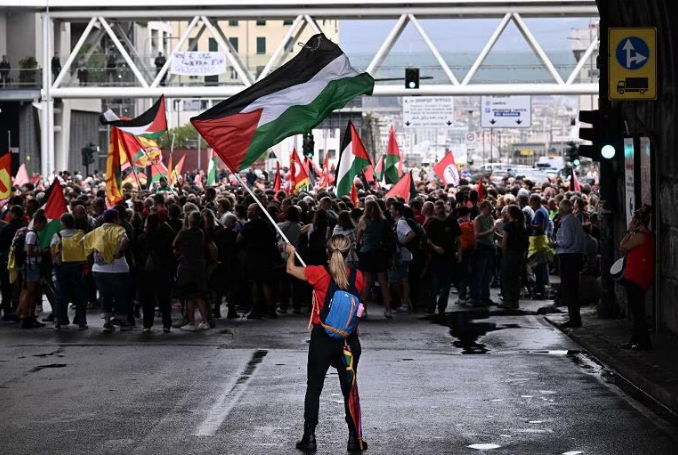
Above photo: Hundreds of thousands of people took to the streets in nearly 80 Italian cities in solidarity with Gaza. Social media.
‘A March Of Humanity’.
Hundreds of thousands marched across Italy on September 22. Blocking highways and ports in one of the country’s largest mobilizations, signaling the return of a collective voice against war and arms trade with Israel.
On September 22, Italy witnessed one of the largest mobilizations in its recent history. Hundreds of thousands of people took to the streets in nearly 80 cities to demand a ceasefire in Gaza and to denounce Italy’s political, military, and economic collaboration with Israel. The day coincided with a 24-hour general strike called by the base union USB together with Cub, Adl, and Sgb.
The strike extended across both the public and private sectors, with major disruptions in transport and port activity. Demonstrators demanded a ceasefire in Gaza, an end to Italy’s collaboration with Israel, and a halt to the rearmament that is reshaping Europe’s political agenda.
From Rome to Naples, Bologna to Palermo, highways were blocked, ports were occupied, and universities were stormed by students chanting ‘Palestina Libera’ (Free Palestine).
What set this day apart were not only the sheer numbers, but also the voices and gestures that marked it: drivers honking in solidarity with students blocking roads, a firefighter in Rome donning a kuffiyeh to remind the crowd that “our responsibility is to rescue—even the children of Gaza,” and entire neighborhoods joining the chants of demonstrators.
These moments were the culmination of a tradition that, though long muted, has deep roots in Italy’s political and civic life.
Durante delle manifestazioni per la Palestina a Roma alcuni automobilisti, fermi nel traffico a causa del corteo, hanno salutato i manifestanti applaudendo e suonando i clacson in sostegno allo sciopero per Gaza.#roma #gaza #palestine pic.twitter.com/tXKo1DU7f9
— Repubblica (@repubblica) September 22, 2025
From Equidistance to Alignment
For decades, Italy was known for its strong tradition of solidarity with Palestine—student mobilizations, union campaigns, and mass rallies that made the Palestinian cause part of the country’s political conscience.
This culture of solidarity was not confined to activists alone. It was echoed in public discourse, universities, and sections of the labor movement, which regularly placed the question of Palestine at the center of their internationalist agenda.
During the years of the First Republic (1948–1992), Italian foreign policy was often described as one of “equidistance” in the Middle East. While officially maintaining balanced relations with both Israel and the Arab world, Italy frequently demonstrated sympathy for the Palestinians, whether by supporting UN resolutions on their rights or by opening political space for the Palestine Liberation Organization (PLO), which established a recognized presence in Rome.
Solidarity initiatives flourished in those decades, giving Italy a distinctive role within Western Europe.
That balance began to erode with the advent of the Second Republic in the early 1990s. The political class gradually abandoned its earlier posture and aligned more closely with Israel and the United States.
The Palestinian cause, once central in Italy’s political and civic imagination, was increasingly marginalized. Today, Italy has moved from the position of mediator to that of supplier: it is the third-largest exporter of weapons to Israel, making the country directly complicit in the machinery of war now devastating Gaza.
A Chorus of Solidarity
In Rome, more than 50,000 people filled the streets, their march spilling onto the capital’s main ring road. What could have been an ordinary clash between protesters and commuters became a moment of collective defiance.
Instead of frustration, drivers responded with support. Horns honked in rhythm, fists rose from car windows, and chants of “Palestina libera” echoed across the blocked lanes. Protesters and citizens, often separated by inconvenience or indifference, found themselves united in one demand: freedom for Gaza.
Similar scenes unfolded in Bologna and Pisa, where students and workers brought traffic to a standstill, and in Genoa, Livorno, and Marghera, where protesters blocked ports—symbols of Italy’s economic lifelines.
Another moment came later in Rome, when a firefighter climbed onto the stage, taising a kuffiyeh in his fist. His words struck at the heart of the protest:
“Our responsibility is to rescue—even the children of Gaza,” he said. “Firefighters are not heroes. We are ordinary workers, and we must protest against policies that strangle us, against rearmament.”
It was not the voice of a politician, but of a worker whose daily duty is to save lives—reminding the crowd that solidarity is built not only in slogans but in the shared struggles of labor and dignity.
Naples railway blocked as protesters stormed the tracks during a national strike, turning the station into a rallying point against the Gaza genocide. 🇵🇸✊ pic.twitter.com/NFEQ3aTVVu
— SilencedSirs◼️ (@SilentlySirs) September 22, 2025
From Naples to Milan: A Nationwide Mobilization
Across the country, tens of thousands filled the streets of Naples, Palermo, Padova, Trieste, and beyond. In Naples, demonstrators occupied the train tracks of the central station, later burning photographs of Italian Prime Minister Giorgia Meloni and her Israeli counterpart Benjamin Netanyahu before moving toward the port.
Former mayor Luigi de Magistris described it as “a march of Neapolitan humanity for Gaza.”
In Milan, several hundred broke into the central station, clashing with police in the day’s most violent episode.
The government seized on this to launch a political attack. Meloni condemned the clashes as “violence and destruction that have nothing to do with solidarity.” Yet those incidents did not obscure the broader picture: the overwhelming majority of protests were peaceful, mass gatherings of students, workers, and families.
A Collective Voice
For years, Italy’s political mainstream and largest trade unions avoided direct confrontation over Gaza. September 22 changed that. Despite the absence of official party endorsements, the mobilization brought together a scale of participation rarely seen in recent Italian history.
Highways and ports were blocked, universities occupied, and squares filled with tens of thousands. More than a show of solidarity, it marked the reemergence of a collective voice that had long been absent from Italy’s streets.
Students in Pisa joined the general strike for Palestine by blocking all the main roads.🔥 pic.twitter.com/S3lM1S6E0P
— The Resonance (@Partisan_12) September 23, 2025
And while the government denounced the protests, the message was clear: ordinary Italians are increasingly unwilling to accept their country’s role as a supplier of weapons to Israel, or its complicity in the Israeli genocide in Gaza.