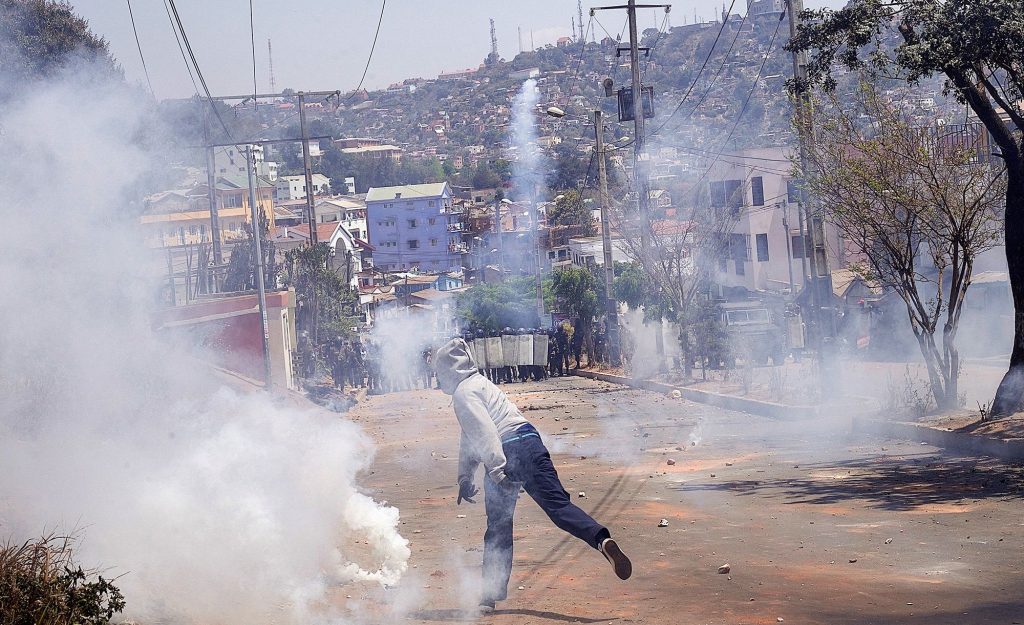
Above photo: Zo Andrianjafy/Reuters.
Madagascar is being rocked by widespread protests in response to electricity and drinking water shortages.
This social explosion reflects a much deeper malaise, and could bring down the government.
Unbearable power cuts and a lack of drinking water are just the tip of the iceberg. Popular anger has erupted in Madagascar as the population grows weary of shortages and failing basic public services. Power cuts can last for up to 12 hours, which can lead to cuts in drinking water supply on an island already suffering from severe water stress. Calls for action quickly mobilized thousands of people. The crackdown was also very harsh: to date, according to the UN, there have been 22 deaths and more than 100 injuries, some of them very serious.
Since September 25, an organization calling itself Gen Z Mada has organized spontaneous demonstrations in most of the country’s cities, particularly in Antananarivo, the country’s capital. In response to crackdowns, students and young people from the big cities have also gathered in front of one of the capital’s universities to denounce the government’s authoritarian turn and the police’s violent repression.
In many ways, this protest movement resembles those that have taken place in recent weeks in Indonesia, Nepal, and, now, Morocco: young people on the front line, organizing through social media, who are deeply opposed to the economic and political elites and their luxurious lifestyles amid deep poverty. In fact, protesters even burned down the private residences of three politicians close to the administration.
The water and electricity cuts symbolize the humiliation endured by millions of Malagasy workers. The dilapidated state of public infrastructure reflects the contempt of the local bourgeoisie and the broken promises of Andry Rajoelina, the current president, who presented himself as a modernizer. It also reflects two centuries of submission to imperialist powers, enabled by successive governments since the country was colonized by France. Madagascar is among the world’s poorest countries, even though the island possesses enormous natural wealth.
The Exploitation Of The Malagasy People And Youth
According to the World Bank, in 2022, 75 percent of the population of Madagascar was living below the poverty line. Half of the country’s workers live on less than $26 per month, particularly in rural areas where wages sometimes barely exceed $12 per month. Wages are lowest in the informal sector, yet this is where eight out of ten workers are employed.
Multinationals exploit these low wages and the desperate situation of millions in the country. For example, in the artificial intelligence (AI) sector, companies specializing in “annotation” have sprung up to hyperexploit subcontractors while churning out huge profits. As part of this extremely alienating and poorly paid labor, workers — the majority of whom have gone to university — help annotate up to 500 images or videos per day, all while making barely $94 per month. But the most paradoxical thing is that this sector, which consumes an enormous amount of electricity, has developed in a country where the majority of the population experiences endless power cuts.
A Country Subject To Imperialist Powers And France
The various imperialist powers and their multinationals are impoverishing Madagascar through the exploitation of its natural resources, with consequences for the environment and local populations. These corporations are expelling farmers from their land and destroying local crops. In this way, the plundering of the island’s mineral resources is exacerbating poverty. These populations are also exposed to climatic hazards, as demonstrated during the terrible famine of 2021 following two consecutive years of drought, which affected more than one million people in the south.
This situation offers no prospects for the country’s youth, who are sinking into unemployment and further precariousness. In a country with a population of 29.6 million, 20.9 million of whom are under 30, this reality is a tinderbox.
To understand the origins of the misery on such a rich island and the despair of Madagascar’s youth, forced to leave their country or work in overexploited sectors in order to survive, we must go back to the country’s colonial origins and its dependence on imperialist powers, particularly France. France, which won the dispute with England to take control of the island and place it under its protectorate in 1885, has continued to subject the country to its domination. The conquests and massacres perpetrated by France on the island by the sinister Marshal Gallieni, the forced exile of Queen Ranavalona to Réunion and then Algiers, and its final annexation in 1896 were a first humiliation for the Malagasy people. Colonial massacres such as that of 1947 have left a deep mark on the country’s history. Even after its independence in 1960, the country remained occupied by the French army until 1973, and repeatedly supported authoritarian presidents, going so far as to ally itself with Rajoelina during the 2009 coup d’état.
French imperialism has profoundly shaped Madagascan political and economic life: the country is surrounded by territories known as “overseas territories” — Reunion Island and Mayotte — and French troops, who train and arm the same police and gendarmes who are now violently repressing the population, while the Scattered Islands remain under French control to this day, undermining country’s full independence. The Indian Ocean Commission still serves as a tool to control the region and secure French interests in the southwestern Indian Ocean, which France considers its preserve. Major French imperialist groups and mining companies such as Rio Tinto plunder the country’s main mineral and economic resources.
President Rajoelina is well aware of the danger this movement poses to his power. He is attempting to channel the anger through the dissolution of the government, all while continuing to crack down hard on demonstrators. It is still too early to know what the outcome of this maneuver will be. But what is certain is that the protesters are increasingly demanding the president’s resignation and are now calling for a general strike in the country, as well as the abolition of institutions such as the Senate and seizing the wealth of the multi-billionaire Mamy Ravatomanga.
While this movement is clearly part of the series of protest movements that are developing in several countries, for the moment it seems to suffer from the same limitations as the movements in Indonesia and Nepal: the lack of a fundamental political alternative to challenge the system that is plunging the island’s population into deeper poverty. This weakness allows the local bourgeoisie and imperialist multinationals to preserve their economic interests for the time being. But for how long?
Internationalist solidarity with the Malagasy people, coming from young people and workers in the region, from Réunion, but also from France, would be an important source of support for building a clearer alternative.