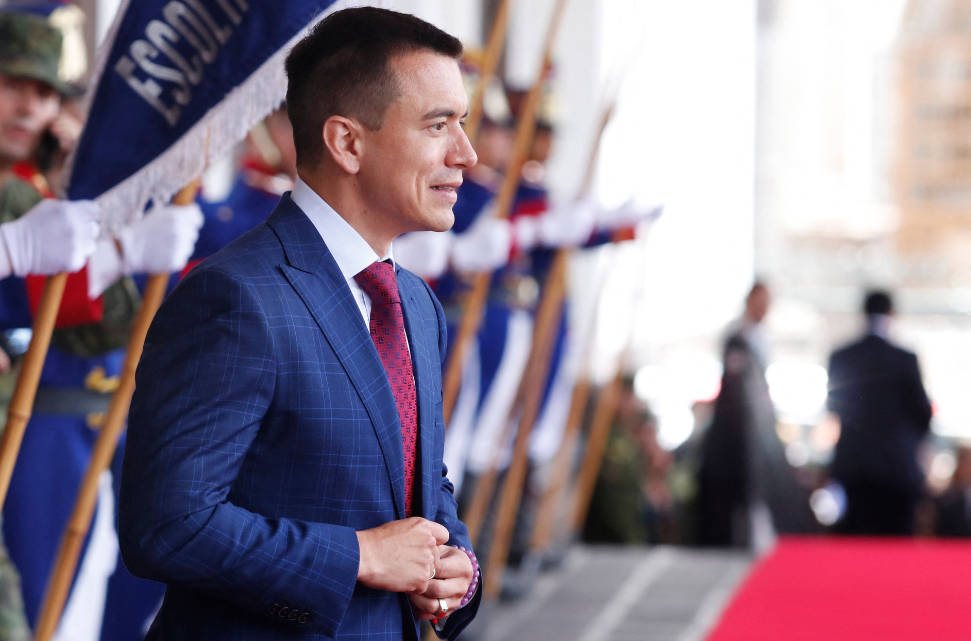
President Noboa is focused on winning a series of ballot measures in a November 16 referendum.
After an unpopular decision to remove diesel subsidies.
In mid-September, President Daniel Noboa announced the removal of Ecuador’s long-standing diesel subsidies. The decision — an unpopular measure that, when previously attempted in 2019 and 2022, sparked Indigenous-led protests that nearly toppled two governments — once again triggered mass demonstrations and a national strike, though this time on a more limited scale. The Noboa administration responded with violent repression, resulting in widespread human rights violations, the deaths of three protesters, and hundreds of arrests and injuries. International human rights organizations condemned the government’s actions, while CONAIE — Ecuador’s largest Indigenous organization, which led the protests — ultimately ended the strike within a month, having secured no concessions and prompting debate over why this year’s protests failed when earlier demonstrations had succeeded.
Noboa is now focused on winning a series of ballot measures in a referendum vote that will be held on November 16, despite the initial opposition of the country’s Constitutional Court. The referendum includes a number of proposals, two of which are especially controversial. The first calls for the convening of a popularly elected constituent assembly to rewrite the constitution. Noboa claims that the proposal is essential for advancing his economic and security agenda, but opponents (like CONAIE, unions, and the left-leaning party Citizens’ Revolution) warn that it would erode fundamental rights enshrined in the current constitution. The second proposal seeks to overturn the constitutional ban on foreign military bases, a measure Noboa insists is vital for combating “narcoterrorists.” Critics, however, reject the idea of permitting foreign military bases — and potentially a US base in particular — in Ecuador, citing concerns over sovereignty, human rights, and the environment. So far, the campaign has been markedly unequal, with Noboa’s side vastly outspending opponents and with the government offering subsidies to sway voters.
Meanwhile, Noboa’s militarized security policy has failed to improve public safety. With a projected 50 homicides per 100,000 inhabitants, 2025 is on track to surpass 2023 as Ecuador’s deadliest year on record. Instead of reducing violence, the government’s approach has fueled an increasing number of reports of human rights abuses, with Amnesty International documenting numerous cases of enforced disappearance. Nevertheless, the US has backed Noboa’s security policies, while Noboa has, in turn, supported the Trump administration’s “war on narcoterror” and military strikes in the Caribbean and Pacific.
Finally, a new study examining the administration of Rafael Correa has been published. It compares the divergent narratives in recent scholarship regarding the legacy of the Revolución Ciudadana government (2007–2017), including its achievements and contradictions.
Noboa’s Removal of Diesel Subsidy Triggers New Cycle of Protests and Violent Repression
Following through on the conditions attached to the loan agreement he signed last year with the International Monetary Fund (IMF), President Noboa announced on September 12 that he was ending Ecuador’s long-standing diesel subsidies, causing prices to jump significantly from $1.80 to $2.80 per gallon. Though he had promised numerous times that he would not eliminate diesel subsidies, which help keep transportation prices affordable for the majority of Ecuadorians and the country’s industry, the news did not come as a complete surprise, as Noboa had already allowed prices for other types of fuel to rise in June 2024. The decision also followed a series of austerity measures implemented over the summer, including the closure and merger of several ministries and thousands of layoffs in the public sector. While these measures were met with criticism by opposition leaders and unions, the decision to end the diesel subsidies — a key tool helping to contain Ecuador’s rising cost of living — ignited Indigenous-led mass protests and strikes in the capital and highlands. The demonstrations soon expanded to include grievances over other government policies and the overlapping security, economic, education, and health crises facing the country. Noboa responded with violent repression.
The removal of diesel subsidies is a widely unpopular policy: It affects operational expenses associated with the industrial sector, the prices of urban transport, and the cost of moving produce from the highlands or Amazon region to markets. This is why Indigenous groups and labor unions have long opposed such a measure. In 2019 and 2022, these groups previously organized mass demonstrations against such policies that nearly toppled two governments and ultimately forced both to reverse course. The enduring support for these subsidies was captured by a popular chant heard at the recent protests: “if diesel goes up, everything goes up,” referring to how diesel price increases drive up many basic costs and, as a result, disproportionately affect Ecuador’s working class and most vulnerable populations.
Anticipating unrest over the measure, President Noboa ordered the temporary relocation of the presidency and vice presidency from the capital, Quito, to the city of Latacunga in Cotopaxi Province and the town of Otavalo in Imbabura Province, respectively. Although the move appeared counterproductive at first — since both areas are strongholds of Indigenous movements with a long tradition of protests — Noboa intended it as a show of force and resolve as well as a strategy to divert the attention of protesters and organizers away from Quito, the site of major demonstrations in 2019 and 2022. Noboa also paired the removal of subsidies with temporary “compensation” measures, such as cash transfers and subsidies for transport workers and for those working in the agricultural sector, which ultimately discouraged them from joining the strike.
Shortly after the removal of subsidies was announced, protests and roadblocks erupted across the country, prompting Noboa to declare a state of emergency in seven provinces, which included the suspension of the right to freedom of assembly. By September 18, CONAIE, Ecuador’s largest Indigenous organization, had announced an indefinite national strike beginning on September 21 in opposition to Noboa’s decision and demanded the reinstatement of subsidies, the reduction in the country’s value-added tax, and the rejection of an announced popular referendum (discussed below). The following day, CONAIE and several allies denounced the government’s freezing of their bank accounts and those of their leaders. The Noboa administration began using rhetoric linking the protesters to terrorists and criminal groups involved in illegal mining and even claimed that the Venezuelan Tren de Aragua gang was financing protests. Residents of Latacunga awoke to a city that had been fully militarized the morning the strike was supposed to begin.
What followed were 31 days of protests and violent state repression, resulting in 206 arrests, 473 injuries, three deaths at the hands of security forces, and hundreds of documented human rights violations, mainly targeting Indigenous protestors, according to human rights organizations. In one widely circulated video, security forces are seen beating a man who was trying to assist a protester they had just shot and killed. In another incident in Otavalo, documented on October 14, security forces blocked injured protesters, including a journalist they had shot, from entering a hospital, then entered the building themselves and prevented medical staff from treating those already inside. Similarly, on October 13, the government launched what it described as a “humanitarian convoy” to deliver aid to people living in protest zones. While officials claimed the convoy was coordinated with the Red Cross, the humanitarian organization denied any involvement and stated that the operation failed to follow standard humanitarian procedures. Human rights groups further alleged that the convoy served primarily as a cover for security forces to clear blocked roads and that those forces attacked protesters and bystanders indiscriminately, injuring more than 20 people.
The military also made frequent, unnecessary, and indiscriminate use of tear gas, which led to at least one death. Journalists faced dozens of instances of abuse by security forces, and one foreign reporter was even deported. In addition, the government — through the telecommunications regulator — ordered several key Indigenous media outlets to suspend operations while authorities cut power, internet, and phone services at protest sites. Of the 206 people arrested, 12 were Indigenous protestors jailed on terrorism charges. Although a judge has since ordered their release, these protestors continue to face prosecution on those charges.
Although the protests largely remained peaceful, the Noboa administration sought to portray them as violent. The administration cited incidents such as a fire at a police station, allegedly set by the 12 protestors charged with terrorism; an Indigenous community’s temporary detention of 17 soldiers; and an attack on a presidential convoy. Five people were arrested in connection with the convoy attack, but a judge quickly ordered their release, arguing that their rights had been violated. CONAIE also alleged that the government had deliberately entered protest flashpoints to provoke such reactions from demonstrators as a justification for violent repression. Overall, a report by Ecuador’s Alliance for Human Rights concluded that the government used polarizing rhetoric that stigmatized and sought to delegitimize the protests, while legitimizing the state’s disproportionate use of violent force against them.
Throughout the strike, a number of international human rights organizations — including Amnesty International, Human Rights Watch, the Inter-American Commission on Human Rights, the Office of the High Commissioner for Human Rights, and the United Nations Permanent Forum on Indigenous Issues — as well as several independent UN experts and Special Rapporteurs expressed concern over the government’s human rights abuses, as did US Representative Rashida Tlaib.
Many of these actors also warned of the government’s closing of civic space — pointing to the freezing of bank accounts belonging to activists, CONAIE, and other organizations — and criticized the recently enacted Social Transparency Law that made such actions possible. The law imposes stricter reporting requirements on civil society organizations (CSOs) and expands the government’s oversight powers over them. It also includes a provision allowing for the dissolution of any CSO deemed to be acting against public order or national security. On October 28, Noboa issued a decree implementing a provision of the law that prohibits CSOs from “directly or indirectly” engaging in activities opposing “authorized” mining projects.
On October 22, CONAIE announced the end of the strike in response to the government’s violent crackdown and President Noboa’s announcement that security forces would launch an operation to clear blocked roads, which raised fears of further violent repression. The end of the strike represents a setback for the Indigenous movement, as — unlike the protests of 2019 and 2022 — it failed to win any concessions from the Noboa government, fueling debate over what made this year’s demonstrations fall short.
Several factors have contributed to this outcome. For one, the Indigenous movement is more divided than in previous years, weakening its influence. Several lawmakers from Pachakutik, CONAIE’s political arm, had even broken with the organization months ago, voting in favor of Noboa’s policies, including a resolution supporting the repeal of the diesel subsidy. The protests also coincided with a leadership transition: Marlon Vargas had replaced the more outspoken Leonidas Iza, who led the 2022 protests, as president of CONAIE just a month earlier.
In addition, the government’s provision of temporary cash transfers and subsidies to transport workers and other key sectors succeeded in dampening their participation in the protests. And while demonstrations occurred across the country, including in Quito, they were largely concentrated in Imbabura province, restricting their overall impact. Noboa’s higher popularity — compared with former presidents Lenín Moreno in 2019 and Guillermo Lasso in 2022 — also granted him more leeway to implement this and other unpopular measures. Finally, the government’s violent repression and legal persecution of opposition organizations played a key role in containing the demonstrations and deterring mobilization.
Noboa Pushes Through Referendum Amid Pressure Campaign Targeting Constitutional Court
The strike and protests unfolded while Noboa was preparing his referendum, scheduled for November 16. The referendum itself was among the grievances raised by protesters, as the Indigenous movement and labor organizations see it as an attempt to roll back rights.
The referendum will ask citizens four questions: Whether they support eliminating state financing for political parties, whether to reduce the number of lawmakers in the National Assembly by over 50 percent, whether to overturn the constitutional ban on foreign military bases in Ecuador, and whether to hold a popularly elected constituent assembly to rewrite the constitution.
The referendum is the culmination of a months-long process in which Noboa submitted multiple rounds of proposals to the Constitutional Court for review, only to have most of them struck down or sent back for modifications. These included the following measures: introducing chemical castration for those guilty of sex crimes, legalizing gambling in five-star hotels, relaxing labor protections, allowing the legislature to impeach constitutional court judges, and prohibiting the use of images and names of individuals found guilty of corruption during electoral campaigns — a measure aimed at former president Rafael Correa, the founder of the opposition Revolución Ciudadana (RC — Citizens’ Revolution) movement. Correa, who continues to wield significant influence in Ecuadorian politics, has been granted political asylum in Belgium following what some analysts describe as a campaign of legal persecution against him.
The review process occurred amid the Noboa administration’s campaign of pressure and threats against the Constitutional Court, following its suspension and annulment of sweeping laws on security and “public integrity” that the president’s majority in the National Assembly had illegally fast-tracked over the summer. Notably, before the court struck down the public integrity law, it had been used to pardon the Noboa conglomerate — one of Ecuador’s largest companies and, until then, its biggest tax debtor — from paying $50 million in tax-related penalties and interest accrued over nearly two decades. During this time, Noboa appointed Alexandra Navarrete, the conglomerate’s former accounting officer, as the new tax chief.
Our August Ecuador News Round-Up examined Noboa’s campaign targeting the Constitutional Court and its judges — whom his administration labeled “enemies of the people” — which drew international condemnation over the threat posed to judicial independence. Since then, the Comptroller General has initiated an audit of the court’s finances, and the government briefly ordered the body to vacate its building — which belongs to the Ministry of Energy — before reversing the decision a day later. A second protest organized by Noboa also took place on September 11, aimed at pressuring the court to approve his proposed referendum questions and to reinstate provisions of laws it had previously suspended.
Noboa then attempted to bypass the court entirely. After it struck down several proposed referendum questions in early September, Noboa twice directed Ecuador’s electoral authority, the National Electoral Council (CNE), to begin organizing a referendum asking citizens whether to convene a popularly elected constituent assembly to rewrite the constitution in full — without first submitting the question to the court for review, as required by the constitution. On September 19, as the court was processing lawsuits related to this move, it received a bomb threat and had to be evacuated. As with Noboa’s other actions, international actors — including several CSOs and the UN Special Rapporteur on the independence of judges and lawyers — expressed concern that Noboa was undermining judicial independence. Amnesty International stated that Noboa’s attacks on the court, repression of the September protests, and militarized security strategy (discussed below) “place Ecuador on the list of countries in the region that are experiencing a worrying rise in authoritarian practices.”
Constituent Assembly Proposal Triggers Fears of Rollback of Rights
The Constitutional Court ultimately approved the question on the convening of a constituent assembly after requesting limited modifications, though some observers have argued that it did so irregularly and essentially caved in to Noboa’s mounting pressure. It is the most controversial proposal on the ballot, and discussions regarding it have dominated most of the commentary regarding the referendum. It is opposed by CONAIE, labor unions, large sectors of civil society, and several political parties — including the left-wing RC, the second-largest political force in the legislature.
If the proposal is approved, the CNE would be required to call popular elections within 90 days to select the members of an 80-seat constituent assembly, which would have between six and eight months to draft a new constitution. Once completed, another election would be held in which citizens would vote to either approve or reject the proposed constitution.
President Noboa and his supporters argue that the current constitution hinders his economic and security agenda and claim it no longer reflects the realities Ecuador faces, therefore failing to represent the popular will. While Noboa has provided few specifics about what he hopes to include in a new constitution, certain inferences can be drawn from his statements and actions.
Noboa has expressed a desire to replace Ecuador’s nearly 450-article constitution with a “simple but efficient” one of about 180 articles. Among the anticipated changes is the repeal of the constitutional ban on investor-state dispute settlement mechanisms (ISDS) — provisions in trade agreements that allow foreign corporations to sue governments in shady and biased international tribunals, which have cost the sued countries billions of dollars — under the guise of attracting foreign investment. This measure was previously rejected by voters in a 2024 referendum, but Noboa appears to still be intent on seeing it realized, in part to follow through on the terms of a controversial “free trade” agreement that he negotiated with Canada.
Noboa may also seek to curb the powers and independence of the Constitutional Court, reform Ecuador’s social security system, and restructure or eliminate key independent institutions responsible for appointing top authorities, including judges, regulators, and prosecutors. In addition, he has expressed opposition to Ecuador’s system of Indigenous justice, which operates alongside the state justice system within Indigenous communities. Broader economic reforms aimed at liberalizing Ecuador’s economy are also expected, and the country’s mining sector is reportedly pushing to weaken environmental protections and Indigenous communities’ right to prior consultation on projects affecting their lands. Noboa has further voiced opposition to the judicial system’s due process protections and to rights afforded to inmates, arguing that the existing constitution “benefits criminals.”
Opponents view Noboa’s efforts as an attempt to roll back fundamental rights. Ecuador’s current constitution is among the most comprehensive in the world, even granting rights to nature. Critics argue that Noboa’s proposed changes would promote privatization and undermine due process and environmental, Indigenous, labor, and human rights — all to expand the government’s security powers and advance a neoliberal economic agenda. They point to Noboa’s repeal of subsidies, past attempts to legalize ISDS mechanisms and relax labor protections, strong promotion of mining and repression of anti-mining activism, efforts to avoid compliance with a 2023 referendum halting oil extraction in a protected area, human rights violations linked to his security policies, and the signing of an IMF agreement that binds the government to a stringent austerity agenda. The president has sought to allay such concerns, asserting that his proposed constitution will protect existing rights and preserve the rights of nature.
Beyond these concerns, opponents also note that the process — estimated to cost around $200 million — is unnecessarily expensive and that many of Noboa’s policy goals could be achieved through ordinary legislation or constitutional amendments. Moreover, they fear that the composition of the constituent assembly may not be sufficiently representative of Ecuador’s diverse regions and minority political parties.
US Military Could Return to Ecuador
The question on overturning the constitutional ban on foreign military bases is nearly as controversial as the proposal to convene a constituent assembly. Through this measure, Noboa — a staunch US ally — aims to establish a US military presence in Ecuador, which has been one of his top priorities since his election in late 2023. The United States previously operated a base in the port city of Manta from 1999 to 2009, but it faced criticism due to sovereignty and human rights concerns and the base’s impact on the surrounding community. When Ecuador rewrote its constitution in 2008, a key provision prohibited foreign military bases, and former president Correa subsequently allowed the base’s lease to expire in 2009.
Despite the ban, Noboa has already taken several steps to facilitate a renewed US military presence in Ecuador. One such step includes the implementation of a Status of Forces Agreement with the US, outlining the conditions for the “temporary” presence of US military personnel in the country and granting them diplomatic immunity. Noboa argues that a US military base — along with the intelligence and operational capacities it would supposedly provide — is central to his security strategy of waging a “war against narcoterrorism.”
The president has proposed several potential locations for such a base, including the environmentally fragile Galápagos Islands, where the US previously maintained a base during World War II, “resulting in substantial ecological disruption,” according to conservation experts. That proposal sparked widespread backlash, prompting Noboa to walk it back in favor of sites on the mainland. Before doing so, however, he attempted to downplay the controversy by claiming that a base in the islands would not necessarily be a military one, despite the referendum question explicitly referring only to military bases. Moreover, in December 2024, Noboa formally authorized the US military to station ships, personnel, armaments, equipment, and submarines on the Galápagos Islands, effectively laying the groundwork for a base there.
US military officials have also publicly advocated for establishing a base in Ecuador, and US Secretary of State Marco Rubio recently stated that the US would consider doing so if invited. Moreover, US Department of Homeland Security Secretary Kristi Noem visited Ecuador in early November, touring the former US base in Manta and other military installations to assess the possibility of establishing an undefined “Homeland Security base” — or even a military base — according to statements from the Ecuadorian government. Following Noem’s visit, Ecuador’s interior minister announced that the country expects the establishment of both a US military base in Manta and a “homeland security base” in Salinas.
Opponents of the proposal, however, raise many of the same concerns voiced during the Manta and Galapagos base eras. There are environmental, sovereignty, and human rights issues, as well as the argument that a foreign military base would do little to address Ecuador’s security challenges, which opponents consider to be structural in nature and rooted in inequality, poverty, corruption, and the weakening of institutions and state capacity in recent years. They also contend that, if Noboa’s true goal is security cooperation, the agreements he has already signed with the United States allow for joint operations, which could be reinforced or expanded, making a military base unnecessary.
Shrinking the Legislature and Revoking Political Party Funding
The two remaining questions ask citizens whether they support reducing the number of lawmakers in the National Assembly and eliminating state financing for political parties. Noboa partly frames both of these questions as cost-cutting measures. He argues that the National Assembly, which he wishes to reduce from 151 seats to 73, is unnecessarily bloated and fails to represent all Ecuadorians, as its makeup gives more weight to smaller regions. The president also contends that continued public funding of political parties, especially those with poor electoral performance, is a misuse of taxpayer funds that should be spent on more urgent needs.
By contrast, supporters of a “no” vote argue that a reduced National Assembly — which is already relatively small when compared with countries with similar population sizes — would actually diminish diversity and concentrate power, as 11 of Ecuador’s 24 regions would each be represented by only one lawmaker. They also defend maintaining public funding for political parties, viewing it as a mechanism to level the playing field between larger and smaller parties and warning that cutting this funding could push some parties to seek illicit sources of money — a serious concern in a country that already struggles with organized crime and where the CNE has often failed to regulate campaign financing.
Inequalities in the Referendum Campaign and Differing Polls
The campaign surrounding the referendum has so far been highly unequal, with President Noboa’s “yes” side appearing to significantly outspend the “no” campaign on online and social media advertising. In addition, state institutions, including the Ministry of Defense, have explicitly and publicly campaigned in favor of the referendum, despite such actions being illegal. The Noboa-aligned CNE, however, maintains that it lacks the authority to review campaign spending and practices on social media, despite being legally required to do so. Electoral authorities have also barred the RC from campaigning on the questions related to military bases and state funding of political parties, citing procedural issues with its request to register as a participating organization during the official campaign period. It remains unclear, however, why the RC was permitted to campaign against the other two referendum questions.
Moreover, as was the case during the last presidential election, Noboa has issued a flurry of cash transfers and subsidies — some framed as economic recovery measures following the national strike, others presented as youth engagement initiatives — that critics argue are clearly politically motivated. The same criticism has been directed at his order to pay Christmas bonuses to public-sector employees one month in advance, just two days before the vote, and at his issuance of a bonus for security forces four days before the election. He announced the latter during a mandated leave of absence, which the CNE required in accordance with Ecuadorian law preventing elected officials from using their positions to influence elections.
Polls vary widely in their predictions. Click Report projected in October that nearly 60 percent of voters support the military base and constituent assembly questions, while Maluk Research’s poll from the same month indicated the opposite, with nearly 60 percent of respondents rejecting both measures. Another pollster, Cedatos, reported that around 52 percent of voters were in favor of both questions. Clima Social’s poll — which, unlike the others, includes undecided and null votes — painted a more complex picture: It showed that the military base question would receive 43 percent “no” votes and 38 percent “yes” votes, while the constituent assembly question would pass with 48 percent “yes” votes compared with 30 percent “no” votes. Across all surveys, voters appear likely to approve reducing the size of the National Assembly and — with the exception of Maluk Research’s poll — eliminating state financing for political parties. However, polls published ahead of Ecuador’s recent elections have proven highly unreliable, calling these projections into question.
Human Rights, Security, and Relations with the US
President Noboa’s security policy continues to result in serious rights violations, according to human rights organizations, while public safety continues to deteriorate. In January 2024, Noboa declared an “internal armed conflict” against gangs, which he has enforced through a series of states of emergency that have allowed him to suspend certain rights and to deploy the military to the streets to combat so-called “narcoterrorists.” Over the summer, he also attempted to fast-track a law that would have significantly expanded his powers over security, but it was struck down by the Constitutional Court shortly after taking effect.
Ecuador currently has one of the highest homicide rates in the world, a situation that experts have attributed to the country’s growing role in the international drug trade and to austerity measures that have weakened the state and curtailed anti-crime social programs. In 2023, the country’s homicide rate reached a historic record of approximately 46 deaths per 100,000 inhabitants, up from 5.8 deaths per 100,000 in 2017, transforming Ecuador from one of the region’s most peaceful countries to one of its most violent. In 2024, the homicide rate fell by 16.5 percent; Noboa attributed the decline to his militarized security strategy, though 2024 remained the second deadliest year on record after 2023. With less than two months remaining in 2025, the country is on track to surpass the 2023 rate, potentially reaching 50 homicides per 100,000 inhabitants. Since August alone, Ecuador has witnessed the assassination of a judge, a local official, and a journalist; prison massacres that left over 57 dead; and a series of bombings in Guayaquil and other regions.
A new International Crisis Group report examines the shortcomings of Noboa’s security crackdown and concludes that, among other things, “Lasting solutions will require the involvement of a wider array of state institutions beyond security forces in the most unsafe neighbourhoods, as well as much stronger social safety nets, particularly for young people who risk being drawn into organised crime and see no viable alternatives to earn a living.”
Instead of improving security, Noboa’s policies have led to a growing number of reports of human rights violations. In September, Amnesty International published a detailed report on the state’s enforced disappearances of civilians, stating that “according to information from the [Prosecutor General’s Office] shared with Amnesty International, complaints have been received about the possible enforced disappearance of 43 people since 2023, the year in which President Noboa began his first term.” The report also notes that the armed forces have obstructed investigations into these cases, while prosecutors have failed to give them adequate attention. The most emblematic of these incidents, known as the Malvinas case — involving the military’s forced disappearance of four children who were later found dead — remains before the courts nearly a year after it occurred, and a trial will begin soon.
Similarly, investigative outlets Tierra de Nadie and Connectas collected testimony from eight members of Ecuador’s armed forces and reviewed classified internal documents, confirming the alleged pattern of human rights abuses within the military. Their reporting states:
Testimonies and the information gathered in the documents provide a snapshot of an internal war without a defined strategy, marked by a largely unexplored dimension: the pressure placed on the military to capture high-value criminals and seize weapons and drugs. This pressure has led to arbitrary arrests, the use of torture as a method for extracting information to enable new detentions in the absence of intelligence operations, and the exhaustion of soldiers assigned to carry out police duties for which their tactical and theoretical training did not prepare them.
In spite of these abuses, US Secretary of State Rubio expressed support for President Noboa’s security strategy during a visit in September, announcing the designation of the Lobos and Choneros gangs as foreign terrorist organizations — a move Noboa had sought early in the Trump administration — along with $20 million in new security commitments. In turn, Noboa has backed the Trump administration’s so-called “war on narcoterror” by designating the Cartel de los Soles as a terrorist organization shortly before Rubio’s visit, conducting joint antinarcotics operations with the US in the Pacific, and supporting deadly US military strikes in the Caribbean and Pacific. Noboa approvingly tweeted news of the strikes and stated in an interview that “we are in favor of strong anti-drug trafficking, anti-illegal mining, anti-criminality policies. Everyone has their style.”
Noboa also refrained from protesting a US strike on a vessel carrying at least one Ecuadorian citizen. The individual, who survived, was repatriated and subsequently released after prosecutors found no evidence of his involvement in criminal activity. Noboa has nonetheless requested further information from Washington to prosecute him and stated that he “cannot determine” whether the US’s strike constituted an “assassination attempt” against the survivor.
New Scholarship on the Revolución Ciudadana Government Evaluates Its Legacy
On November 7, scholars from universities in Ecuador and Spain published a peer-reviewed article in Nature examining the administration of Rafael Correa (2007–2017), comparing the narratives surrounding its legacy, the outcomes it produced, and its contradictions. It states:
A dominant traditionalist narrative depicts this decade as one of authoritarianism and economic mismanagement, thereby justifying the post-2017 push for institutional “reconstitution.” In contrast, heterodox accounts interpret the period as a project of democratic development — marked by the expansion of rights, social justice, and economic improvement — and as a rupture from the exclusionary neoliberal model of “minimal democracy” that preceded it. This study adjudicates between these competing interpretations through a comparative analysis of political, economic, and social indicators across three periods: the pre–Citizens’ Revolution era (1996–2006), the Revolution itself (2007–2016), and the post-Revolution years (2016–2023)….
The findings reveal substantial improvements during the Citizens’ Revolution in areas such as education, income inequality, infrastructure, security, and citizen consent, across internal, historical, and regional dimensions. These results support the view of the Citizens’ Revolution as a democratizing and developmental force, despite certain authoritarian tendencies. By contrast, like the regime prior to the Citizens’ Revolution, subsequent administrations have overseen a marked regression, characterized by diminished public consent, economic deterioration, and rising violence. The study concludes that the Citizens’ Revolution constituted a significant departure from neoliberal minimalist democracy, offered an alternative model of inclusive development, and left a legacy—both of accomplishments and contradictions—that continues to shape Ecuador’s political, social, and economic trajectory.