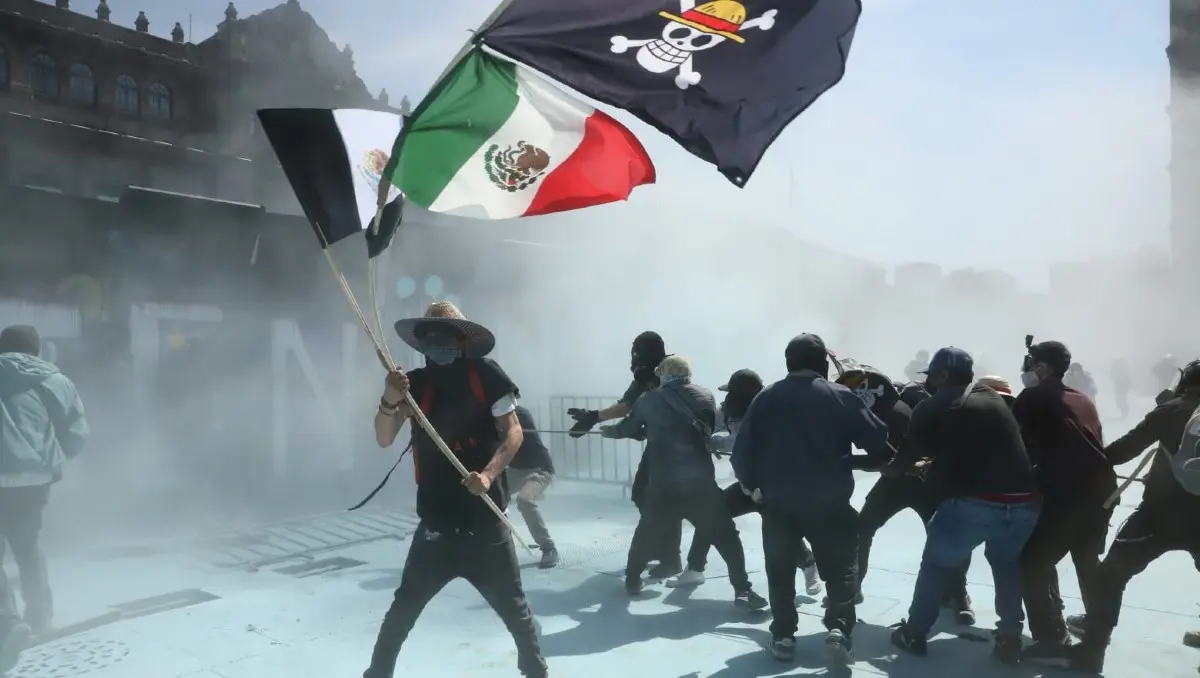
Above photo: Young people mobilized in downtown Mexico City with banners and flags. Milenio.
The political right co-opts citizens in precarious situations to avoid structural change.
The clashes in Mexico City’s Zócalo were dramatic, a spectacle of generational fury broadcast around the world. Thousands of young Mexicans, many sporting the wide-brimmed straw hats that have become a defiant symbol, marched under the banner of the so-called 15N “Hat Movement.”
Triggered by the assassination of opposition mayor Carlos Manzo, the demonstration quickly became a furious call for President Claudia Sheinbaum’s resignation, complete with skirmishes against police and the unexpected sight of the One Piece pirate flag flying high above the turmoil.
For many observers outside of Mexico, this looked like a spontaneous, organic youth rebellion against insecurity and corruption. But the political reality is far more complex.
President Sheinbaum’s administration immediately countered, dismissing the protests as an “unorganic, paid” campaign, financed by right-wing opponents and amplified by social media bots.
This article investigates that duality: tracing how genuine, structural youth despair is being strategically co-opted and instrumentalized by the discredited national right and foreign conservative networks based in the United States, all aimed at destabilizing the Mexican government.
The Authentic Roots Of Rage: Neoliberal Exhaustion
To dismiss the young people marching entirely is to overlook the profound, legitimate anguish that serves as the protest movement’s fuel. Generation Z in Mexico is experiencing the systemic exhaustion of decades of neoliberal policy.
They are the most educated generation in Mexican history, yet they face brutal precarity, underemployment, and the relentless creep of gentrification that makes basic financial stability an illusion.
The most pressing issue compounds this economic anxiety: the record levels of cartel violence, endemic corruption, and impunity that have made life cheap.
The "Generation Z Protests" in Mexico was entirely astroturfed by right wing and foreign interests groups. The Carlos Manzo planned demonstrations were hijacked by these groups to foment regime change.
Classic.https://t.co/NUSui2LMLq https://t.co/Wd3ril5A2C— Austin MacNamara (@gremloe) November 17, 2025
These are not trivial grievances; they are the consequence of a failed state model that predates the administration of Andres Manuel Lopez Obrador (2018-2024).
Crucially, not all youth discontent flows into the 15N movement. There is an authentic, left-wing counter-narrative, epitomized by groups like “Generación Z Mexico” (ZMX), who marched days earlier on November 8th (8N).
Their demands are explicitly class-conscious: a 40-hour work week, housing justice, anti-gentrification policies, and pro-Palestinian solidarity.
Their agenda is focused on class struggle and capital violence, not merely a call for a change in administration.
The ZMX movement reveals that youth dissatisfaction is real, but its natural orientation is often towards the structural left, not the libertarian right.
The Political Camouflage And Co-Optation
The 15N movement’s strength lies in its ability to market itself as apolitical, a “neither left nor right” movement of fed-up citizens. This is the political camouflage.
Launched through anonymous manifestos and AI-generated social media videos on platforms like TikTok, the central demand for the revocation of the presidential mandate cleverly sidesteps any traditional ideological platform.
However, the camouflage quickly faded. Almost immediately, major figures of the traditional right-wing opposition, including Senator Lilly Téllez and prominent deputies from the PRI and PAN parties, publicly adopted the movement’s symbols and talking points. This sudden embrace was not an act of solidarity, but an essential political tactic.
The traditional opposition has faced a severe credibility crisis since 2018, having been overwhelmingly rejected by the electorate.
Mexico’s President blames foreign actors for chaos at the Gen Z protest
Claudia Shainbaum called the clashes politically manipulated, funded from abroad, and driven by bots
Many participants had no real connection to the movement — so who’s really behind it? pic.twitter.com/INKGQgiVyx
— RT (@RT_com) November 16, 2025
Unable to win on their own established brand, they must use a “youth banner” as a depoliticized vehicle to attack the Sheinbaum administration and its popular social programs.
Furthermore, the very label of “Generation Z” in a political context is itself a subtle trap—a sociological category that deliberately erases the fundamental struggles of social class, geography, and material conditions in favor of a homogenized, easily marketable identity of “frustrated youth.”
The U.S. Connection: Destabilization And Disinformation
The most concerning element of this manufactured crisis is its explicit link to the international conservative infrastructure, primarily the U.S.-based Atlas Network.
Headquartered in Arlington, Virginia, Atlas is a global coordinating body that promotes a pure neoliberal agenda, providing training, funding, and strategic connections to affiliate groups worldwide. Its mission is to advance limited government, free-market fundamentalism, and radical deregulation.
This ideology fundamentally opposes President Sheinbaum’s political project. Her “Fourth Transformation” (4T) agenda advances social spending, government intervention in key sectors, and strong measures to combat inequality.
🇲🇽🤖 OVER 8 MILLION BOTS ACTIVATED TO INCITE ANTI-SHEINBAUM PROTEST
President Sheinbaum EXPOSED the right-wing operation: 90 million pesos spent in two months to inflate tomorrow’s protest, using Argentinian and Spanish accounts linked to the Atlas Network, infamous for… pic.twitter.com/39s0BwO3Uc
— Samuel 🇲🇽 (@resisres) November 14, 2025
From the government’s view, the Atlas Network actively works to hinder or overturn these progressive social and economic policies.
Evidence suggests the network is playing a direct role in the destabilization efforts:
- Financing and Training: The government has accused Atlas and its affiliated corporate entities of providing funding and training to specific opposition organizations, ensuring they have the institutional muscle to maintain street presence.
- Disinformation Campaigns: The network is accused of financing massive social media campaigns, employing thousands of bots to amplify anti-government slogans and narratives. This is crucial for creating the perception of a larger and more organic movement than what truly exists on the ground, a classic tactic of manipulating public discourse.
- Foreign Corporate Interest: Ultimately, the manipulation serves U.S. corporate and conservative financial interests. A destabilized or weakened Mexican government is less likely to stand firm against foreign energy, trade, and resource interests, making the fight against the 4T a critical geopolitical battle for control over Mexico’s economic future.
Resisting The Narrative
The anti-Sheinbaum protests are a calculated, two-pronged attack: they weaponize the legitimate, class-based frustration of young Mexicans while simultaneously being fueled by intentional political and foreign manipulation.
For the young people who are genuinely tired of insecurity and precarity, the crucial realization must be this: the forces funding the “apolitical” Hat Movement are the same forces that championed the neoliberal policies responsible for the insecurity and inequality they now protest.
Structural change requires structural politics. Gen Z must look past the manufactured consensus of the right-wing opposition and recognize that the real fight for dignity and justice lies in the class-conscious solutions being put forward by movements like ZMX, which seek to transform the system, not just change who sits in the National Palace.
#FromTheSouth News Bits | Mexico: The government has launched an offensive against at least 12 drug cartels operating in the state of Michoacan. pic.twitter.com/NuIH87YeoB
— teleSUR English (@telesurenglish) November 17, 2025