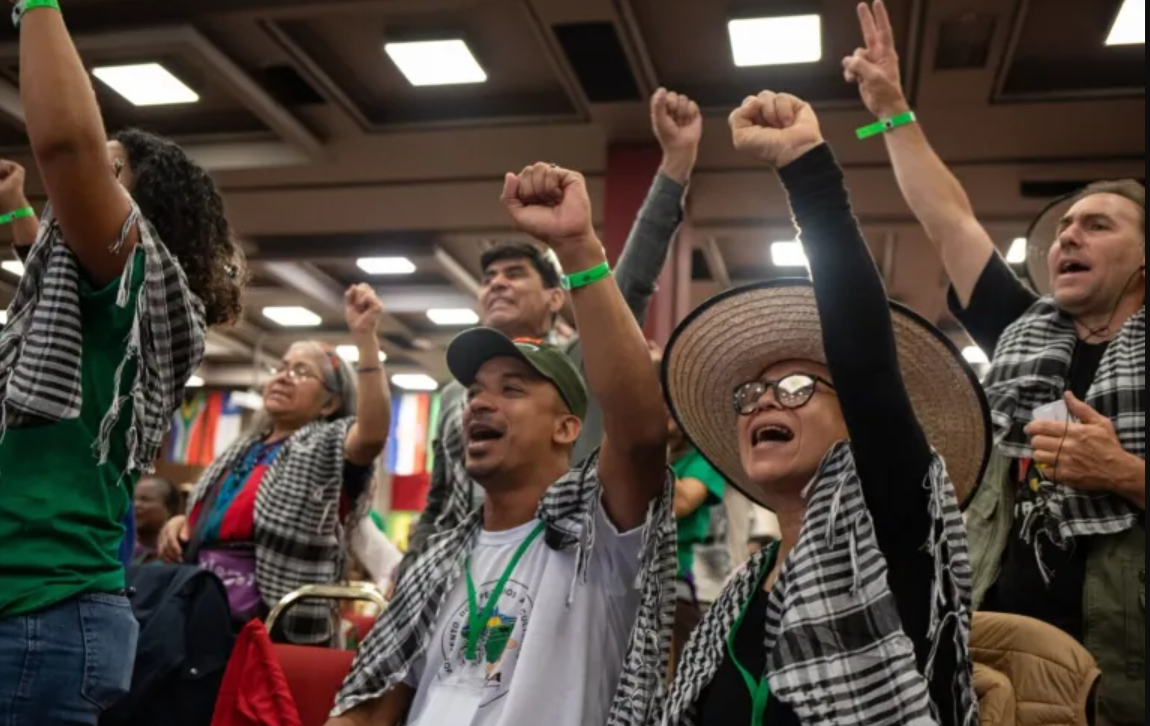
The CLOC Inspires.
“Formation must be linked to a strategic political project for the transformation of society. This very project is constantly under development and formation must be part of the process. For this reason, formation cannot be dogmatic nor spontaneous but instead should be prepared, planned and combined with the development of the strategic objectives of the organization.” – La Via Campesina
Introductory Note
Across a vast Latin American landscape, the imperialist project of past and present runs up against a plurality of organized resistance. Be they extractive mining conglomerates and the dams they need built, corporate agribusiness and its endless expansion of the agricultural frontier, or the financial capital behind it all, the incursions of capital into Latin America – with the collaboration of corrupt local elites – are almost always met by an extraordinary diversity of worker-, student-, peasant-, Indigenous-, Black-, LGBTQIAPN+- and women-led movements defending their lived, lands, waters, territories, peoples, histories, and horizons. When one looks specifically to the countryside, Latin American social movements stand firm in the recuperation of ancestral knowledge, the defense of multiple ways of life, and the popular construction of food sovereignty – the right of all peoples to define, develop and defend their own food systems through the exercise of rights to land and territory, agroecological production systems, and an end to free market neoliberal impositions. In contrast to the amnesia characteristic of imperial ‘America’ [See: Monroe to Trump], the place known as Nuestra América (Our America) is the carrier of a historical memory rich in organizational experiences and approaches towards collectively building social justice, sovereignty, rights and self-determination. In the face of military dictatorships, fascism and armed extractive industries, the struggle for democratic transitions towards just societies has developed a creative maturation of strategies and tactics among popular movements, with political education at the heart of many.
The Coordinadora Latinoamericana de Organizaciones del Campo, or Latin American Coordination of Rural Organizations (CLOC), is a “movement of movements” that includes all Latin American member organizations of the global peasant movement La Via Campesina (LVC). CLOC’s remarkable experience in combating colonialism, racism, patriarchy, agribusiness and capital’s extractivist agenda has given rise to a continental system of political education beyond the scope of traditional cadrefication. CLOC’s is a process of experience- and reflection-based education the movements call formación.
CLOC-Via Campesina: Who, What, Where and Why?
The Latin American Coordination of Rural Organizations (CLOC-Vía Campesina) is a continental articulation of peasant, farmworker, fisherfolk, and other land- and territory-based movements with decades of direct experience in the struggle for human, economic, social, cultural, and political rights. The accumulated experience of cadre within CLOC is deep, as many come from the collective experience of building revolutionary transformation in local, national, continental and international contexts. Born in 1994 from an alliance of people’s organizations mobilized in what was known as “500 years of Indigenous, Black, and Popular Resistance”, a protest against official celebrations of Columbus’ arrival to the Americas, CLOC’s steadfast embrace of class struggle offers a profound and pluralistic understanding of socialism, as it stands at the forefront of the struggles against patriarchy, racism, colonialism, capitalism, neoliberalism, and imperialism in the effort to build a new society free of oppressors or oppressed in right relation to Mother Earth.
Currently, the CLOC includes 84 member organizations in Latin American and Caribbean countries. Some of its more well-known members are Brazil’s Landless Workers’ Movement (MST) [See: Brazil’s MST by DSA], Chile’s National Association of Rural and Indigenous Women (ANAMURI), Cuba’s National Association of Family Farmers (ANAP), Haiti’s Papaya Peasant Movement (MPP), Puerto Rico’s Organización Boricuá for Ecological Agriculture (Boricuá) and Guatemala’s Peasant Unity Committee (CUC). Among its many efforts, CLOC is dedicated to consolidating food sovereignty at the levels of nation and territory by multiplying experiences and knowledge in agroecology. To confront the living legacies of colonialism, patriarchy and racism, CLOC connects peasant organizing efforts with those of workers, students, and others disproportionately demeaned and disenfranchised by corporate interests.
At the global level, CLOC brings together the struggles for peasants’ rights in Nuestra America with permanent solidarity with the Palestinian people in their struggle for life, rights, and sovereignty. The CLOC campaign “Sovereign Peoples, People in Solidarity”, for example, helps people across the continent hear from and connect with the efforts of the people of Cuba, Haiti, Venezuela, and Nicaragua to build and sustain transformative political projects while resisting U.S. imperialist aggression and unilateral coercive sanctions. Unapologetic in nature, CLOC expresses a firm and public commitment to “furthering debates that contribute to building the theoretical and programmatic foundations for a socialist project in the Americas.”
Many of these debates take place through CLOC’s formación infrastructure, processes, and programs. The CLOC’s ‘Banners of Struggle’, available online in Spanish, give a sense of its vision for structural, democratic change to defend life, biodiversity, and rights in the Americas:
- Popular, Comprehensive, and Redistributive Agrarian Reform
- Peasant Agroecology based on the Recovery of Ancestral Knowledge
- Food Sovereignty based on Public Policy supporting the Peasant and Small Farm Sectors
- Implementation of the United Nations Declaration on the Rights of Peasants and Other People Working in Rural Areas (UNDROP)
- The Construction of Popular Peasant Feminism
- Alliance-Building with Organizations of Other Sectors
- Youth-led Processes for Intergenerational Renewal
- Internationalist Solidarity
- Political, Ideological and Technical Training or formación…
What is Formación?
People’s movements develop a collective identity based on a shared analysis and, above all, a shared experience of struggle for a fundamentally different society. As noted in DSA’s 2023 article on Paulo Freire and Political Education, “there can be no theory that doesn’t inform practice, and vice versa. While distinguishable, the two must be inseparable, two sides of the same coin”. While in some contexts [See: Global North] for one person to wear “many hats” – to the point that often there can be meetings with more organizations “present” than people in the meeting – this can be problematic and is often an obstacle in the construction of a collective political project. Within the CLOC’s political culture, it is understood to be much more advantageous to have a shared analysis and greater levels of organicity – which is a kind of organizational culture that helps individuals understand where their unique contributions can be most impactful and appreciated within the larger needs of the collective. There is a popular saying that reflects this concept: “It’s more helpful to have one idea in a hundred people than one person with a hundred ideas.” Movements create specific moments for people to share their unique thoughts, reflections and opinions – with consensus and unity being the overall objectives – adjoined by moments in which members are expected to carry out responsibilities effectively without imposing their own desires or opinions on the collective’s agreed-upon commitments.
Formation is simply one part of a larger whole. As social movements or popular organizations attempt to change society, they must take action of some kind – whether that be through street protests, sit-ins, occupations, encampments, boycotts, lawsuits and beyond. Action is a moment in a long-term struggle, and should be planned and carried out collectively. Organization is another moment; this is when people debate and decide what their long-term vision is, and what kind of a structure can help them get where they hope to go. Assemblies, internal elections, designation of roles, and the creation of political positions are all part of organization. Formation, in turn, is a moment of struggle in which people temporarily remove themselves from action in order to critically reflect upon that action. Formation gives form to the action of an organization. By studying their own experiences and mistakes, as well as those of others across borders or throughout history, organizations can more effectively adjust their strategies and tactics, to be able to return to their practice with a more accurate understanding of their context and situation. The cycle of action-reflection-action, like the practice-theory-practice cycle described by Paulo Freire, is part of a collective movement through history known as praxis, as people resist and learn from that resistance. Formation is part of a critical process of collective self-preparation for world-changing activity.
According to La Via Campesina’s International Formation Collective, of which CLOC is an integral part, “formation is an infinite and permanent process of producing, socializing and sharing new knowledge derived from confronting ideas and comparing them with reality. It is a process of producing and reproducing the knowledge of our own reality, including the commitment to seek and distinguish our unique reality from the rest. All of this, of course, not only to understand the world but with the intent to transform it.”
Over 30 years into its development, the many movements that make up CLOC now maintain multiple formation processes with diverse tracks and methodologies. Designed to prepare new and experienced grassroots cadre for a lifelong – often difficult and dangerous – journey of political engagement for social transformation, these processes also serve to strengthen internationalist unity within diversity that is unique to the CLOC and La Via Campesina.
A few of the CLOC’s most prominent formation processes are:
- Latin American Institutes of Agroecology (IALA)Beginning with the IALA Paulo Freire in Barinas, Venezuela, the IALA model of peasant universities created by and for member organizations of the CLOC has now spread to include Argentina, Brazil, Chile, Colombia, Cuba, the Dominican Republic, Mexico, Nicaragua, Paraguay, Puerto Rico and Venezuela. These autonomous social movement universities provide advanced training in agroecological production methods, as well as organizing skills, dialogue, and reflection to learn from concrete struggles and improve the practice of social movements in territories.
The IALAs are a space of Latin American integration that recover the historical memory of 500 years of colonialism and over 200 years of formal independence while US neocolonialism has continued.
- Political and Ideological Formation Schools
Organized at two distinct levels – regional grassroots leadership and continental organizational leadership – the CLOC’s Political and Ideological Schools aim to consolidate an experienced collective of cadre at the national, regional, and continental levels capable of accompanying popular struggles with political clarity and determination.
At the regional levels, both the “Andean School” (Venezuela, Colombia, Ecuador, Peru, and Bolivia) and “School of the Southern Cone” (Argentina, Brazil, Chile, Uruguay, Paraguay) host grassroots organizers in a diversity of national venues – schools, churches, cultural centers, and more – where selected participants share organizational updates, contextual analyses, contributing to a dialogue of knowledge as well as mística, meals and other daily commitments (cooking, cleaning, studying, and more).
At the continental level, the rotative 15-day Egidio Brunetto School (held in different contexts and countries each time it’s organized) and multiple short-courses held at Managua’s Francisco Morazán International Peasant School host leadership development processes for those who have completed courses and processes at the regional levels.
- Continental Women’s Schools
The CLOC’s Continental Women’s Schools are about empowering rural women organizers in what La Via Campesina defines as “popular peasant feminism,” a uniquely movement-based contribution to grassroots feminism that centers class analysis and the collective construction of food sovereignty. The most recent CLOC Women’s School took place in the Dominican Republic (May 2024) –- the sixth such school in recent years. In it, Nicaraguan feminist leader Yolanda Areas Blass noted that, “each region in La Via Campesina used to organize their own political education processes. Now we have been able to strengthen the school system of the Women’s Articulation from the first International Women’s School carried out in Africa, where we advanced globally in the discussion about popular peasant feminism and about women’s political participation.” From grassroots to global, the CLOC and Via Campesina’s popular peasant feminism are contributing to other important formation processes such as the Berta Cáceres International Feminist Organizing School (IFOS).
- Continental Communication Schools
Involving many of the same grassroots leaders engaged in the above mentioned processes, the CLOC’s Continental Communication Schools are an equally important cycle of action, reflection, and matured action designed specifically to deepen political and technical expertise in “popular anti-capitalist communication.” According to their own reporting, the 5th Continental Communication School (online due to Covid-19) included critical reflections on “the concept of internationalism and its implications for popular struggles” as well as “the ongoing challenges facing communication in CLOC organizations.”
Participant communicators, “learned about and evaluated CLOC’s current continental communication work as a counter-hegemonic strategy in the class struggle.” They then, “delved into the nature of CLOC’s communication, current strategies and challenges, internal and external communication tools,” before engaging in practical, “workshops strengthening skills in areas such as photography, video, audio, graphic design, social media, newsletters, and internal communications”.
“The rich process of political education in popular communication,” left participants of the 2020 course with, “many lessons learned, challenges identified and, above all else, a growing collective (of communicators) with transformative dreams and hopes, strengthened by a revolutionary and internationalist spirit.”
- Continental Youth Encampments
Last but by no means least, the CLOC’s multiple youth-led processes feed into their own larger political education process known as ‘Encampments’. Each held in a unique national/historical context, hosted by the youth of a CLOC-LVC member organization, dozens of organized youth gather to, “promote formation and reaffirm the principles of CLOC Via Campesina as well as to exchange productive experiences, celebrate Latin American and Caribbean culture, cultivate the mystique and strengthen the peasant struggles of the regions of our territories.” In Spanish only, the following documentary shares some of the voices, smiles, and experiences of the XVII Youth Encampment of 2022.
Closing Remarks
Latin America’s Coordination of Rural Organizations (CLOC) is a living, breathing, and learning articulation of people’s movements prioritizing the political development of cadre within a larger process of action, reflection, and matured action aimed at consolidating a socially just and ecologically sound society for all. It listens to and learns from its own organizers – encouraging honest debate amongst the many – while encouraging friends and allies to contribute their own experiences through a dialogue of knowledges. From a place of organizational strength and sincerity, the CLOC learns while teaching and teaches while learning. For those of us engaged in our own processes of political education for societal transformation, the CLOC inspires.
Readers interested in contacting the CLOC directly can do so in both English and or Spanish emailing: secretaria.cloc.vc@gmail.com.
Source: DSA Political Education
See Also:
https://cloc-viacampesina.net
https://www.instagram.com/cloclvc/?hl=en
https://web.facebook.com/cloc.viacampesina
https://web.facebook.com/friendsatc/?locale=es_LA&_rdc=1&_rdr#