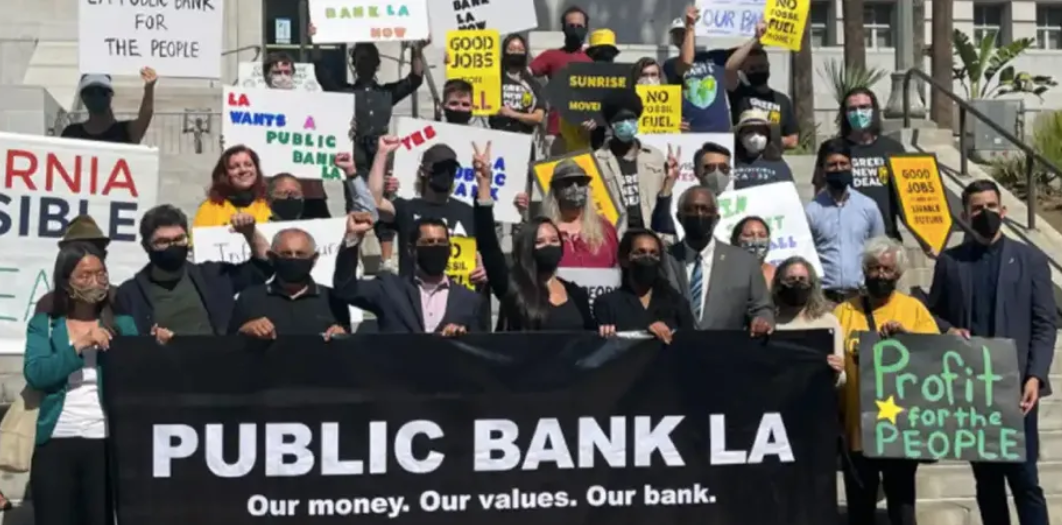
Above photo: Los Angeles is one of the cities where progress toward public banking is greatest. Santiagoad53.
A keystone for taking control of our money and economies.
After years of being considered a niche concept, relegated to a few academic articles and zealous activists, the idea of public banking is about to hit the mainstream. From coast to coast, 2025 witnessed a blossoming of support for public banking, especially on the local level. Not only did several activist groups hold conferences to drum up support for public banking, but numerous municipalities took concrete actions to inch closer to creating their own public banks, and politicians who supported public banking achieved historic victories during the most recent election.
Arguably, the state with the strongest public banking movement is California. In 2025, the public banking movement experienced growth across the state, especially for local and city-owned public banks.
For years, activists in Los Angeles have been fighting to create a public bank for the city. In 2018, organizers were successful in getting a measure on the ballot to amend the city charter to allow for the creation of a city-owned public bank. Unfortunately, the measure was defeated. Undeterred, a year later public banking advocates convinced California’s state legislature to pass AB-857, which granted local governments the power to create their own public banks.
Since then, municipalities and counties throughout California have been exploring the option.
On May 30th of this year, members of the Los Angeles City Council introduced a motion to fund a feasibility study for a Los Angeles public bank. In 2023, the council voted 12-0 to approve $460,000 for a public banking feasibility study, but the funding was eventually diverted. Refusing to give up, supporters continued to press their council on the issue, and on June 23rd, the city council unanimously passed the motion and reallocated funds to the study.
Inspired by Los Angeles, organizers in Fresno are pressuring their city to also commission a feasibility study. In late September, public banking advocates organized an educational event through the Fresno City College to push local leaders on the concept of public banking. Eric Payne, the executive director of the Central Valley Urban Institute, told the nonprofit news outlet Fresnoland, that Fresno residents “know that Wall Street isn’t going to give us the pass that we need… It’s going to have to come from us.”
Meanwhile, on November 1st, the San Francisco Board of Supervisors unanimously passed a nonbinding resolution requesting that the mayor and city departments explore the creation of a public “green” bank to provide low interest loans to clean energy and other environmentally related projects. In 2023, the San Francisco Board of Supervisors had already passed a plan to create a public bank using funding from the Inflation Reduction Act. However, despite the plan’s unanimous approval, the project awaits implementation from the city’s executive. Still, public banking advocates in the city do not appear to be waiting. A recent poll showed that 67% of the city’s voters support the creation of a public bank, and activists are considering a ballot measure in 2026 to force the city’s hand.
On the east coast, New York state’s public banking movements also experienced significant gains.
On August 5, in Rochester, New York, community leaders and activists gathered at an event called the Community Outreach Forum to address the city’s poverty, including the creation of a public bank. For years, advocates have been working with local leaders to get the city council to create a public bank. Included among their ranks is the Genesee Co-op Federal Credit Union, which sees public banking as a means to support community banks and credit unions through lending partnerships.
Most noteworthy, public banking advocates cheered when one of their champions, democratic socialist Zohran Mamdani, was elected mayor of New York City on November 4th. As a member of the New York State Assembly, mayor-elect Mamdani cosponsored Assembly Bill A3352. Modeled off California’s AB-857, New York’s A3352 would have empowered local governments to create their own public banks. As a candidate for mayor, Mamdani emphasized his support for public banking. Prior to his election, the editors of Money on the Left, an online journal and podcast, published a document calling for New York City to adopt a new financial paradigm that the authors referred to as Democratic Public Finance, which included public banking, in addition to other strategies to bring the financial sector under popular control.
In Washington’s elections, public banking advocates scored two victories, with the mayor-elects of two of Washington’s largest cities—Tacoma and Seattle—being supporters of public banking.
In Tacoma, mayor-elect Anders Ibsen has been interested in public banking for years. At a mayoral campaign forum organized by Tacoma for All—a coalition fighting for worker and tenant rights—he explicitly mentioned his willingness to explore public banking as a means of leveraging the city’s assets to deal with the Tacoma’s housing shortage.
In Seattle, political outsider Katie Wilson—who also identifies as a democratic socialist—narrowly defeated incumbent mayor Bruce Harrell with just over 2,000 votes. Recently, Wilson has appointed Tiffani McCoy, the president of Washingtonians for Public Banking and the co-executive director for House Our Neighbors, as part of her transition team. In addition to being a champion for public banking, McCoy was instrumental in winning the ballot initiative and tax increase to create Seattle’s social housing developer.
All this momentum means that it is only a matter of time before a city breaks free from the grip of the nation’s megabanks and establishes the first public bank within a state in the United States since North Dakota took the visionary step in creating the Bank of North Dakota in 1919. Considering that affordability, and with it the frustration over the high cost of essentials such as housing, utilities, and groceries, has become the new central focus of American politics, it is not surprising that public banking as seen a recent surge in support.
As Victor Hugo once wrote, “No army can withstand the strength of an idea whose time has come.”