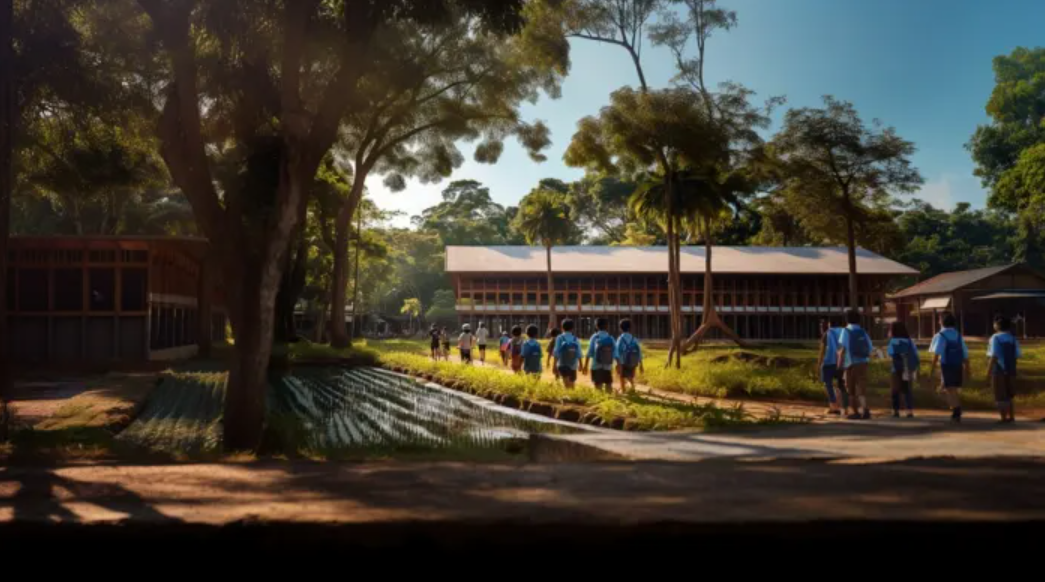
Above photo: Free Pix.
And so it is written—tragically, predictably—that Venezuelans and Americans will bleed because power prefers spectacle to accountability.
In his excellent and provocative article, Roger D. Harris posed the following question in a recent edition of LA Progressive: Will the U.S. Attack Venezuela? His essay served as a warning, a fiery herald no eye could ignore.
I do not rise to echo that caution across the void; I come to bear witness, a sentinel tracing its contours through time. I write from the memory of a land that invited me to bring a Freirean-style pedagogy to various sectors of the country, a los bosques, campos, tierras de cultivo y barrios de Venezuela.
The request was made in the same manner of invitation that my mentor, Paulo Freire, once named an act of knowing: to read the world and the word, reading and re-reading reality in order to decipher the hieroglyphs of suffering and hope inscribed across the lives of ordinary people.
Yet today, Venezuela finds itself drafted as a prop in a tawdry American melodrama. It has been reduced to a pawn on the cold chessboard of a president eager to summon the drums of war as diversion, to drown the scandal of Epstein’s ghost with the thunder of distant artillery. In this theater of manufactured crisis, truth is treated as a disposable character, expendable once its lines are read.
And so it is written—tragically, predictably—that Venezuelans and Americans will bleed because power prefers spectacle to accountability. Even as Nicolás Maduro, cornered but not blind, extends his hand in a gesture meant to forestall catastrophe, the machinery of distraction grinds forward. History has seen this script before: empires staging conflagrations to hide their own rot, sacrificing the vulnerable on the altar of political survival.
But history also remembers those who refused resignation. Those who spoke in the cadence of resistance, who dared to describe the world not as the powerful narrated it, but as the oppressed lived it. And so I write—not as a neutral observer, but as one who has walked through the heat of those fires and learned their language—so that this moment, too, may be read with clarity when the archives of tomorrow are opened.
Venezuela, in 2006, was a continent rising inside itself, a revolution humming beneath the palms, along the streets, across the barrios, and I arrived to learn, to listen, to teach — not from the marble podium of scholars, but from the dust, the pulse, the living breath of the streets—where hope rises like heat from the labor of those whom history tries to forget.
Looking back, it was during my visits to Venezuela that I entered the long forge of my pedagogical work — a labor not mine alone but shared with others who bore the torch first lit by Paulo Freire, the Brazilian sage whose Pedagogy of the Oppressed split open the classroom walls and revealed them for what they were: battlegrounds where history itself was contested.
Here, in the barrios, in the universities, in conversations with students and revolutionaries alike, I learned that teaching was not merely a transfer of knowledge, but a mutual labor of awakening, a praxis where the oppressed became teachers and the powerful were called to listen. It was in this crucible that the Bolivarian Revolution’s pedagogy — its insistence on dignity, justice, and collective imagination — came alive in ways no textbook could ever capture.
I write from the memory of a land that offered its hand to this wandering scholar and asked only that he walk among its fires with open eyes. It is a land where the streets hummed with the fierce music of laughter and debate, where clinics dispensed healing braided with solidarity, and schools were classrooms of hope, where children traced the cartography of justice in chalk, their hearts beating with the stubborn rhythm of possibility.
During my journeys there, I walked among revolutionaries of various stripe—Marta Harnecker and her husband, Michael Lebowitz; Luis Bonilla; the poet-priest Ernesto Cardenal; and countless others whose voices carried the weight of history. They were living proof that imagination, pedagogy, and social justice could collide to transform lives. Harnecker had advised Allende, counseled Chávez, and worked across Latin America; And Cardenal—ah, Cardenal—was the revolutionary monk whose verses could make the mountains shiver. A towering figure of liberation theology, he built a peasant community on the Solentiname Islands, where art and prayer mingled like twin currents of the same river. His defiance of the powerful was so unyielding that Pope John Paul II confronted him on the Managua tarmac, wagging a reprimanding finger, even as the Sandinistas embraced him as a Minister of Culture and a midwife of the Nicaraguan imagination. Cardenal reminded us that poetry could be a weapon and a sacrament at the same time.
Their insights, their discipline, their lived ferocity made it unmistakably clear that this was a fecund and unrepeatable moment—a season ripe for contributing to the accomplishments of Hugo Chávez’s Bolivarian Revolution, and for learning how imagination, pedagogy, and social justice can intersect to transform the lives of millions.
Their wisdom illuminated what Chávez had sought to do for his nation: teach that the state could be reshaped in the image of its forgotten majority, that revolution is a classroom where the poor are professors and the privileged must learn to listen.
He set his sights on the cities, where crime had metastasized like a shadow across streets and neighborhoods, and he devised programs to heal rather than punish, to transform fear into safety, despair into hope. Security was never abstract—it was entwined with education, health, and dignity. Yet Chávez died too soon to see these ambitions fully realized, leaving a revolution still in motion, still fragile, still reaching toward a future that might fulfill the promise of its streets, its classrooms, and its people.
But shadows do more than remember; they foretell. Across continents, the shadow of the U.S. empire stretches, slow and inexorable, chilling the earth beneath its careful sweep. By his own admission, Trump has already sent his operatives into Venezuelan soil. The CIA prowls like a patient shadow, slipping through corridors, whispering in the ears of the timid and the powerful alike.
The assault is hybrid: economic, psychological, spiritual. It seeks to suffocate the imagination before tanks ever roll. And yet the threat is not only external; it is a test of spirit. It is in this shadow that I write of Hugo Chávez, not as history, not as ideology, but as fire made flesh, as the pulse of the dispossessed, as the Chavismo that outlives men, women and threats alike.
Chávez rose from the plains of Barinas like a storm carved in red, a horizon ignited. Brown-skinned, thick-voiced, the son of teachers and revolutionaries, his blood carried the memory of two continents: Indigenous and African. The white elite, powdered with privilege, called him ese mono — that monkey — mocking his accent, his gestures, the very presence of his body. Yet every insult, every hiss, every effigy dragged behind luxury cars became fuel for the fire. The storm they feared was the life of the poor made visible and organized to fight. It was the impossible given form, given life.
To meet Chávez was to witness a cosmic disturbance. He was soldier and shaman, prophet and president, child of Bolívar and midwife of the dispossessed. Chávez was, in his own incendiary way, a Christian of the barricades. He reached into the deep well of religious language and lifted out images bright enough to sear themselves into the public imagination. Time and again he invoked Jesus Christ not as a benign figure of stained glass, but as the first revolutionary, the insurgent carpenter who overturned the tables of empire long before Bolívar ever unsheathed a sword. For Chávez, the Bolivarian Revolution was nothing less than a Christian uprising of the poor—a gospel rewritten in the dust of the barrios.
Yet his relationship with the Catholic hierarchy remained uneasy, a tango of blessing and rebuke. While bishops scowled from cathedral balconies, Chávez preached his rough-hewn liberation theology from the plazas, insisting that God walked barefoot among the dispossessed. In his rendering, faith was not a quiet refuge but a trumpet blast, a call to wrest justice from the clenched fist of history.
Chávez’s body bore the genealogy of the oppressed. His voice summoned the continent to awaken.
In the marble halls once consecrated to oil barons and the soft-footed priests of extraction, I watched a nation begin to molt its old skin. Students who had long drifted through society as shadows rose suddenly into the light as poets of the environment, cartographers of their own long-silenced dreams. Teachers from the hills and barrios became the educators of entire villages, coaxing possibility out of drought-stricken soil. Citizens, once treated as footnotes in their own homeland, stepped forward as architects of history, chiseling their futures into the stone that had ignored them.
Chávez taught that the state could be refashioned in the image of its forgotten majority—that the poor were not the objects of policy but the authors of destiny. And in the fiery grammar of his revolution, the classroom expanded to encompass the whole republic: the poor standing as professors of lived truth, while the privileged, for once in the long dominion of privilege, were invited to sit, to listen, to learn from those they had oppressed.
The revolution was not abstract. It was in the dust of the shantytown, where drums beat on hollow lampposts, sending signals of uprising through the night. It was in the Bolivarian Circles — both choir and militia — alert, vigilant, alive — warning of coups while singing the gospel of Nuestra América, una sola patria. Chávez did not merely speak; he consecrated airwaves with his television show, Aló Presidente, transforming rhetoric into ritual, ideology into prayer. The transnational poor would inherit the earth, and in that declaration, the cosmos shifted, if only in our hearts. He would invite members of the audience to dialogue with him before the cameras.
Neoliberal capitalists — perfumed, predatory, the vampires of our age — stood against Chávez, an adversary so formidable it would take the strength and courage of a Saint Michael to strike them down. Yet he did not fight alone; he redirected the veins of the earth toward the multitude. Poverty fell. Literacy rose. The sick were healed by Cuban doctors trading medicine for petroleum. A new arithmetic of justice was written, not in ledgers but in gestures — oil for healing, speech for igniting ideas, power for dignity.
He called it buen vivir: to live well, not to live rich. An ancient covenant measuring life not by accumulation, but by relationship. Rivers have rights, mountains are more than resources, communities are sacred. The North, obsessed with GDP, might call it the “good life,” but Chávez understood that the good life is not bought or sold; it is breathed, sung, shared.
I remember him saying, in that low, commanding voice, “Never forget — the people are the true teachers of revolution.” I had traveled to teach, but I left having learned. In every barrio, in every school, in every oil field redirected to serve life instead of greed, I saw the lesson: revolution is the classroom of the poor, the seminar of hope, the university of the dispossessed.
Even beyond Venezuela, his spirit reached — heating oil for the frozen poor of the Bronx while Wall Street toasted its bonuses. In these gestures, empire’s hypocrisy was exposed, more cutting than any manifesto. It is this vision of humanity that Trump’s hybrid war seeks to crush: the red heartbeat of Venezuela, the pedagogy of the oppressed applied to reality, the charisma that moves millions not by fear, but by hope.
Empire will call Chávez a dictator, demagogue, clown. They will polish their editorials, scaffold their morality, and present democracy as a porcelain idol shattered at his feet. But those who remember will know better: Chávez was a storm made flesh, a red dawn breaking across barrios and oil fields alike. He reminded us that democracy can serve the poor, that socialism can wear a human face, that power can be a covenant, not a weapon — and that love, fierce and unflinching, is the most formidable weapon of all.
I remember how much I enjoyed teaching at the Bolivarian University of Venezuela, located near the Central University of Venezuela — part of Mission Sucre, which provided free higher education to the poor, regardless of academic qualification, prior education, or nationality. It was housed in the ultra-deluxe offices of former PDVSA executives whom Chávez had removed for their attempt to bring down the government. College enrollment doubled under Chávez. Student projects were insolubly linked to local community improvement. At a graduation ceremony in the early years of the university, Chávez famously said: “Capitalism is machista and to a large extent excludes women; that’s why, with the new socialism, girls, you can fly free.”
Chávez also established a structure to offer employment for graduates of UBV, through a Presidential Commission that placed new graduates across the country in development projects. The graduates received a stipend slightly above the minimum wage. Some of these projects involved Misión Árbol — the Tree Mission — which sought to restore the environment damaged by capitalism, including recovering the Guaira River.
When I was first invited to Venezuela by the government to support the Bolivarian Revolution, a handful of us were given the use of a Guardia Nacional airplane, flown by two young pilots with an AK-47 between their seats. My Spanish is poor, but with the generous help of professors who offered to serve as translators, I was able to speak to crowds of students and workers and discuss the relationship between my mentor and dear friend Paulo Freire and the pedagogy I hoped to share.
I also spoke at the Central University of Venezuela, whose students are mainly relatives of the ruling elite. Not many were Chavistas at the time — at least not openly. After I declared myself a Chavista — Soy Chavista! — some students reportedly tore my portrait from a mural of critical theorists in retaliation. And yet, in the years that followed, I was able to have deep, meaningful conversations with some of the students there, witnessing the slow, quiet work of consciousness-raising, of dialogue, and of revolutionary pedagogy at the very heart of institutions that had once been bastions of privilege.
Chavismo is not nostalgia. It is not a relic to be cataloged by historians. It is combustion. It is pedagogy made kinetic. It is the refusal to submit, the insistence on dignity, the stubborn, luminous affirmation that life, and love, and justice belong first to those who have been taught by suffering to know their own worth. Every Venezuelan who rises to teach, to heal, to organize, becomes a living barricade against empire, a red comet tracing arcs of possibility across the night sky.
Trump may measure Venezuela in barrels of oil, its precious mineral resources, in the count of military drones, in the sway of oligarchs. He may see Venezuela as a playground for conquest, a chessboard for his diversionary tactics. But he cannot account for the living curriculum of the barrios, where the poor are professors and hope is a weapon. He cannot calculate the chemistry of love and fearlessness, the multiplication of courage, the geometry of solidarity. In that calculus, his invasion is already defeated.
And perhaps that is the ultimate lesson of Chávez: that the fire he ignited cannot be extinguished by armies, that the spirit of the dispossessed cannot be auctioned or silenced, that the pedagogy of the oppressed is itself a shield — invisible, inexhaustible, impossible to conquer. The comet of Chavismo still arcs through history, still illuminates the dark, still dares the world to dream beyond the ledger, to imagine beyond the empire, to rise with courage and with love.
And so, as the night thickens with the shadow of empire, we are reminded that history is not written in treaties, missiles, or editorials. It is written in the courage of those who refuse to bow, in the songs of those who will not forget, in the classrooms where the oppressed become teachers and the poor become architects of destiny. Chávez taught us that the true revolution is not the seizure of power but the awakening of the people; that democracy is not an ornament to display but a covenant to honor; that love, fierce and unflinching, is the most formidable weapon of all.
If the invaders come and the drones hum, the sanctions strangle and the whispers of Trump’s spies seep into damp and desolate corridors of cunning, they will find streets alive with the crackling chorus of laughter and debate, clinics where healing is not a transaction but a covenant of solidarity, and schools where children sketch the first rough drafts of justice on blackboards while hope beats like a small, defiant drum in their hearts. It is my hope that they will find that the fire Chávez ignited has spread far beyond the red beret and the echo of Aló Presidente. That it has become a critical pedagogy, a covenant, a spirit that courses through every barrio, every classroom, every hand lifted in defiance of injustice.
And the world will watch. Those who remember will see that empire, for all its instruments, cannot touch what is consecrated by imagination, courage, and collective love. It is my hope that the comet of Chavismo still arcs across the firmament, and its light illuminates not only Venezuela but the possibility of a world where the dispossessed can teach, can govern, can love without fear. It is a call to all who dream of justice: to rise, to organize, to learn from the fire of the oppressed, to know that hope is a revolution as much as it is a sentiment. It is a lesson that teaches that the spirit of the people is the final barricade no empire can breach.
Hugo Chávez was more than a man. He was a summons. He was a blaze, a pedagogy, a promise. And in the hearts of those who follow his path, in the streets and schools and mountains of Venezuela, and in the imagination of those beyond its borders, that summons endures. It reminds us — in the shadow of empire, in the roar of hybrid war — that freedom is not given. It is learned. It is lived. It is fought for, fiercely, collectively, with love that is as dangerous as it is sacred.
Those of us who came from various countries to volunteer our skills on behalf of the Bolivarian Revolution became less a school than a constellation, scattered across the country yet drawn together by a single star: the refusal to let education be reduced to training, democracy to market arithmetic, or students to commodities stamped for sale. We fought to make pedagogy not a ritual of obedience but a rehearsal for freedom—a chorus where the silenced might recover their voices, where the classroom might become an insurgent commons, where critical thought could slash through ideology’s veil.
Against the steel machinery of standardized testing, against the gray bureaucracies of managed schooling, we raised not bayonets but the fragile, radiant banner of hope. Every classroom became a battlefield of spirit, every chalkboard a manifesto, every student’s question a spark that could ignite the tinder of possibility.
Paulo cautioned me not to transmit his ideas when I am visiting other countries that may be interested in his work. He encouraged me to invite those in Venezuela to reinvent his works in the contextual specificity of their own lived experiences. Chavez expressed the same sentiment, that whatever critical approaches may emerge from my working in the barrios of Venezuela, the critical pedagogy that arises will be Venezolano, stamped with the toil and struggles of the Venezuelan people.
Freire’s words had already been engraved into my bones: education is never neutral. It is always a tool—either for the domestication of the spirit or the emancipation of our humanity, a blade that can trim our wings or cut the bars of our cages.
Those who appreciated the leadership of Chavez, the teachings of Freire, and the critical pedagogy emerging from North America, chose emancipation. They chose freedom. And in choosing, they accepted the price: to live perpetually in struggle, to be pressed by the weight of history, to walk always beneath the shadow of backlash. Working with them toughened my soul at the same time as it marinated it with hope. Even in that crucible we discovered a strange, luminous joy—the joy of knowing that another world will arise from their struggle, that justice was not merely a rumor, that humanity’s unfinished song still waited to be sung. And so we marched forward, bruised but unbowed, with the faith that the world to come—one of freedom and social justice—was not only imaginable but already stirring within us, impatient to be born.
But that was a decade before Trump.
The United States may threaten, may scheme, may send its moles, its sleeper agents, its spooks to invade. Trump spoke of Venezuela as though it were a storm cloud he could summon on a whim—declaring that “all options are on the table … the strong ones, and the less than strong ones,” as if he held a cosmic remote with the power to redirect fates.
He warned the Venezuelan military that they would “lose everything” if they stayed loyal to Maduro — a threat delivered not from the distance of diplomacy, but from the prow of a ship gathering its ammunition.
In his vision, America would not merely be a spectator: it could become a tempest, reshaping Venezuela by force if necessary, bending the country’s destiny back into the frame he saw fit.
But the spirit of Chavismo — luminous, indomitable, radiant — cannot be invaded. It cannot be silenced. It will not die. It may be defeated militarily but Chavismo will rise from the grave again and again. And in that refusal to die lies the enduring, prophetic truth: the people, once awakened, are always unconquerable.
The people remain.
Hope remains.Rise.
Teach.
Love.
Organize.
Defy.The fire remains.
The spirit remains.
The comet arcs.
The dawn breaks.Unconquerable.
Indomitable.
Luminous.
Alive.
So what is the situation right now? Argentine political theorist Atilio Borón interviewed by Cira Pascual Marquina argues that for decades Washington governed the hemisphere with the velvet glove of soft power, shaping destinies through diplomacy, dollars, and the quiet pressure of “consensus.” But today the glove has fallen away. What stands revealed is the naked fist of the empire itself. The skies and seas tremble with steel—an unmistakable choreography of warships, bombers, and surveillance craft tracing arcs of intimidation across the Caribbean.
Borón even ventures—though the claim demands meticulous historical excavation—that we are witnessing the greatest imperial air-naval mobilization in our region since the dread days of October 1962, when the world held its breath and the horizon glowed with the possibility of annihilation.
Now, once again, the old empire stirs, and the hemisphere feels the weight of its awakening.
In Borón’s own words:
Let’s look at the numbers. In 2000, total trade between Latin America and the Caribbean with China was about $12 billion a year. By 2005—the year the US-led Free Trade Agreement of the Americas was defeated in Mar del Plata—that figure had already jumped to $50 billion. By 2024, according to the Economic Commission for Latin America and the Caribbean [ECLAC], it had reached approximately $538 billion. This alone helps explain why US foreign policy today can be summarized in three words: keep China out.
But the problem for Washington is that keeping China out is no longer possible. China is already the main trading partner for Brazil and Chile, likely for Colombia as well, and the second-largest for Mexico and Argentina. And globally, China maintains significant economic ties—through trade, investment, or both—with more than 140 countries. China is here to stay.
India also has a growing presence in the region, though with a lower profile, while Russia plays a role in infrastructure and defense projects in several countries. All of this is unfolding in a region that is extraordinarily rich in natural resources—resources the United States desperately needs.
We know that the US has its eyes on Canada’s water resources. But what about Venezuela’s rich rare earth minerals?
Think of the planet’s deepest vaults, and imagine that four-fifths of their luminous treasure lies buried in China, while nearly nine-tenths of the world’s refining fire is stoked in Beijing’s furnaces. Latin America holds only scattered shards of this elemental gold, yet even these smaller troves glitter fiercely in the eyes of empire. And so Washington races across the continent—Chile’s long deserts, Argentina’s salt flats, Brazil’s vast interior, even Venezuela’s embattled hills—seeking to pry open the earth wherever a glimmer remains.
Washington is desperately trying to stitch together a new cordon of obedience—a triad sharpened against Venezuela, Cuba, and Nicaragua. According to Borón, the US leans on avatars of iron-fisted spectacle: Argentina’s Javier Milei, a market evangelist wielding a chainsaw like a prophet gone astray; El Salvador’s Nayib Bukele, the “millennial caudillo” who rules through a glowing screen and an ever-expanding prison archipelago; and Ecuador’s Daniel Noboa, heir to oligarchic fortunes and shadowed by whispers of the narco underworld. These are the pillars of the new order the United States hopes to raise.
Borón notes that some now call Washington’s latest scheme a “mini-FTAA”: a draft free-trade pact binding Argentina, Ecuador, El Salvador, Guatemala, and inevitably the United States. But to call it a trade agreement is to mistake the leash for a ribbon. It is not partnership but imposition. Of its nineteen restrictive provisions, sixteen are Washington’s alone—an arithmetic of power in which the strong write the rules and the vulnerable are invited only to sign.
The absurdity is almost operatic. Imagine, notes Borón, the United States exporting live cattle to Argentina, a nation whose very soul is braided into the pampas and the herds that roam them. It is a gesture so perverse it exposes the entire enterprise. Market “opening” is the pretext; extraction is the aim.
Behind the diplomatic fanfare lies the true hunger: lithium, rare earth minerals, hydrocarbons—the elemental marrow of the twenty-first century. Everything else is props and drapery.
So why does Venezuela remain the brightest target on Washington’s map, and what fuels this new military escalation?
Because for decades, American oil corporations treated its subsoil as an annex of Houston, drawing fortunes from the Orinoco belt. That dominion fractured the moment Hugo Chávez seized the helm and declared that Venezuela’s riches would belong to its people. The rupture widened further when Washington’s own sanctions—meant to punish—ended up severing US companies’ remaining footholds altogether.
Borón notes that the global oil market has entered an age of sharpened scarcity, and the calculus has changed. Geological surveys confirm what Washington has known but rarely said aloud: Venezuela carries the largest proven oil reserves on the planet—greater even than Saudi Arabia’s shimmering deserts. And these reserves rest not on the far side of oceans but a mere four or five days from US refineries, compared to the thirty-five required to sail from the Persian Gulf. Geography itself tilts the scales: cheaper, faster, safer routes guarded by nearly forty US military bases strung across the Caribbean like watchtowers.
With such advantages lying just offshore, the Bolivarian Revolution’s audacity—its nationalization of oil, its insistence on sovereignty, its refusal to kneel—became intolerable. What Washington could once siphon, it now seeks to seize by other means.
Thus today’s escalation is not a mystery but a continuation: an empire reaching again for the wellspring it once believed was its birthright.
Today the global oil market resembles a battlefield of shadows—every barrel a cipher of power, every shipment a move in a planetary chess match. And in this contest, Venezuela stands like a buried titan. Geological surveys whisper the same staggering truth: beneath its soil lies the largest proven oil reserve on Earth, a hoard that dwarfs even the legendary fields of Saudi Arabia.
But the treasure is not only vast—it is near. Borón points out that the Orinoco Belt lies a mere four-or five days’ voyage from US refineries, a short sail compared to the thirty-five days needed to reach across the Persian Gulf. Geography therefore itself becomes a weapon: cheap, swift, shielded by nearly forty US military bases that ring the Caribbean like a steel archipelago. Given such colossal advantages, how could Washington tolerate a revolution that dared to reclaim this inheritance? The Bolivarian nationalization of oil, the assertion that Venezuela would decide its own destiny—these were not policies; they were heresies.
And so the United States reached for every tool in its imperial cabinet to break Maduro’s defiant republic. The guarimbas of 2014 and 2017—street violence dressed as democratic uprising. The unilateral coercive measures that strangled the economy and cost tens of thousands of lives. The grotesque theatre of “Juan Guaidó,” a man who held the presidency only in foreign press releases, yet whose phantom authority allowed the plunder of Venezuelan patrimony, including Citgo. And now, as if to crown the farce with insult, the Nobel Peace Prize bestowed upon María Corina Machado—a figure Borón claims is inextricably bound to the very currents of political aggression she now pretends to transcend.
Having exhausted propaganda, sanctions, sabotage, and puppetry, Washington’s gaze shifts once more toward the military horizon. Yet even here, according to Borón, the path is now exceptionally perilous. When the United States invaded Panama in 1989 to unseat Manuel Noriega, it unleashed 26,000 Marines, and still a full month passed before Panama City was subdued. That was a small nation, fractured and isolated.
To invade Venezuela would be to reenact one of history’s oldest and most ruinous errors: the belief that a nation’s destiny can be rewritten by foreign boots on the ground rather than by its own people. It would mean smashing the fragile instruments of sovereignty in order to play an imperial tune, as if humanity were a choir that could be commanded into harmony by Trump wielding a conductor’s baton to the tune of YMCA by the Village People. “Young man, there’s no need to feel down, I said / Young man, pick yourself off the ground, I said / Young man, ’cause you’re in a new town …”
It is clear to me that an invasion of Venezuela is wrong because it violates the first law of political dignity: that a people must be the authors of their own future. Sovereignty is not a shiny trinket to be seized; it is the hard-won right of millions who have suffered dictatorships, uprisings, scarcity, sanctions, and sabotage. To invade is to silence those voices under the roar of warplanes and to pretend that freedom can be delivered like cargo.
It is wrong because intervention breeds not democracy, but debris. Iraq lies in the memory like a warning flare; Libya like a wound still unable to close. These invasions left nations fractured, their institutions hollowed, their streets haunted by the ghosts of decisions made in distant capitals. To repeat the pattern in Venezuela would be to set another country on fire in order to claim it was being purified.
It is wrong because the poor always pay the highest price. The barrios—already stretched thin by hunger, by sanctions, by blackouts—would become battlegrounds. Children who now draw chalk maps of justice on blackboards would instead draw a breath of terror between explosions. An invasion means that the most vulnerable shoulders become the front line, and the dreams of a generation are ground beneath tank treads.
It is wrong because war is the oldest distraction in the tyrant’s toolkit. Leaders summon foreign enemies when domestic truth grows too dangerous. This is why Trump wants war. To drown out the cry of “release the Epstein files”! War becomes a curtain behind which corruption hides, a stage where the powerful strut while others bleed. To threaten Venezuela with invasion is to treat its people as pawns in an American melodrama, instruments for drowning out scandals and failures at home.
It is wrong because Latin America carries centuries of scars from imperial trespass. From Haiti to Guatemala, from the Dominican Republic to Chile, the hemisphere remembers the heavy footsteps of foreign soldiers claiming to bring stability, or conquest, only to leave repression and ruin in their wake. Invading Venezuela would reopen wounds older than any one administration, confirming the worst fears of those who see the North as a permanent interloper.
And finally, it is wrong because violence cannot midwife democracy. Democracy is born of participation, not occupation, of struggle, not subjugation. If Venezuela is to transform, it must be through the patient, dangerous, hopeful labor of its own people—not through the shock and awe of a nation that mistakes its power for righteousness.
To invade Venezuela would not be an act of liberation. It would be an act of amnesia—forgetting everything history has tried to teach us about the price of empire and the fragility of peace.
And times, once pliable, have hardened into something else. The old order believed Latin America would always bend, always bow to Washington’s gravity. But Venezuela refused. When Hugo Chávez dared to turn the nation’s oil inward—toward the barrios, toward the clinics, toward the people who had known only the taste of hunger and asphalt dust—America responded not with argument but with punishment. Sanctions fell like iron hail, shattering supply chains, choking hospitals, grinding public infrastructure under an invisible boot.
But history has a talent for opening doors where empires expect walls. Into the cratered landscape stepped Russia, not out of charity but out of strategic hunger. Moscow saw Venezuela’s pain as an aperture, a seam in the American hemisphere, and it pried that seam wide. Russian engineers arrived with deadly arms and schematics where medicine and machinery had been starved away. Factories flickered back to life. Hospitals exhaled. Ports hummed again with a new, unfamiliar accent.
And then came the ships.
Today, along Venezuela’s Caribbean coast—once a postcard of sunlit indifference and vulnerability—stand the dark, glinting silhouettes of Russian missile batteries, predatory as herons in the marsh. These are not the crude toys of some petrodollar dictatorship; they are hyper-modern hunter-killers, systems built to sniff out and sink aircraft carriers, to blind naval battle groups, to remind Washington that oceans no longer guarantee immunity.
The coastline has become graced with radar domes and launch rails, each missile stockpile a warning: the world has shifted. What was once the backyard of the United States is now a forward operating sanctuary for a rival power, a geopolitical reef where great ships dare not drift too close.
Venezuela—bruised, wounded, embargoed—has become something else entirely: a fortress suspended between a collapsing empire and a rising counter-empire, a test case for a century in which the periphery no longer obeys the center, and in which even the punished find ways to become dangerous.
What is needed in the United States, especially in the madness of the Trump administration and with Pete Hegseth in charge of the U.S. War Department, is a change of consciousness. For Freire, tragedy is never merely measured in casualties—it is measured in stifled consciousness, in the silencing of those who are learning to know themselves as agents of their own history. Venezuela, under the Bolivarian Revolution, represented a living classroom in which ordinary people—the poor, the marginalized—were not objects of policy but professors of their own liberation. Schools, clinics, neighborhoods became spaces where knowledge and dignity were forged hand in hand, where the oppressed learned that they could write the syllabus of their own existence.
An invasion by Trump would be tragic because it would turn that classroom into a battlefield, shattering the dialogical space Freire so cherished. The people would no longer teach each other the language of solidarity and resistance; instead, they would be forced into the grim grammar of survival under foreign boots. The very pedagogy of hope—the slow, painstaking work of turning lived experience into political consciousness—would be drowned beneath the roar of bombs, the jarring rhythm of occupation.
It would also be tragic because overt oppression begets internalization of oppression—the “domestication of the spirit” Freire warned against. Freire insisted that education, dialogue, and participation are tools of emancipation; a violent invasion imposes the opposite. It teaches fear, submission, and the illusion that power comes from outside, rather than being built collectively from below. The Venezuelan people would be reminded, with terrifying clarity, that their destiny can be interrupted by forces that refuse dialogue, that refuse to recognize their humanity.
Finally, such an invasion would be tragic because it would betray the ethical arc of history itself. Freire saw liberation not as a moment of spectacle, but as a sustained struggle of hearts, minds, and communities. War interrupts that labor, replacing pedagogy with coercion, creativity with destruction, hope with terror. It is not merely a political misstep—it is an assault on the very conditions that allow people to “read the world” and “write themselves into it,” to discover the radical possibility that they are the authors, not the subjects, of their own history.
An invasion is more than tragedy; it is an anti-pedagogy, a violent lesson in power without conscience, a stark reminder that oppression, when wielded from afar, can undo the most patient, generative work of human liberation.
My work with the Chavistas did not drift past a disgruntled UCLA alumnus unnoticed; it left a wake, and in that wake, the hunters of heresy assembled. They called themselves the Bruin Alumni Association, though they were not an official UCLA organization, but ragtag Republican group led by a rogue ex-student. The name itself carried the faint perfume of a vigilante posse. In the dim backrooms of partisan generosity, they took Republican funds to deputize students as undercover scribes—young informants paid to smuggle lecture notes and furtive audiotapes out of classrooms, as if the university were not a public institution but a besieged citadel whispering sedition.
From this fever dream they fashioned a blacklist, one suited to the new century’s McCarthyism: the Dirty Thirty. Thirty scholars accused of ideological treason for the crime of thinking aloud. And there, perched like a gargoyle atop their hierarchy of academic wickedness, they placed my name. Number One. The worst of the worst. A Canadian émigré said to be indoctrinating the next generation of American doctoral students with ideas sharp enough to trouble the empire’s sleep.
The Los Angeles Times told the story with the hushed astonishment of someone watching a familiar house slowly fill with smoke. It recorded my response—my simple verdict that their tactics were beneath contempt. For anyone with eyes unclouded by fear, the scheme was transparent: a revival of that old American witchcraft, McCarthyism dressed in the discount suit of a campus surveillance project.
Any decent citizen, I said, could see through propaganda this crude.
Behind it all was a benefactor, a man named Rupe, an alumnus whose foundation paid five thousand dollars to recruit student spies—a bounty placed on the heads of professors whose ideas strayed beyond the acceptable perimeter of polite politics. It was a small sum in the great ledger of influence, but more than enough to tempt some into turning education into espionage.
So when, years later, Charlie Kirk’s Professor Watchlist pinned my name to its digital pillory, I felt no shock. History rarely repeats itself, but it is fond of clearing its throat in the same key. I had already seen students—fragile guardians of truth—accepting money to invent scandals, to trade in fiction dressed up as fact, like courtiers slipping counterfeit coins into the king’s treasury. What startled me most was not the brazenness of the lie but the speed with which others—professors, administrators, stewards of the very institution that claims to prize reason—rushed to believe these fabrications. They gathered around each accusation like villagers circling a bonfire, their faces flickering with the ancient hunger for blame. In their thirst for blood, they never paused to ask whether the cup they were handed was full of venom or water.
Those of us who had been branded as the “Dirty Thirty” understood this spectacle all too well. We had already learned that in the theater of manufactured outrage, truth is often the least invited guest. And so we refused the scarlet letter, reclaimed the insult, rechristening ourselves In Good Company—for when a society begins hunting its teachers, one finds dignity not in exoneration but in solidarity with the accused.
For when slander becomes a currency, solidarity becomes a shield. And so the story spilled beyond the borders of the university, carried by international wires and sympathetic ink. Around the world, readers recognized what had happened: a group of educators sold out for hard cash, and a university reminded, once again, that the freedom to think is always more fragile than it appears.
The price one pays for working with the Bolivarian cause is never tallied in dollars or denunciations alone. It is measured in the quiet toll extracted by an empire whenever someone dares to stand beside the poor and the dispossessed, and to do so without apology. To speak with the Chavistas, to listen to their dreams, is to brush against a current the powerful would prefer remain hidden. And once you touch that current, they mark you—not with ink, but with suspicion, as if solidarity itself were a subversive act.
It is the same price levied on anyone who refuses to bow before the sanctioned myths of the North. The moment you align yourself with a movement born in the barrios rather than the boardrooms, the guardians of orthodoxy unsheathe their pens like daggers. They whisper that you have consorted with radicals, that you have tasted forbidden ideas, that you have not kept to your proper place. And soon enough, the machinery gears up: the watchlists, the shadow committees, the student informants rewarded for their willingness to trade conscience for coin.
What they cannot understand—what they have never understood—is that the Bolivarian cause does not recruit by coercion but by conviction. It does not ask for obedience; it invites you to see the world from the vantage point of those who have been told their entire lives that they do not matter. And once your eyes adjust to that horizon, no threat, no blacklist, no paid accuser can persuade you to look away.
The price, then, is not simply persecution. It is the knowledge that your very presence unnerves those who thrive on silence. It is being followed by the long shadow of suspicion in hallways where ideas should walk freely. It is watching colleagues avert their eyes, administrators clutch their procedural manuals like shields, and critics sharpen their stories long before the facts have drawn their first breath.
Yet the price is also its own reward. For in standing with the Bolivarian poor, you inherit something the powerful can never counterfeit: a sense of being rooted in the struggle for human dignity, a belonging that no watchlist can erase, and a certainty that truth, though costly, is never for sale.
And so you pay the price. And you pay it willingly. Because once you have stood with those who refuse to kneel, you discover that the only thing more dangerous than dissent is the empire’s fear of it.
I was fortunate enough to work in a good university, a place where, despite its tremors and contradictions, reason eventually regained its footing. When the dust settled and the torches burned out, no sanctions were imposed on the Dirty Thirty. The institution, shaken but not shattered, recognized that to punish us would be to wound itself—to confess, publicly, that fear had overtaken thought.
But in other places of higher learning, the cost would have been far steeper. There are campuses where dissent is treated like contraband, where a professor’s conscience can be weighed against a donor’s checkbook and found wanting. In such halls, the accusation alone becomes a sentence.
Careers collapse not with a verdict but with a whisper. Doors close quietly—funding vanishes, committees evaporate, teaching loads swell like punitive tides. A single student’s falsified notes can become the blade that cuts a scholar loose from the fragile rope of job security.
In those darker precincts of academia, the price of standing with the poor, or of thinking outside the sanctioned boundaries, is exile. Tenure becomes a brittle promise, and truth a luxury few can afford. One misguided report can banish a professor to the margins, their office cleaned out as if they had trafficked in explosives rather than ideas. Some are reassigned to administrative limbo; others are encouraged to “seek opportunities elsewhere,” a phrase that floats like incense over the altar of institutional cowardice.
And beyond the campus gates, the consequences metastasize. Visa statuses threatened. Research grants withdrawn. Invitations rescinded. A lifetime of scholarship reduced to a footnote in the ledger of ideological policing. In countries less forgiving than my adopted home, the cost can be imprisonment, disappearance, or the quiet silencing that happens when the threat of state power hums beneath every question a teacher dares to ask.
So yes, I was fortunate. My university weathered the storm and remembered, belatedly but meaningfully, that its purpose was to protect inquiry, not prosecute it. But I carried with me the knowledge—etched sharply as any scar—that elsewhere the very same accusations would have ended careers, broken families, and extinguished voices the world desperately needed. For in the grand theatre of knowledge, not every stage is safe, and not every institution is brave.
And that is the hidden cost: knowing that the freedoms you keep by fortune alone are the very freedoms others lose by design.