Everything Must Change.
Europe celebrated defeating fascism in 1945 but immediately resumed its colonial control of the Global South. Now, eighty years later, the West is bankrupt financially and morally and is discovering that colonialism’s bill has finally come due.
The Nazis’ unconditional surrender on May 7, 1945, triggered a bacchanal across the West and parts of the East as millions poured into the streets to celebrate on the following day, singing, dancing, hugging, and famously, kissing. From Winnipeg to Warsaw, and Chicago to Copenhagen to Cape Town, the jubilation expressed on Victory in Europe Day– or VE Day as it came to be known—represents a singular, unifying moment for the world community.
The Allies’ victory over fascism did not mean, however, that all fascism was banned, just fascism against white people, as the Algerians quickly discovered on the occasion of VE Day. Five-thousand emboldened Algerians took to the streets of two towns in the country’s north, Sétif and Guelma, to press the French for independence from colonial rule.
The French gendarmerie opened fire on the indigenous dissidents, sparking a nationwide uprising that would plant the seeds for the Algerian resistance and its war against white settler rule nearly a decade later. In a May 11 telegram, General Charles de Gaulle, then head of the provisional French government, instructed the settler government in Algeria:
“Take all necessary measures to repress all anti-French acts by a minority of agitators.”
When the guns finally fell silent a month later, an estimated 45,000 Algerian civilians lay dead or buried in mass graves, their bodies often cremated so that their next-of-kin could not identify them.
Eighty years after Victory in Europe Day, the world is closing in on a day to commemorate Victory over Europe and its homicidal, kleptocratic settler class.
Everywhere, the evidence of the collective West’s collapse abounds.
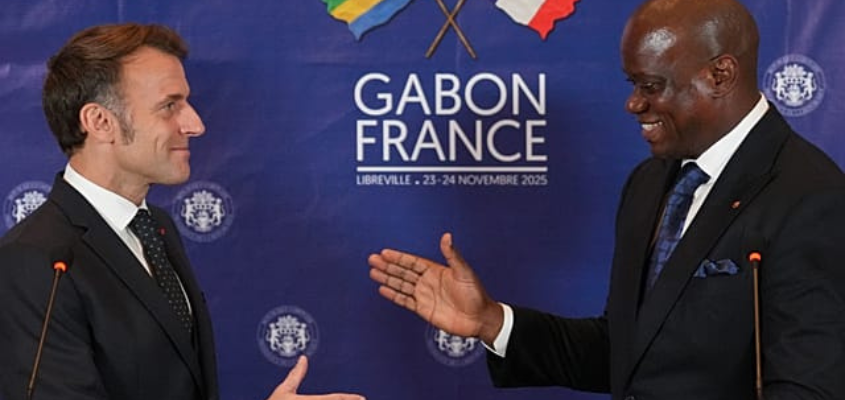
Portraying it as a reset of France’s imperialist relationship with Africa, President Emmanuel Macron last week completed a five-day tour of Mauritius, South Africa, Gabon and Angola. Political analysts are keen to note France’s crumbling economy that accrues largely from its lost access to cheap energy from its former colonies in Africa’s Sahel region; in recent years, nationalist governments in Mali, Burkina Faso and Niger have expelled French troops, declaring an end to settler colonialism.
Saddled with higher energy costs, France is forced to borrow more and more money to make ends meet. Servicing its national debt this year will cost French taxpayers $78 billion, more than any government department other than education and defense.
In October, the ratings agency Fitch downgraded French debt, potentially making it more expensive for the French government to borrow. Some economists speculate that France may have to turn to the International Monetary Fund for a bailout similar to Greece in 2013. That context led Wongel Zelalem, a correspondent for the African Diaspora News Channel, to say this last week upon Macron’s return:
“We are calling this (the) ‘begging tour’ because the agenda for this tour that Macron communicated with the world is that he plans to strengthen France’s influence in Africa and we all know why that is. France has been losing popularity in African countries left and right…Chad, Senegal, Cote d’Ivoire, Mali, Burkina Faso, Niger.
Basically, it’s losing its grip, its power, its influence. So now Macron has this bright idea to focus on other countries in Africa.”
Also, last week, Britain’s Chancellor of the Exchequer, Rachel Reeves, announced tax increases of nearly $34 billion—mostly on personal income taxes– by 2030. That follows a tax increase of about $53 billion last year. The UK’s economy is, in fact, more pitiful even than France, registering the second weakest economic performance among the Group of Seven, or G7, countries in the post-pandemic era. Between the final quarter of 2019 and the first quarter of 2024, Gross Domestic Product in the UK grew just 1.7 percent, compared with 5.1 percent in Canada, and 4.6 percent in Italy, according to government data. Economic growth slowed to an imperceptible 0.1 percent in the quarter ending in September.
Simultaneously, borrowing costs in the UK have skyrocketed, with interest rates on long-term government bonds in September soaring to their highest level in nearly 30 years. In the month of October alone, the UK government borrowed $23 billion to cover its budget deficit.
Central to the West’s financial crisis is the white settler’s illogical—and unsustainable—rent seeking schemes to squeeze more and more money out of workers, particularly people of color, as evidenced by the impending collapse of the subprime auto lending bubble in the U.S. targeting African Americans, just as the subprime housing bubble did nearly 20 years ago.
Concomitantly, the West continues to organize its economies around guns rather than butter to affect a militarized policy of primitive accumulation such as that deployed by France in colonized Algeria. Prodded by the United States’ proxy war in Ukraine, Europe increased its military spending by 17 per cent to $693 billion in 2024. All European countries increased their military spending in 2024 except Malta. Military expenditures by NATO members in 2024 accounted for 55 percent of global spending, or $1506 billion; Europe’s 32 NATO members spent $454 billion in total; 18 spent at least 2 per cent of GDP on weapons in 2024, up from 11 in 2023.
That is money that could be better spent on affordable housing, healthcare, green technologies and industrial development. This is especially true of Germany, which is Europe’s largest economy. The bombing of Russia’s Nord Stream pipeline cut off Germany’s supply of cheap gas that literally fueled the country’s manufacturing sector. The ensuing increase in energy costs have combined with inflation, increased military spending, growing competition from China and the Trump administration’s tariffs to shrink consumer demand for German products.
Germany shed 120,000 manufacturing jobs in 2024 alone, and a leading trade association, the Federation of German Industries, forecast that industrial production will decline in 2025 for the fourth consecutive year. In a press statement released December 2nd, Peter Liese, president of the Federation, described Germany’s finances as the worst crisis in the postwar era.
Continuing, he said:
This “is not a temporary economic downturn, but a structural decline.”
Western nations on both sides of the Atlantic might take a page from China’s playbook in pursuing a mixed economy–similar, ironically enough, to Franklin D. Rosevelt’s New Deal and its redistributive Keynesian policies– that are capitalist but not imperialist and acknowledge consumer buying power as the key to a sustainable demand economy. But if to a hammer every problem resembles a nail, then to the European imperialist no problem is so great that it can’t be solved with more larceny or more murder. There is not much hope that Western political elites will modernize their systems of deep economic exploitation without being made to do so by organized and populist revolts in their countries.