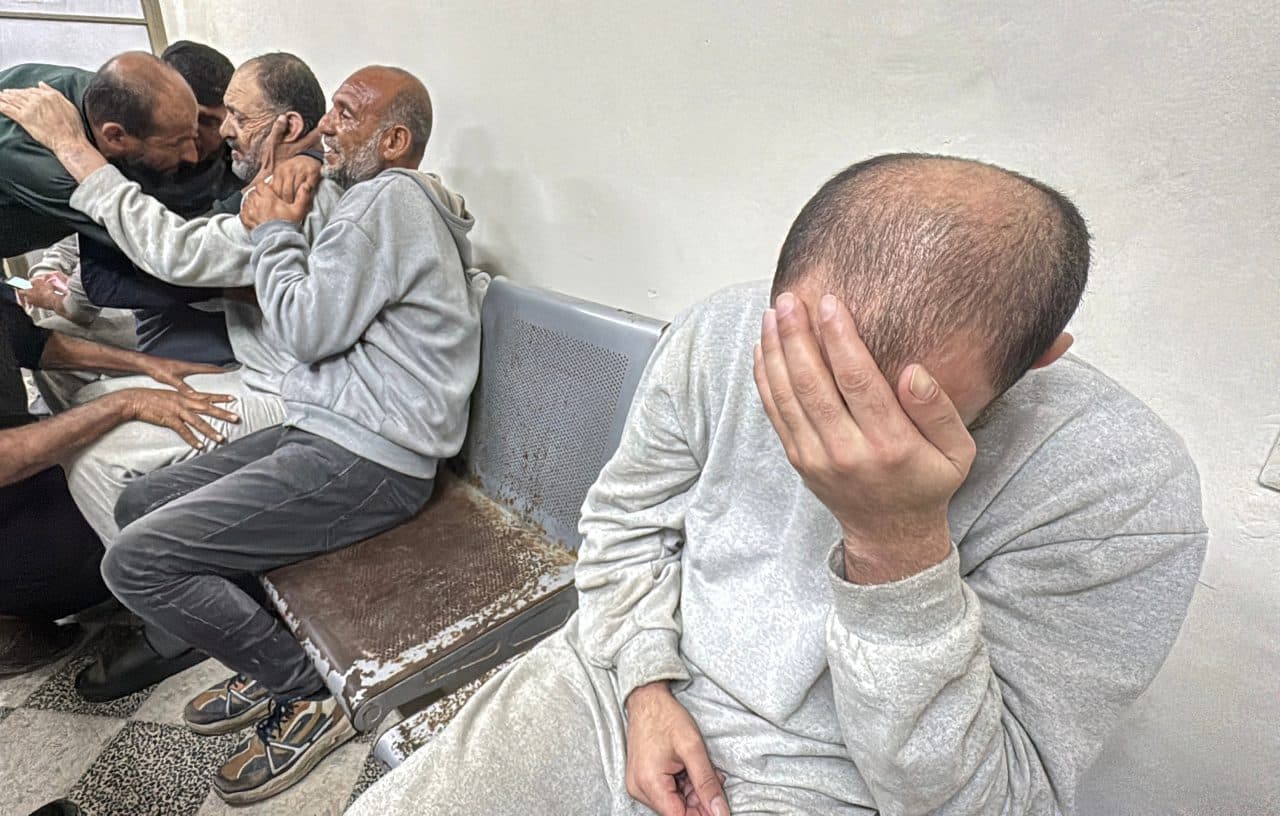
Above photo: Palestinian prisoners released by the Israeli army are taken to Al-Aqsa Martyrs Hospital for medical examination, the Palestinian prisoners arrested by the Israeli army from Gaza Strip during their ground incursion, Dair El-Balah, December 7, 2025. Ahmed Ibrahim apaimages.
After the U.S. imposed sanctions, YouTube took down over 700 videos from prominent Palestinian human rights groups.
Rights advocates say this censorship goes beyond Palestine and affects the future of international justice and accountability.
In a stark escalation undermining global efforts to preserve accountability for Israeli violations, Palestinian civil society organizations have been hit by an unprecedented campaign to erase their digital archives and silence their documentation work.
What began as a U.S. political decision has now translated into sweeping and coordinated digital censorship, threatening decades of human rights documentation that formed the backbone of Palestinian legal submissions to international courts.
For years, Palestinian human rights groups have meticulously collected evidence of Israeli abuses, from targeted killings and home demolitions to torture and violations against detainees. Much of this work was compiled and submitted to the International Criminal Court (ICC) as part of ongoing investigations.
Yet, in recent weeks, YouTube removed more than 700 videos belonging to three of the most prominent Palestinian organizations: Al-Mezan Center for Human Rights, Al-Haq, and the Palestinian Center for Human Rights (PCHR). These videos included testimonies from survivors, footage of military attacks, and forensic investigations that had become foundational to global human rights reporting.
The takedowns were triggered by U.S. sanctions imposed under Executive Order 14203, a measure introduced during the Trump administration to obstruct the ICC’s investigation into alleged Israeli war crimes
This digital crackdown does not occur in isolation. It follows years of systematic attempts to delegitimize Palestinian civil society, including the designation of several leading organizations as “terrorist institutions” by the Israeli government in 2021 and their subsequent outlawing by the Israeli military commander in the occupied West Bank. This classification paved the way for today’s intensified campaign to dismantle Palestinian documentation work both on the ground and online.
A Direct Attack On Accountability Efforts
YouTube did not attribute the removals to an automated error or content-violation policies; instead, the company removed al-Haq’s account without notice or justification. “We were simply told that an account doesn’t exist with this email address,” says Zeina Hurani, a representative of the organization.
YouTube confirmed to The Intercept that it deleted the accounts as a direct result of the State Department’s sanctions against the group following a review.
The order grants the U.S. government broad authority to sanction individuals or institutions “supporting ICC efforts to investigate or prosecute Israelis without Israel’s consent.” For Palestinian human rights organizations, the interpretation of this order has had catastrophic consequences.
Raji Sourani, Director of PCHR and a widely respected human rights lawyer in Palestine, described the sanctions to Mondoweiss as “a scandal in human rights work.” He explains that no rights organization had ever before been sanctioned simply for cooperating with an international legal body.
“The imposed sanctions will lead to funding difficulties and consequently paralyze our work,” Sourani said. “Today, we are unable to pay the salaries and dues of our staff, which will threaten our ability to document the stories of victims. We have never experienced anything of this scale before.”
Al-Haq has faced similar restrictions. Zeina Hurani told Mondoweiss that the impacts extend far beyond YouTube’s removals.
“Many of our social media accounts were deleted or restricted, limiting our ability to communicate publicly about the crimes and human rights violations committed,” she said. “All our bank accounts were closed. We can’t receive funds, we can’t pay staff, and our American colleagues were forced to resign out of fear of severe criminal and civil penalties.”
Beyond the financial blow, Hurani notes that the removal of their digital archive represents an attempt to erase the historical record. “These videos contain testimonies of people who risked everything to tell the world what happened to them. Losing this archive means losing crucial evidence.”
Digital Erasure
This removal is part of a wider pattern of mass digital censorship targeting Palestinian content globally. According to a report by 7amleh, the Arab Center for the Advancement of Social Media, platforms have increasingly adopted moderation systems that disproportionately suppress Palestinian voices.
A monitoring and documentation manager at 7amleh, Ahmad Qadi, told Mondoweiss that the behavior of large tech companies is neither accidental nor neutral. “Platforms frequently comply with takedown requests from the Israeli government, often at very high rates, and rely heavily on automated systems rather than human review,” Qadi says. “This accelerates the large-scale removal of Palestinian content while limiting transparency and accountability.”
In 2024 alone, 7amleh documented 507 cases of content removals or account restrictions affecting Palestinians. The situation worsened dramatically after platforms reduced the confidence threshold for automated moderation on Arabic content from 80% to just 25%, meaning that content can now be flagged for removal even when algorithms are highly uncertain.“This effectively guarantees the over-moderation of Palestinian content,” Qadi explained. “The threshold for silencing Palestinians has never been lower.”
While Palestinian documentation is being erased, pro-Israel digital networks have aggressively moved to dominate the narrative. Israeli ministries, cyber units, and coordinated volunteer networks have mobilized online campaigns encouraging users to mass report Palestinian content, exploiting automated moderation systems to eliminate footage of Israeli violations.
These efforts are reinforced by the rapid spread of state-backed narratives framing Israeli military operations as acts of “self-defense.” As Palestinian voices disappear from platforms, the visibility of official Israeli messaging rises, shaping public perception and altering the global information landscape.
Meta, in particular, has been singled out for its failure to curb Hebrew-language hate speech. Despite provisional measures ordered by the International Court of Justice requiring states to prevent “direct and public incitement to commit genocide,” Meta continues to host, and in many cases approve for paid promotion, content calling for violence against Palestinians.
According to 7amleh’s Racism and Incitement Index 2024, more than 12 million violent or inciting posts targeting Palestinians were detected across digital platforms this year. Many of these posts were boosted through Meta’s advertising systems, meaning the company profited directly from anti-Palestinian incitement.
A Dangerous Global Precedent
Legal experts warn that the combination of sanctions, platform compliance, and political pressure is creating a dangerous precedent that extends far beyond Palestine. If powerful states can criminalize cooperation with international courts, and digital platforms can erase archives of human rights violations at their request, then global accountability mechanisms are at risk of collapse.
The chilling effect is already visible: civil society organizations worldwide fear that documenting war crimes may now expose them to financial sanctions, digital erasure, or criminal penalties.
“This is not only about Palestine,” Sourani warned. “This is about the future of international justice. If institutions can be punished for cooperating with the ICC, then the very idea of accountability is at stake.”
Despite the unprecedented assault on their finances, infrastructure, and digital presence, Palestinian human rights groups insist that they will not abandon their mission.
“We remain committed to implementing solutions, finding alternatives to platforms based in the United States, and continuing to serve our people,” Hurani said.
Sourani echoed this sentiment: “This confrontation is between those who want the law of the jungle and those who want the rule of law,” he said. “We will continue documenting, we will continue filing cases, and we will not allow our victims to be silenced.”