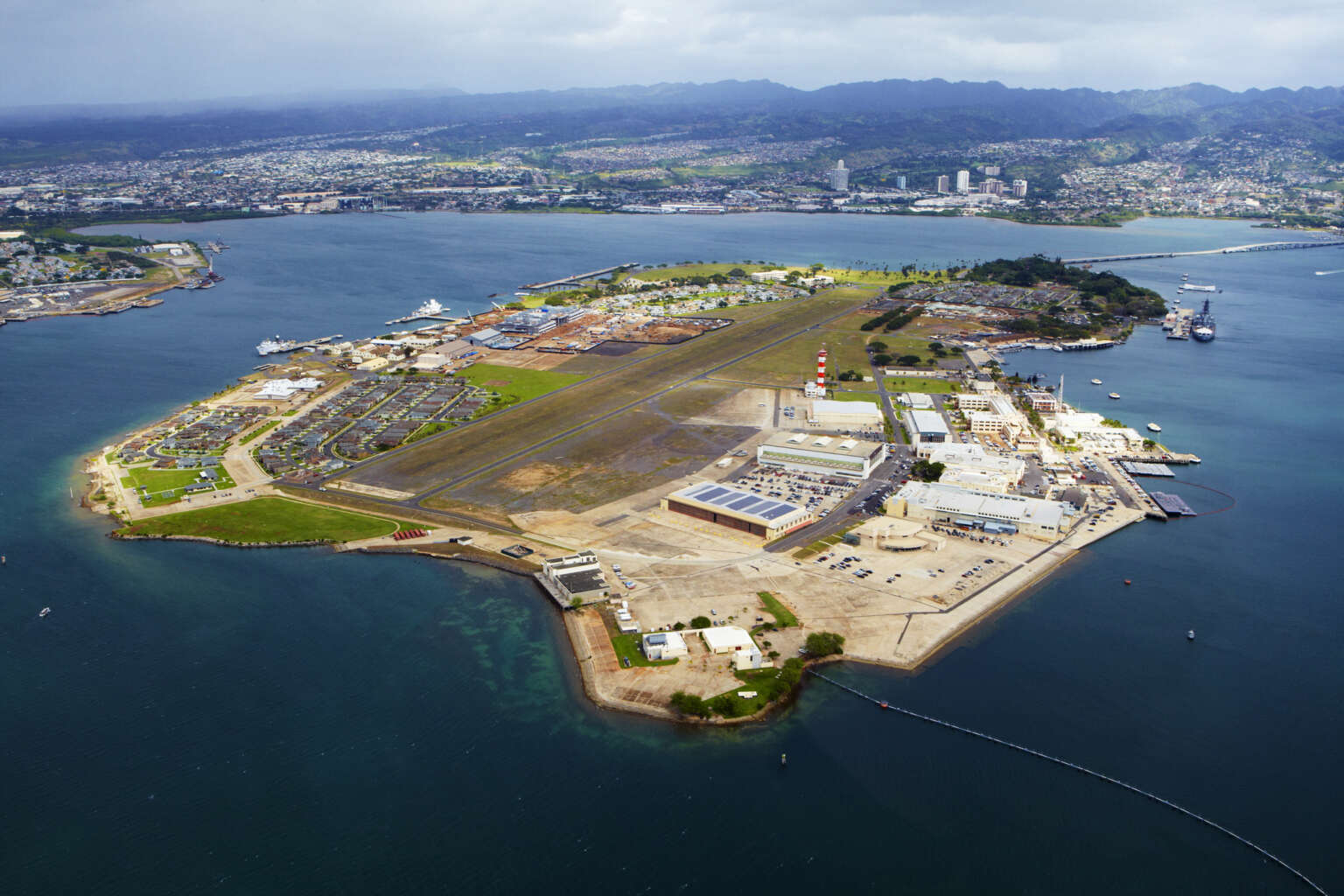
Above photo: Aerial view of Pearl Harbor, a deep water U.S. naval base and headquarters of the U.S. Pacific fleet, taken circa 2012.
The US military is abusing Hawaiian land.
Will residents be able to exert Indigenous sovereignty and get it back?
Since 1964, the U.S. military has leased roughly 47,000 acres of land from the State of Hawai‘i — for a token $1. The leases, which account for 18 percent of military lands in Hawai‘i, are set to expire in 2029, offering Hawai‘i a rare opportunity to reclaim land from the war machine. As the expiration date looms, Hawai‘i residents are at a crossroads: remain a staging ground for U.S. imperialism or pivot toward community well‑being, environmental sustainability, and economic self‑determination.
But that decision may arrive sooner than 2029: Allegedly faced with pressure from federal officials to fast-track lease renewals by the end of this year, Democratic Gov. Josh Green signed a statement of principles in September with Army Secretary Dan Driscoll expressing the intention to “explore the feasibility of land use that aligns national security and Army readiness needs with the State’s priorities for public benefit.” A month later, Green sent Driscoll a proposal for a $10 billion plan that included a “community benefits” package. He argued that this sum would be favorable should the Army pursue “condemnation,” the use of eminent domain to seize Hawai‘i’s land for “national security.”
Native Hawaiian groups swiftly condemned the move in a September 2 statement signed by 40 organizations. They opposed fast-tracking the leases and pointed out that Green and Driscoll sidestepped federal and state statutes that require a thorough review — a process the Army and Navy had already failed to complete earlier that year.
After mounting pressure from the Office of Hawaiian Affairs, state legislators, and numerous environmental and civic organizations, Green walked back the end-of-year deadline and extended the negotiation timeline into 2026. Still, the episode highlighted how easily the U.S. military can bypass democratic debate in the name of “national security,” and how vital it is for the public to have informed discussions about the military’s impact on Hawai‘i.
How Hawai‘i Became Occupied
The U.S. military controls roughly 254,000 acres across Hawai‘i, making it the most militarized state per capita in the country. On O‘ahu alone, the military occupies 86,000 acres, or 25 percent of the island. These lands were part of the “ceded” territories illegally seized from the Hawaiian Kingdom in 1898.
Once a sovereign nation, Hawai‘i was the starting point for America’s century of imperialism and conquest in the Pacific. In the late-19th century, American missionaries and plantation owners, seeking to avoid U.S. tariffs on Hawaiian sugar, conspired with the U.S. Navy to orchestrate a coup to overthrow Queen Lili‘uokalani in 1893.
Although the coup was condemned by President Grover Cleveland as illegal, in 1897 President William McKinley signed the Newlands Resolution, illegally annexing Hawai‘i as a U.S. territory through a joint congressional resolution, bypassing the legally required two-thirds majority in the Senate to ratify a treaty between two nations.
After annexation, the provisional government reclassified Crown and government lands as “public” property and transferred them to the U.S. Interior Department. In 1908, the U.S. designated Pearl Harbor a naval base, making Hawai‘i a strategic location between the U.S. and Asia, and shifted U.S. “Manifest Destiny” from a continental to a global empire. When Hawai‘i was admitted as a state in 1959, about 1.8 million acres of former Crown and government lands — including those currently considered for lease renewal — were transferred to the state, with the condition that these lands be used for five specific public purposes, including the “betterment of the condition of native Hawaiians.”
U.S. Military Footprint
This year, the Hawai‘i State Legislature passed House Resolution 199 directing the Department of Land and Natural Resources to conduct a comprehensive economic analysis of military‑leased lands. The purpose was to assess lost economic opportunities in agriculture, housing, and education, as well as costs for cleanup of contaminants and unexploded ordnance. In the end, the legislature did not fund the study.
While we lack a comprehensive view, there are indications that the U.S. military’s impact on Hawai‘i’s economy and environment is significant, especially as it pertains to housing. According to a 2024 Pentagon report, 35 percent of the 42,333 servicemembers living on O‘ahu occupy off-base rental housing. This represents about 10 percent of the private rental properties on Oahu. Not only do military personnel displace local renters, but they also drive up rental prices because of Basic Housing Allowances, which help them outbid locals. While the amount varies by rank, the lowest enlisted pay grade living in Honolulu, an E-1 military personnel without dependents, receives $2,403 per month in addition to their salary. Meanwhile, high-ranking military personnel without dependents receive $4,287 monthly.
When you add this to their free or low-cost health care, food allowances, subsidized groceries at the commissaries, store discounts, and free education and training, it’s clear that military personnel enjoy a much more comfortable financial situation than many local residents. Even Rep. Ed Case, a Blue Dog conservative Democrat, acknowledged this dynamic: “One factor in driving unacceptably high home rental prices throughout our state and especially on O’ahu is military servicemember participation.”
Environmental Damage
While positioning itself as a protector of Hawaii’s security and well-being, the U.S. military strains and poses a major threat to the island’s natural resources. According to data from the Honolulu Board of Water Supply, the U.S. Marine Corp Base in Kāneʻohe is the single largest consumer of water in Hawai‘i, using 63.7 million gallons per month.
Aside from water usage, the U.S. military also jeopardizes Hawai‘i’s freshwater supply. In 2021, 20,000 gallons of jet fuel leaked from the Navy’s Red Hill Bulk Fuel Storage Facility into the Moanalua-Waimalu aquifer, affecting more than 93,000 people, mostly military personnel and their families.
The fuel storage facility was built in 1940, 100 feet above the aquifer, which serves as the main source of drinking water for over 400,000 Oahu residents. Groups such as Kaʻohewai, a coalition of Native Hawaiian organizations, the Sierra Club of Hawai‘i, and the grassroots group O’ahu Water Protectors mobilized to pressure the Navy to shut down and defuel Red Hill. The disaster response and efforts to shut down the facility have cost taxpayers over $2 billion, and the Board of Water Supply is suing the Navy for $1.2 billion in damages related to cleanup and protecting the island’s drinking water from further contamination. Because of the Red Hill crisis, the Board of Water Supply asked residents to reduce water use by 10 percent, and in 2025, they doubled that request to 20 percent.
“The Red Hill crisis exposed a central contradiction of the military’s presence in Hawai’i,” wrote Kyle Kajihiro, University of Hawai‘i at Manoa professor. “Contrary to the dominant national security discourse that the U.S. military protects Hawai‘i and the Pacific region, Red Hill epitomizes the military occupation of Hawai‘i that threatens people and the environment.”
Precedence for Resisting Lease Renewals
Even before a lease can be renewed, the state’s Bureau of Land and Natural Resources (BLNR) must approve the military’s environmental impact statement. In 2025, the BLNR rejected the U.S. Army’s Final Environmental Impact Statement and its lease renewal of 23,000 acres at Pōhakuloa Training Area on the Big Island.
Pōhakuloa is the U.S. military’s prized lease, covering about 132,000 acres, of which 20 percent is leased from the state. Under the lease, the military must remove or disable ammunition after training. However, in response to a lawsuit filed by two Native Hawaiian cultural practitioners, a judge ruled that the state did not enforce cleanup rules at Pōhakuloa. Inspectors discovered shells and discarded vehicles on the property, and found that the Army’s cleanup efforts and the state’s record-keeping were inadequate. The military’s failure to uphold its lease commitments led the Hawaiʻi County Council in August to unanimously approve a resolution calling on the military to halt all “desecration activities” and for the state to conduct comprehensive cleanup and restoration before considering any lease extensions or land swaps at Pōhakuloa.
According to Mahina Tuteur, a Native Hawaiian attorney with Pō`ai Ke Aloha `Aina, Hawai‘i ’s history with the U.S. military teaches two important lessons. First, once land is acquired — whether through lease, condemnation, transfer, or other means — it is rarely returned unless there is organized opposition. Second, the state of Hawaiʻi has often failed in its duty as a trustee for these lands.
Tuteur points to two long-term successful organizing initiatives where Kānaka `ōiwi, along with peace and environmental activists, mobilized communities and filed lawsuits to stop live-fire bombing by the U.S. military. For decades, the U.S. military used Kaho`olawe to practice live-fire bombing for the Korean and Vietnam wars, even simulating an atomic bomb blast. In 1976, as the movement for Hawaiian sovereignty grew, Kānaka `ōiwi occupied Kaho`olawe and demanded an end to the bombings and the return of the land. Fourteen years later, their efforts succeeded, and cleanup efforts began with $400 million allocated to remove unexploded ordnance, though it remains incomplete.
Another example is Mālama Mākua, a Native Hawaiian-led community group on O`ahu, which successfully stopped live-fire bombing and secured cultural access in Mākua Valley after fighting for decades to end the military’s use of their land. They are close to ending the military’s lease as a first step towards reclaiming all occupied land.
Tuteur argues that communities should demand that the State of Hawai‘i act as an active trustee, with clear obligations to beneficiaries — Native Hawaiians and the public — by requiring environmental and land assessments, ongoing cleanup efforts, and a process rooted in the state’s constitutional duty to protect these lands for future generations.
Redefining Security in Hawai‘i
Governor Green invoked “national security” to accelerate negotiations of lease renewals with the U.S. Army, writing that the usual public‑input process must be set aside because of the “urgency” expressed by Army Secretary Dan Driscoll.
When the State of Hawai‘i signed the original 1964 leases, it did so under the shadow of eminent‑domain threats. As Tuteur explains, “Condemnation has been weaponized as a colonial tool and negotiating tactic, often resulting in harm to Hawaiian families.” For Green and Driscoll to think that there can be “friendly condemnation” — the expeditious transfer of property via eminent domain — highlights just how far apart the sides are on this issue.
Why rush now, especially as U.S.-China relations enter a phase of “managed rivalry,” a term coined by David Meale, a former diplomat, that refers to the space for cooperation despite lingering tensions. A 2025 study by Harvard and MIT scholars published in International Security reached the same conclusion: “There is no evidence that China poses an existential threat to the countries on its borders or in its region that it does not already claim sovereignty over.” Analyzing thousands of articles, speeches, and policies, the authors concluded, “China does not seek regional hegemony or aim to compete with the United States for global supremacy. Instead, China views international relations as multilateral and cooperative.”
Instead of expanding militarization, the U.S. should partner with China on shared challenges — especially climate change, to which the U.S. military is a major contributor.
According to Neta Crawford, a professor at the University of St. Andrews, the Pentagon is the single largest institutional consumer of energy in the United States and the world’s biggest single source of fossil‑fuel‑related greenhouse‑gas emissions. Crawford and Lennard de Klerk found that for the 2024 Rim of the Pacific (RIMPAC) war drills, U.S. forces, which were given 20 million gallons of naval and jet fuel, produced about 300,000 tons of CO2-equivalent emissions, exceeding the annual emissions of the eight lowest-emitting countries in 2022.
Hawai‘i is especially vulnerable to the climate crisis. Chip Fletcher, dean of UH Mānoa’s School of Ocean and Earth Science and Technology, warns that rising carbon dioxide has already pushed Hawai‘i into a Pliocene‑like climate, where average temperatures exceed 84 degrees Fahrenheit and threaten photosynthesis, but if they climb to 104 degrees Fahrenheit, tropical crops could die permanently. Rising temperatures from climate change are causing intense droughts, triggering wildfires that destroyed Lahaina and warming oceans, leading to “coral bleaching” and acidification that is destroying marine ecosystems around the islands.
Rather than serve as a training ground for a prospective U.S.-China war, Hawai‘i can instead become the piko (center) of peace and resilience. Hawai‘i’s 2015 legislative commitment to 100-percent renewable energy illustrates the state’s capacity to lead on sustainability.
Professor Jonathan Kamakawiwoʻole Osorio, dean of the Hawaiʻinuiākea School of Hawaiian Knowledge, emphasizes that the U.S. occupation of Crown and Government lands deprives Hawaiʻi of wise land use. Kānaka ʻōiwi are reclaiming traditional, sustainable food practices like growing taro and building fishponds, advancing innovative solutions to our most urgent infrastructural and affordability issues. “These lands are from a public trust, and that means that the use of these lands, the deployment of these lands, has to fulfill a public interest,” Osorio said in an interview with Truthout. “There is no greater public interest than anticipating the changes that climate is going to force on our society.” Osorio advocates for expanding community governance over these trust lands so that natural resources are managed for the benefit of the people, not for military purposes.
Reclaiming Land for Hawai‘i’s Resilience
With public pressure mounting, Rep. Jill Tokuda (D- Hawai‘i), who sits on the House Armed Services Committee, helped remove language from the 2025-26 National Defense Authorization Act that would have temporarily authorized the military to condemn state land. “Under no circumstances should we entertain the idea of giving land away to the military,” Tokuda said in a press release. “If they attempt such an illegal action, they will lose in court and more importantly, they will lose the trust of the people of Hawai‘i.”
Now, the people of Hawai‘i must seize this crucial opening to advocate for using these state lands to meet more basic human needs that increase the islands’ resiliency and self-sufficiency, especially in the face of climate change.
Keoni Lee, co‑CEO of Hawai’i Investment Ready, argues that Hawai‘i’s pre‑colonial economy — rooted in the non‑monetary ahupuaʻa system where “success was measured by the health and productivity of people and ‘āina” — offers a template for a regenerative future. He warns that today’s extraction‑driven, GDP‑focused model generates inequality and environmental harm. Lee is part of a growing movement in Hawaiʻi that is elevating models like Kumano I Ke Ala, a community-based social enterprise that restores and cultivates traditional agricultural lands and trains youth in the values that supported a once fully sustainable traditional Hawaiian food system.
Native Hawaiian advocates are building momentum toward a shift in the governance of resources in Hawaiʻi, which has been dominated by extractive and abusive industries, such as the military, for too long. While large‑scale stewardship projects exist, they are often treated as side ventures, and lack long‑term capital investments, like roads or schools. Investing in regenerative economies, Lee argues, could create thousands of place‑based jobs in restoration, farming, and renewable energy. “We’d keep more money circulating locally instead of leaking out, building real security from the inside out,” Lee explains. “Hawai‘i’s resilience is national security.”
By engaging in informed public debate about the economic, environmental, and cultural costs of the military’s footprint — and exploring repurposing the military’s footprint for community-driven, sustainable uses — Hawai‘i can transform from a base preparing for war into a beacon of peace, resilience, and Indigenous innovation.