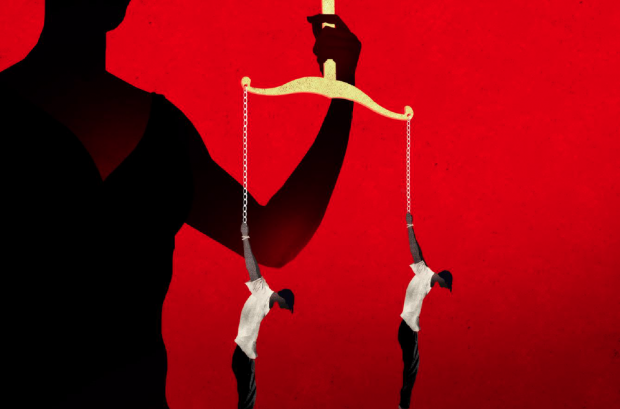
Above Photo: From HRW.org.
A Roadmap to Justice for CIA Torture
Summary
It is now well established that following the attacks on the United States on September 11, 2001, the US Central Intelligence Agency (CIA) operated a global, state-sanctioned program in which it abducted scores of people throughout the world, held them in secret detention—sometimes for years—or “rendered” them to various countries, and tortured or otherwise ill-treated them. While the program officially ended in 2009, the cover-up of these crimes appears to be ongoing.
Many detainees were held by the CIA in pitch-dark windowless cells, chained to walls, naked or diapered, for weeks or months at a time. The CIA forced them into painful stress positions that made it impossible for them to lie down or sleep for days, to the point where many hallucinated or begged to be killed to end their misery. It used “waterboarding” and similar techniques to cause near suffocation or drowning, crammed detainees naked into tiny boxes, and prevented them from bathing, using toilets, or cutting their hair or nails for months. “We looked like monsters,” one detainee said of his appearance while in CIA custody.
Much new information about detention and interrogation in the CIA program became public with the release in redacted form of the 499-page summary of the Senate Select Committee on Intelligence report in December 2014 (“Senate Summary”). The Senate Summary reported that the CIA subjected at least five detainees to “rectal feeding,” described in one case as infusing the pureed contents of a lunch tray into the detainee’s rectum via a medical tube, done “without evidence of medical necessity.” The Senate Summary also found that during a waterboarding session, one detainee became “completely unresponsive, with bubbles rising through his open, full mouth.” The CIA forced some detainees to stand for days on end without sleep while they had broken bones in their legs and feet, even though CIA personnel knew this would cause them long-term physical injury. A CIA cable described one detainee as “clearly a broken man” and “on the verge of complete breakdown.”
The US government has not adequately accounted for these abuses. It has an obligation under international law to prosecute torture where warranted and provide redress to victims, but it has done neither. No one with real responsibility for these crimes has been held accountable and the government has actively thwarted attempts on the part of victims to obtain redress and compensation in US courts.
The Obama administration asserted that it conducted a criminal investigation of the CIA program through a Department of Justice inquiry led by a career prosecutor, Assistant US Attorney John Durham. The Durham investigation closed on August 30, 2012 without bringing any criminal charges. The apparent failure of the investigation to question current or former detainees undercuts any claims that it was thorough or credible.
As set out in this report, Human Rights Watch concludes there is substantial evidence to support the opening of new investigations into allegations of criminal offenses by numerous US officials and agents in connection with the CIA program. These include torture, assault, sexual abuse, war crimes, and conspiracy to commit such crimes. In reaching this conclusion, we have drawn on our own investigations, media and other public reports, and the declassified information in the Senate Summary. But more evidence exists that has yet to be made public.
We believe that an independent and impartial investigation that has access to the full Senate report, other information that the government continues to keep classified, and interviews with current and former detainees, would yield further evidence of crimes and identify more suspects than we do here.
US officials who created, authorized, and implemented the CIA program should be among those investigated for conspiracy to torture as well as other crimes. They include: Acting CIA General Counsel John Rizzo, Assistant Attorney General for Office of Legal Counsel (OLC) Jay Bybee, OLC Deputy Assistant Attorney General John Yoo, an individual identified as “CTC Legal” in the Senate Summary, CIA Director George Tenet, National Security Legal Advisor John Bellinger, Attorney General John Ashcroft, White House Counsel Legal Advisor Alberto Gonzales, Counsel to the Vice President David Addington, Deputy White House Counsel Timothy Flanigan, National Security Advisor Condoleezza Rice, Defense Department General Counsel William Haynes II, Vice President Dick Cheney, and President George W. Bush. In addition, James Mitchell and Bruce Jessen, CIA psychologist contractors who devised the program, proposed it to the CIA, and helped carry it out, should also be investigated for their role in the initial conspiracy.
We believe there is also sufficient evidence to investigate others who were not necessarily part of the initial conspiracy but who later joined it. Individuals can join an already existing conspiracy if they are aware of the conspiracy’s unlawful aims, in this case torture, and take steps intended to help the conspiracy succeed. These would include those who reauthorized the program after the legal memos endorsing it—the “Torture Memos”— were withdrawn, those who supplied false information to the Justice Department upon which the Justice Department relied in providing reauthorization, and those who later oversaw operation of the CIA program.
Others should not only be investigated for torture but also for offenses such as war crimes, assault, and sexual abuse. Even if individuals who carried out the torture can be said to have reasonably relied in good faith upon OLC memos or CIA guidance to justify their conduct—which, as detailed below, there is serious reason to doubt—considerable evidence exists that CIA officers and interrogators tortured detainees in ways that went beyond what was authorized.
This report also considers and rebuts arguments that barriers to prosecution under US law—such as statutes of limitation, certain defenses, or a “specific intent” requirement—might make it impossible to pursue criminal cases.
The failure to credibly investigate and prosecute torture committed in any territory under US jurisdiction violates US obligations under the Convention against Torture and Other Cruel, Inhuman or Degrading Treatment or Punishment and other treaties to which the US is a party. Other countries and entities should open their own investigations into CIA torture and should exercise universal jurisdiction, where applicable, over US nationals and others implicated in torture or other abuses. Additionally, countries that were complicit or otherwise unlawfully assisted the CIA program should also conduct investigations into the alleged illegal conduct of their own nationals.
Besides violating international law, the US government’s inaction in the face of clear evidence of torture sends a message to future US policymakers and officials that they too can commit torture and other ill-treatment and not fear being held accountable. Several presidential candidates for the 2016 elections have already indicated they would consider using so-called “enhanced interrogation techniques” if they were to be elected.
Holding government officials accountable for serious abuses is never easy; when high-level officials are involved, it can be politically divisive. But Human Rights Watch research over the past 25 years in dozens of countries has shown that forgoing criminal accountability carries a high price. (See particularly Human Rights Watch, Selling Justice Short (2009)). Lack of accountability may fuel future abuses and weaken the rule of law.
Globally, the US unwillingness to prosecute CIA torture weakens US authority to oppose torture and other abuses abroad, provides a ready excuse for countries unwilling to prevent or prosecute torture in their own countries, and undermines global respect for the rule of law.
The egregious abuse of prisoners in CIA custody and failure to hold anyone accountable has undermined global efforts to fight terrorism. Detainee abuse, including abuse of prisoners by the US military, has been used by terrorist groups to obtain new recruits and contributed to anti-US sentiment in many countries.
Ultimately, the guilt or innocence of any of the US officials involved in organizing or carrying out the CIA program will rest with the criminal justice system. Suspects should be tried in criminal proceedings that comport with international due process and fair trial standards, including allowing them to challenge evidence, present defenses, and raise mitigating circumstances. But before these fundamental institutions of democratic rule can even be set in motion, US criminal justice officials need to first conduct credible investigations and bring charges where appropriate, requirements that have gone unmet for well over a decade since the first revelations of CIA torture after 9/11.
This report is organized into three parts—credible investigations and prosecutions, redress, and international justice—reflecting different steps the US and other countries should take to pursue accountability for CIA program abuses.
Credible Investigations and Prosecutions: The first part of this report examines some of the specific federal criminal charges that could be brought against US officials involved the CIA program. The most senior responsible officials should not be able to avoid culpability on the grounds that they relied on advice from White House lawyers stating that the interrogation techniques used on detainees did not amount to torture. This defense is weak not only because the legal reasoning was so poor that it was soon repudiated by other Bush administration lawyers and virtually all other legal professionals, but also because, in this case, those involved in the CIA program themselves helped create the legal advice being used as a shield to protect them from accountability for their alleged crimes.
Officials in the CIA and at the White House should have known, from the moment the techniques in question were proposed, that they were violating the federal Torture Statute: the techniques were reverse-engineered from a program designed to train US special forces to endure torture, some were explicitly designated as torture by US courts, and many were banned in the US Army Field Manual for Intelligence Interrogations in effect at the time the abuse was approved.
And there is evidence in the Senate Summary that officials actually knew that the techniques violated the Torture Statute. According to a Department of Justice Office of Professional Responsibility investigation (OPR investigation), the CIA, through its acting General Counsel John Rizzo, expressed concern about “criminal liability” under the Torture Statute and sought, but failed to obtain, a guarantee from the Justice Department’s Criminal Division that employees would not be prosecuted for use of the techniques.
The Senate Summary also contains a reference to a draft letter to the attorney general from “CTC Legal” —a likely reference to someone in the legal department of the CIA’s counterterrorism center—acknowledging that the “aggressive methods” of interrogation the CIA was planning would violate the Torture Statute. While there are no records showing that the letter was sent, its existence shows that at least some CIA advisers believed from the beginning that the techniques being proposed were illegal. Finally, the OPR investigation also noted that in mid-2002 senior White House and CIA officials appear to have been involved in shaping the contents of the soon-to-be issued legal memos authorizing abusive interrogation techniques, with sections likely added at their request after the Justice Department refusal to give a non-prosecution guarantee.
Viewed in this context, there is strong reason to conclude that the infamous and since discredited “Torture Memos” issued by the OLC in August 2002 authorizing techniques that many others had previously determined to be torture, should be viewed as little more than a legal fig leaf. “The position taken by the government lawyers in these legal memoranda amount to counseling a client as to how to get away with violating the law,” said John Gibbons, former chief judge of the US Court of Appeals for the Third Circuit, after the memos had been released.
Other White House and CIA officials and OLC lawyers later joined the conspiracy by knowingly keeping in the dark government officials they knew would oppose the CIA program, allowing the conduct to continue despite knowledge detainees were being mistreated, and reauthorizing the program once original authorizations were revoked after news of torture by the US military at the Abu Ghraib prison in Iraq became public.
CIA personnel also engaged in practices that went well beyond the illegal techniques “authorized” by the Torture Memos. Practices such as “rectal feedings,” use of water to induce near suffocation, and certain painful stress positions, were either not authorized or administered in ways that were not authorized. As such, the memos should not even be contemplated as a defense for such actions.
Lastly, while the five-year federal statute of limitations for most federal crimes might be thought to present an insurmountable bar to prosecution, it should not apply to many of the crimes committed as part of the CIA program. It is not a bar to prosecutions for torture or conspiracy to torture when there is a “foreseeable risk that death or serious bodily injury” may result, or to prosecutions for the types of sexual abuse allegedly committed by CIA program personnel. For all federal conspiracy charges, moreover, the statute of limitations can be extended if perpetrators conceal a central component of the conspiracy, as seems to have been the case here.
Redress: The second part of this report looks at the US government’s obligation to provide redress to victims of abuse, including compensation and rehabilitation services, guarantees of non-repetition (including through legislation and public statements), and public disclosure of relevant information. The Convention against Torture and other treaties require the US to provide redress for torture and other serious abuses, including arbitrary detention and enforced disappearance. Not only has the US failed to provide compensation or any other form of redress to detainees in CIA custody, the Obama administration has blocked every attempt by former detainees to bring civil suits in US courts by invoking doctrines of state secrecy, state immunity, and national security.
International Justice: The third part of this report looks at the efforts of other governments to investigate CIA torture and related abuses that occurred in their countries. Investigations in other countries have targeted US officials as well as national officials alleged to have participated in or been complicit in CIA abuses.
The duty to prosecute serious violations of international law lies primarily with domestic judicial authorities in the country with principal jurisdiction over the crime. This normally requires having a territorial link to the crime or the persons involved. However, third countries can also investigate and prosecute on the basis of universal jurisdiction—laws embodying the idea that certain crimes, including torture and war crimes, are so egregious that every state has an interest in bringing perpetrators to justice.
The Convention against Torture contains a universal jurisdiction clause that places an affirmative duty on governments to prosecute suspects who come on their territory regardless of where the torture took place. The Geneva Conventions of 1949 relating to war crimes contains similar provisions. The US government’s failure to conduct its own thorough and credible investigations into allegations of torture increases the importance of states exercising universal jurisdiction for crimes alleged to have been carried out as part of the CIA program.
Although the United States is not a party to the International Criminal Court (ICC), the ICC may also be an avenue to accountability for alleged abuses by US nationals in Afghanistan. The ICC is conducting a preliminary examination of the situation in Afghanistan, which includes alleged torture of detainees by US armed forces there. Whether the preliminary examination will lead to a formal investigation was not known as this writing.