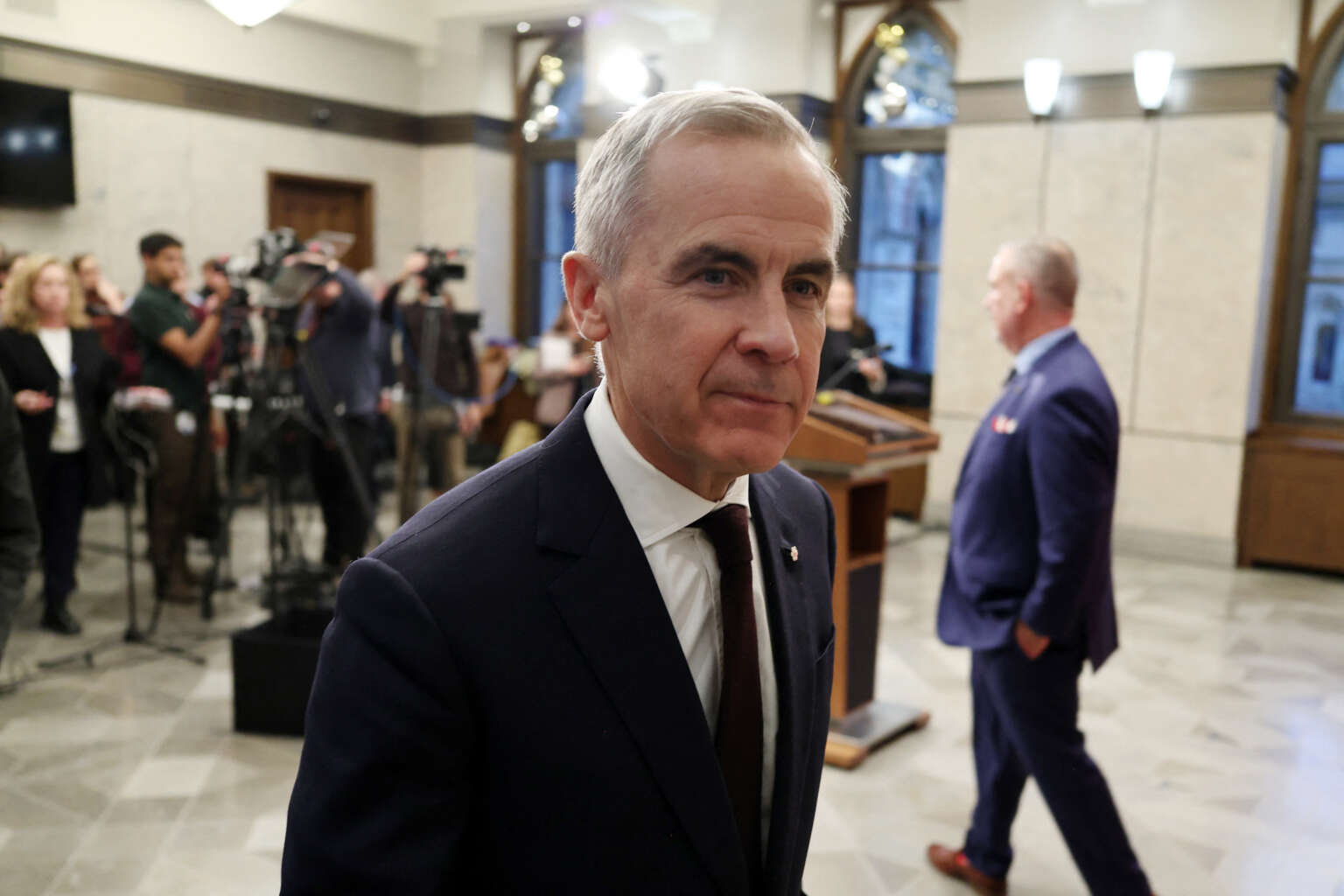
Above photo: Canadian Prime Minister Mark Carney leaves after speaking with reporters about new measures to protect Canadian strategic industries in Parliament Hill, Ottawa, Ontario, Canada, on November 26, 2025. Dave Chan / AFP via Getty Images.
“We’re talking about significant volumes of Canadian weapons fueled into contexts of genocide.”
Canadian Prime Minister Mark Carney has hailed a new economic deal with the United Arab Emirates as a way to “attract billions of dollars in investments into Canada.”
The $50 billion agreement — $70-billion in Canadian dollars — was announced as Carney travelled to Abu Dhabi in November for talks with Emirati leaders, and comes as Canada attempts to diversify its economic partners as it contends with effects of U.S. President Donald Trump’s tariffs.
“We’re building big things, and the UAE wants to build with us,” the Canadian leader said in a social media post about the pact.
Yet back in Canada, human rights advocates and legal experts have condemned the Canadian government for deepening ties to the UAE as it stands accused of fueling mass atrocities in Sudan.
They say Carney’s visit to the powerful Gulf nation is especially galling given the emergence of new reports about Canadian-made weapons being used by a Sudanese paramilitary group accused of committing “the gravest of crimes” in the war-torn Darfur region — with UAE support.
“Carney is selling out our principles — including Canada’s commitment to the basic rules of international law and to human rights — to make money,” said Mark Kersten, an assistant professor specializing in international law at University of the Fraser Valley.
“With troubling success, the prime minister is showing that the chance of economic prosperity in Canada and diversifying trade partners comes at the cost of caring for the very lives of others,” Kersten told Truthout in an email.
Crimes Against Humanity
Carney’s November trip to the UAE — the first by a Canadian prime minister since 1983 — came just weeks after the Sudanese paramilitary Rapid Support Forces (RSF) seized control of North Darfur’s capital, el-Fasher.
The United Nations and the world’s leading human rights groups have accused RSF fighters of committing massacres against civilians in their takeover of the city.
Displaced residents have said they saw dead bodies lining the streets as they fled el-Fasher, and there have been multiple reports of widespread rape and sexual violence, kidnappings, and extortion.
Researchers in the United States have said satellite imagery indicates the RSF is digging mass graves to bury bodies.
While the UAE vehemently denies backing the RSF, UN experts and human rights groups have said the country has provided military support to the group.
Earlier this year, media outlets reported on a leaked document written by a panel of UN experts that said cargo flights were routinely bringing weapons from the UAE to Chad. The arms were then smuggled across the border into Sudan for use by the RSF.
The experts said “the cargo flights from airports in the UAE to Chad were so regular that, in effect, they had created a ‘new regional air bridge,’” The Guardian reported.
U.S. lawmakers also have acknowledged the UAE’s role in fueling the war in Sudan, with Secretary of State Marco Rubio saying during his Senate confirmation hearing in January that the country was “openly supporting an entity that is carrying out a genocide.”
Democratic Senator Chris Van Hollen also recently urged Washington to stop sending weapons to its Gulf ally amid the atrocities in el-Fasher.
“In January of this year, the Biden administration confirmed to me directly that the UAE was providing material support to the RSF, even though the UAE had assured the United States that it wasn’t and that it wouldn’t,” Van Hollen said during a Senate speech last month.
Meanwhile, in May, Amnesty International said “sophisticated Chinese weaponry” that was re-exported by the UAE was captured in Khartoum, the Sudanese capital, as well as used in Darfur.
“The presence of recently manufactured Chinese bombs in North Darfur is a clear violation of the arms embargo by the UAE,” Brian Castner, Amnesty’s head of crisis research, said in a statement at the time.
“Our documentation of AH-4 howitzers in Khartoum further strengthens a growing body of evidence showing extensive UAE support to the RSF, in violation of international law.”
The RSF has been battling the Sudanese Armed Forces for control of Sudan since April 2023, and was accused of committing crimes against humanity long before its takeover of el-Fasher.
That includes “persecution on ethnic grounds, forced displacement and contributing to extermination,” according to a UN Human Rights Council report from September.
In 2024, Canadian exports of military goods and technology to the UAE totalled just over $5 million ($7 million in Canadian dollars), according to government records.
Yet despite the relatively small sum, rights groups say any amount of weapons that could be funneled into the conflict in Sudan is too many.
In early November, Canadian public broadcaster CBC News verified photographs showing rifles manufactured by a Canada-based company in the hands of RSF fighters in Sudan. CBC News said it was not immediately clear how the rifles ended up with the paramilitary group but noted that experts have detailed past diversions by the UAE.
Rights groups also have documented that armored vehicles produced by the STREIT Group, a Canadian-owned company whose main manufacturing facility is in the UAE, have also been used by the RSF in the war.
The company — one of the largest armored vehicle manufacturers in the world — has repeatedly denied any wrongdoing.
Yet both cases are an apparent violation of a UN arms embargo on Sudan that was put in place more than two decades ago to try to prevent ethnic cleansing and other atrocities in Darfur. The RSF grew out of the Janjaweed, an Arab militia aligned with former Sudanese President Omar al-Bashir, which was a main target of that 2004 arms embargo.
Canada’s Obligations
In addition to the UN arms embargo, Canada is a signatory to the Arms Trade Treaty (ATT), a pact that regulates and sets conditions for the global flow of arms.
The ATT bans signatories from transferring weapons to another country if there is a plausible risk they could be used in violations of international humanitarian law, such as war crimes.
Asked to comment on reports that Canadian weapons are being used by the RSF in Sudan, Global Affairs Canada — the foreign affairs ministry — pointed to the UN arms embargo on the country.
“This prohibits any person in Canada or any Canadian outside Canada from knowingly exporting arms and related material, wherever situated, to Sudan or to any person in Sudan,” a spokesperson said in an email.
But the department did not comment on Truthout’s specific questions on whether it is reviewing any Canadian companies whose weapons have been reported in the hands of RSF fighters.
It also did not answer questions about whether it plans to suspend any existing or future arms export permits to the UAE over its support for the RSF and concerns that weapons may be reaching the paramilitary group via the Gulf country.
Global Affairs Canada said it has a “robust risk assessment framework” to evaluate weapons export or brokering permit applications.
“Canada has made no exceptions to this legal requirement,” the spokesperson said. “If these laws are violated, we will ensure those responsible face legal consequences that could include fines, seizure of goods and criminal prosecution.”
Separately, Foreign Affairs Minister Anita Anand said late last month that she was “very seriously” looking into the reports of Canadian weapons being used by the RSF.
“No Canadian companies are permitted to export arms to Sudan directly or through third countries,” Anand told The Globe and Mail.
Risk of Genocide
But the legal experts who spoke to Truthout said reports about Canadian-made weapons ending up in Sudan go back years — and action is long overdue.
“We’ve seen vehicles produced by STREIT appearing in places where they shouldn’t be for over a decade now, including in Sudan,” said Kelsey Gallagher, a researcher at anti-war group Project Ploughshares.
The STREIT Group did not respond to Truthout’s request for comment.
Gallagher acknowledged that the armored vehicles reportedly used by the RSF in Sudan almost certainly were not manufactured in Canada. But he said STREIT Group nevertheless remains “a company with a Canadian footprint.”
“The fact that Canadian-made weapons systems are permeating what has been described as the world’s worst humanitarian crisis would contradict the notion that Canada has the strongest arms control regime in the world,” Gallagher told Truthout.
“Clearly something has broken down here, something has gone wrong.”
Canada must do more to strengthen its arms export regime, including putting more robust systems in place to oversee how Canadian weapons are ultimately being used, Gallagher said.
This sentiment was echoed by Kersten at University of the Fraser Valley, who said that even if weapons are manufactured abroad, there are steps that the Canadian government can take.
“Canada can still prosecute Canadian citizens if they encourage or provide material support for the commission of international crimes — war crimes, crimes against humanity, and genocide.”
The UN Genocide Convention also imposes an obligation on signatories — such as Canada — to prevent genocide whenever a risk of such violence exists.
“Given the dynamics of the violence, it would be implausible to argue that there is no risk of genocide in Darfur,” Kersten said.
“As a result, Canada is under an obligation to act to prevent [genocide] and one, very obvious way to achieve that is to stop any weapons from being sold in [Canada] or by Canadians to entities like the RSF.”
“Doesn’t Take This Seriously”
Michael Bueckert, vice president of advocacy group Canadians for Justice and Peace in the Middle East, is not optimistic that Canada will take real action, however.
Instead, Bueckert said Carney and his government have signaled that they are prioritizing “corporate profits over human rights” around the world.
The prime minister — who took office after winning elections in April — has sought to grow trade relationships with a range of countries amid fraught U.S.-Canada ties.
That includes India, which just last year was accused by Carney’s predecessor, Justin Trudeau, of being involved in the killing of a Canadian Sikh activist on Canadian soil.
The Canadian government has also been accused of misleading the public by allowing weapons to be sent to Israel amid the country’s genocide of Palestinians in the Gaza Strip, despite a promise to halt such transfers.
“The evidence is that we’re talking about significant volumes of Canadian weapons fueled into contexts of genocide, both in Gaza and in Sudan,” Bueckert told Truthout.
“There are things that Canada should be doing — that it can do — to make sure that it acts on this risk” of Canadian-made weapons reaching Sudan, he added.
“But so far, we’ve seen the smallest amount of lip service that the Canadian government can get away with and no real indication that they’re going to be taking action,” Bueckert said. “Clearly, Canada wants to put a lot of emphasis on a strategic economic partnership with the UAE and that’s the most important thing.”