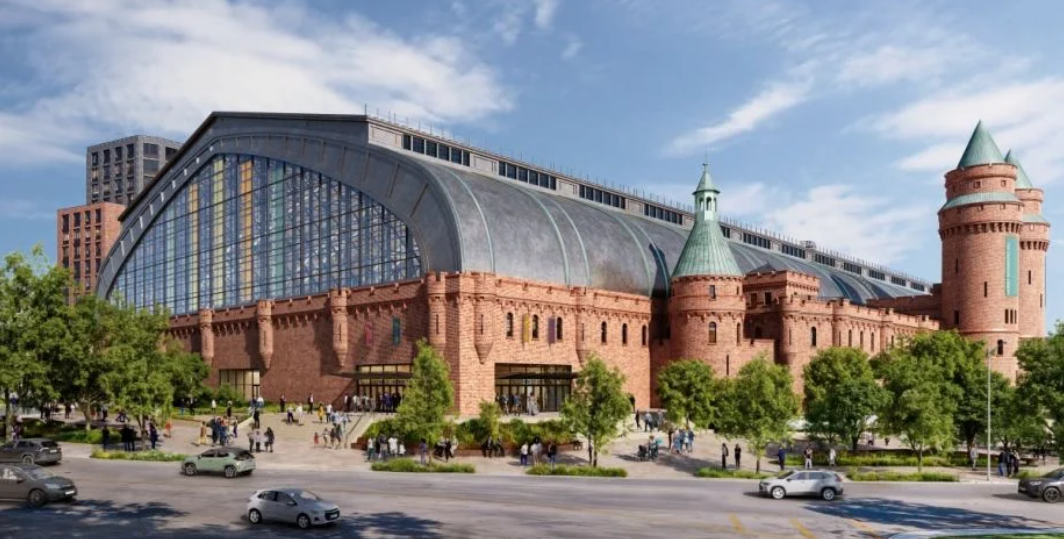
Above photo: A rendering of the redeveloped Kingsbridge Armory. FXCollaborative.
After decades of failed mega-projects, the Kingsbridge Armory is now the site of one of the country’s most ambitious experiments in community ownership and shared control.
Located in the Kingsbridge Heights section of the Bronx, the 570,000 square-foot Kingsbridge Armory was said to be the largest armory in the world when first completed in 1917. Above its columnless, 180,000 square-foot main drill hall, the vaulted ceiling peaks at around 120 feet. Two 140-foot tall headhouse towers flank the main entrance on Kingsbridge Road, giving the building its castle-like appearance. After the National Guard vacated the armory in 1994, the building reverted to city ownership two years later, and has sat mostly vacant ever since.
“Anybody who moved to the area, that building’s been a part of our lives and it’s been empty this whole time,” says Juan Nuñez, whose family moved to the neighborhood in 2001. “Whatever goes into that building can affect the community as a whole, not just the businesses surrounding it, but everyone. We don’t want it to turn into just, like, a Target where they give people these crappy jobs and push out our local businesses.”
Over the last two decades, two city-selected development teams have tried and failed to repurpose the armory, first as a mega-mall and then as a multi-rink ice sports facility.
As an organizer with the 5,000-member Northwest Bronx Community and Clergy Coalition, founded in 1974, Nuñez has spent the last three years leading a grassroots campaign demanding the city turn over ownership of the facility to the surrounding Kingsbridge Heights community itself. The coalition sees community ownership and control over the facility’s ongoing future as the best way, perhaps the only way, to revitalize the Kingsbridge Armory without displacing the existing residents and beloved local businesses nearby.
“We want to make sure that whoever comes next, whatever the city decides, that the city doesn’t decide on their own, make it so the community gets to decide, not just negotiate but actually decide what gets built inside of the building,” Nuñez says. “We want to make sure then this doesn’t become something like the Barclays Center where they build something there that’s just going to push out local businesses, raise local businesses rent and rents all for tenants, too.”
After three years of meetings and negotiations between the community, public officials and developers, Nuñez and the coalition are getting their shot. Backed by more than $200 million in public dollars and the vocal support of their local council member, the Northwest Bronx Community and Clergy Coalition is on track to own more than 20% of the square footage at the renovated Kingsbridge Armory. On top of that, the newly selected developer team has agreed to an array of additional elements giving local residents and businesses an ongoing voice in the tenant mix and programming at the site.
The project may yet fall apart. It may not meet everyone’s current expectations. But Council Member Pierina Ana Sanchez — born and raised in the neighborhood — believes it will be the one that finally elevates community power in economic development to more than pilot projects, picket signs and community benefit agreements.
“If we could do it here in this massive, difficult, complex, horrific monster of a project, you can do it over there in that 200,000 square-foot project,” Sanchez says. “It’s an incredible precedent. … These success stories show what is possible.”
Community power in economic development
Community ownership and control of commercial and mixed-use real estate have been quietly gaining momentum across the country — Kensington Corridor Trust in Philadelphia, The Guild in Atlanta, E.G. Woode in Chicago, East Bay Permanent Real Estate Cooperative in Oakland, Rondo Community Land Trust and Partnership in Property Commercial Land Trust in the Twin Cities, to name just a few.
Some of these examples are cooperatives, whose members include the occupants of the buildings as well as members of the surrounding community and investors. Others, like Kensington, have created perpetual purpose trusts as another form of intentionally structured community control over real estate. And in Denver, as Next City and Proximate recently reported, a community land trust has expanded beyond affordable housing to take control of 4,000 square feet of commercial and community space.
So far, as important as these storefronts and other spaces are to their surrounding communities, they’re mostly on the smaller end of the scale. A few hundred square feet here, maybe a few thousand square feet there. None comes close to the 570,000 square-foot Kingsbridge Armory. There aren’t many projects of that scale, period. Something so large and also something city-owned, which offers a moment to set some new precedents for how public officials and city agencies can act in situations where they’ve historically been all too easily prone to ignore communities and follow the lead of whoever has the deepest pockets.
A community vision for community power
Community organizing helped defeat the first proposal, back in 2009, to turn the Kingsbridge Armory into a mega-mall featuring the standard big corporate tenants like Bed, Bath & Beyond or Old Navy.
The Northwest Bronx Community and Clergy Coalition spearheaded a campaign demanding the city require all future mall tenants to pay employees at least $10/hour, then considered a living wage in New York. After the city-selected developer team refused to agree, City Council voted to deny their proposal.
The ice rink plan, which city council approved in 2013, seemed to come out of nowhere. Fueled in part by celebrity involvement (hall of fame hockey player Mark Messier) in a deal backed by corporate dollars from ice sports equipment manufacturers, it was indicative of a development process that privileged those who had an abundance of money and power but little connection to the community.
“[With the ice rink developers] we were able to negotiate community space and procurement and local hiring,” says Nuñez. “But that really was, I felt like, something that was going to be put there and then ultimately change the neighborhood and who lives there — a kind of gentrifier armory. The folks that are living here now are not going to be going ice skating. They were prepping for those that were coming after. That wasn’t for us.”
The community benefits from the ice rink project never came to fruition. Developers failed to raise the funding necessary for the project to break ground — despite the celebrity backing, millions from corporate donors, a $108 million loan commitment from New York State, and eight years to find the rest of the money. The city, which still had ownership of the property, quietly walked away from the ice rink plan at the end of 2021.
The third time around, things have already unfolded much differently. Before soliciting a new round of proposals from developers for the Kingsbridge Armory, the city spent nine months engaging with thousands of local residents to bring their ideas and vision into a new request for proposals. The community engagement process was c0-chaired by Council Member Sanchez and Sandra Lobo, executive director of the Northwest Bronx Community and Clergy Coalition.
Residents told the city they wanted flexible indoor space for community events and recreation as well as a live performance venue. They wanted affordable retail that complemented existing businesses in the neighborhood. They wanted space for light manufacturing businesses that were already being displaced from the Bronx, businesses that could provide good paying jobs.
But the biggest, most ambitious idea of them all? Residents wanted the city to turn over ownership of the Kingsbridge Armory to the community, allowing neighbors long excluded from major real estate decisions to have ongoing power over what goes on at the site.
“I’ve been to all the meetings they’ve had for a couple years, wrote on ideas, gave ideas, presented ideas, or when I can’t make it to a meeting, I’ll call or email Juan [Nuñez] to ask what happened,” says Tara Carr, a member of the coalition and lifelong resident of the Bronx.
“[Community ownership] is a huge key component, because it lets us know that we have power, we have a say in what happens around us, what happens in our environment. Because we live here, we work [here], we take our children to school here, we take our children to the local businesses here, we develop a relationship with local businesses over the years of living here.”
Creating possibility
For those who grew up nearby, the Kingsbridge Armory has been such a constant yet quiet presence that it can be hard for them to recall their first memory of it.
For Council Member Sanchez, it might have been tagging along after school with her mother to pick up one of her older brothers, who was among the last ROTC trainees who trained at the facility before it was decommissioned. Or it might have been picking up strawberry cheesecake from a bakery across the street from the armory, one of the first places her mother let her walk by herself.
Sanchez first took office as city council member in January 2022. As she started going around to have her first informal one-on-one meetings as a council member, usually over Dominican coffee, everyone told her she was crazy to put the armory at the top of her list of priorities while in office.
“People were like, ‘don’t take that on, it’s going to be a huge failure, it’s going to be impossible, it’s too expensive, it’s too complicated,’” Sanchez says.
But Sanchez knew that, with the city having just walked away from the failed plan to convert the armory into an ice sports facility, she would have a huge opportunity. In New York, as in nearly all cities, the local council member has veto power over zoning and significant land use changes in their district — including and especially when it comes to deciding the future of long-vacant city-owned property, like the Kingsbridge Armory. It was that veto power, pressured by the community organizing, that killed the proposal to turn the armory into a mega-mall back in 2009.
That kind of power has often been a magnet for corruption and political favoritism. Developers often make campaign donations with the implicit, or sometimes explicit, expectation of buying influence over officials whose decisions can boost speculative developers and investors’ profits. Developers also wield access to capital as leverage when seeking zoning or land use changes, pitching their projects as the only way to bring jobs, tax revenue and the kind of ribbon-cutting photo ops that flatter elected officials.
Sanchez wasn’t about to push forward a community-led vision for the Kingsbridge Armory empty-handed. At the same time that she was co-chairing the task force that resulted in a new RFP for the armory, she was working on getting the city and the state to commit $100 million each to the facility’s redevelopment. Her own office committed an additional $12 million in discretionary public funds, and Borough President Vanessa Gibson’s office chipped in with another $2 million.
“Knowing that I would have a shot at having so much leverage during the [land use approval process], I wanted to first make sure that I set it up for success with overlapping elected officials,” Sanchez says. “I said, let’s pull together as much public funding as possible, then we can put the terms around it together and hopefully move it and shepherd it from there.”
Those $214 million in public dollars aren’t nearly enough needed to implement the vision put forth by the community in the RFP process, but the timing was important. They were committed after the community visioning process that led to the new RFP, but before the city had announced which developer team it had picked to implement the vision.
For Sanchez, that meant the city agencies and public officials involved in selecting the developer as well as approving zoning and land use changes for the project would be less prone to sacrificing pieces of the community’s vision for the sake of making sure the project “penciled out” — the phrase developers love to use in reference to a project’s financial feasibility.
Community ownership still ended up as one of those pieces that was constantly on the chopping block, before and after those $214 million in public dollars were committed to the project. According to Sanchez, there was resistance and skepticism all along the way to ensuring some version of community ownership and control would make it into the final redevelopment agreement between the city and the developer. While New York has thousands of housing co-ops and other forms of community-controlled real estate, it just hadn’t been part of a project this large before.
“My philosophy on most things, but especially in this job as a council member, is that possibility doesn’t exist, it is created,” Sanchez says. “We can’t let people tell us what is or what isn’t possible. We have to create what is possible, and we do that through public engagement and conversations and persuasion.”
The first step was ensuring community ownership would be in the final report from the community visioning process. Step two was making sure community ownership made it into the RFP documents from the New York City Economic Development Corporation, which led the RFP process on behalf of the city.
“Step three is when they’ve selected a developer, and conversations are moving forward, it’s saying, hey, [community ownership] was in the report, it was in the RFP, what are you doing to make this a reality?” Sanchez says. “We didn’t really know what it was going to look like from many perspectives in terms of elected officials and community groups. We started with that vision that we wanted the community to have not only a say, but, explicitly, community control.”
Bringing a vision to life
After months of working with the city to develop an RFP for the armory facility, the Northwest Bronx Community and Clergy Coalition submitted its own proposal to the New York Economic Development Corporation, the city’s quasi-public economic development arm.
The agency selected another developer: 8th Regiment Partners, comprising local firms Maddd Equities and Joy Construction. But, shortly after being announced as the winner in January 2025, 8th Regiment Partners reached out to Lobo.
“[They] wanted to partner with us,” Lobo says. “It was important to start that conversation with a bigger framework of the non-negotiables that were really critical to the community.” After being tapped, she said “we gathered with folks and said OK, here was the big, long list of things we wanted…now we need to get a sense of, where is the line in the sand for us?”
Over the next six months, the coalition laid out what they wanted under a potential partnership with the city-selected developer.
Living wages and union jobs were once again part of the community’s vision. That’s now promised as part of a project labor agreement signed between the city and 8th Regiment Partners.
The coalition also wanted the redeveloped armory to adhere to high environmental standards, given the long history of environmental injustice in the Bronx. The building will be all-electric, including the 500 new housing units that will be built next to the historic structure in the project’s second phase. (All 500 units will be low-income restricted between 30-80% area median income, affordable to a large swath of existing Bronx residents.) There are also plans for a rooftop solar array, as well as stormwater retention elements around the exterior of the site.
8th Regiment Partners estimates the completed project will generate $17 million a year in total revenue from concerts and rental income. Under the agreement with Northwest Bronx Community and Clergy Coalition, a percentage of those revenues will flow into an ongoing community benefit fund, governed by a community advisory council, with the intention of supporting community wealth-building and anti-displacement programs in the neighborhood.
And the centerpiece of the agreement: two 99-year commercial condo units owned by the Northwest Bronx Community and Clergy Coalition.
One will become a 25,000 square-foot community hub with space for workforce development programming, worker-owned cooperative development and local business support; the other, a 100,000 square-foot facility with flexible space for at least two light manufacturing businesses that will sublet from the coalition. Together, the two commercial condos comprise around 20% of the total square footage at the Kingsbridge Armory (excluding the new residential buildings to be built later).
In addition, through a community council and a commercial condo association, the community will have a voice when it comes to the tenant mix and programming throughout the rest of the commercial and office space in the facility.
“When we thought about the core components of the community ownership piece within our project, it was the light manufacturing,” says Lobo. She points to Don Carvajal Coffee Roasters and the Point Morris Distillery as examples of successful Bronx businesses that have been pushed out of the Bronx or have been unable to find space to expand. “That really felt like the quintessential challenge to the Bronx. When we have these success stories, they actually can’t remain. They can’t stay.”
Sanchez was pleasantly surprised by the agreement struck between 8th Regiment Partners and the Northwest Bronx Community and Clergy Coalition. She anticipated much more distance between the developer and the community that she might have to help bridge.
There are still plenty of details that will only be worked out after the project moves forward. There’s work to be done codifying the community-ownership and community governance pieces into the ground lease signed between the city and the developers. That agreement must be signed before the developer team can go out and start raising the rest of the estimated $650 million needed for phase one of the Kingsbridge Armory redevelopment — which would cover rehab and renovations on the existing 570,000 square-foot facility.
But community control won’t be an afterthought tacked on to the Kingsbridge Armory redevelopment at the end of all that. As the developer team goes out to seek funding sources to cover the rest of what’s needed, there is actually a small but growing crop of investors who are actually looking for projects that involve some form of it.
“The partnership is definitely the right path to get to where we need for this project to be successful,” says Maddd Equities founder Jorge Madruga, speaking for 8th Regiment Partners. “[The coalition] knows a lot of the stakeholders who already lost space in the Bronx or have a big need for space in the Bronx. We weren’t in touch with those businesses, that’s something the coalition brings that’s special to this. Hopefully those businesses will come in and grow so much they’ll move out of there and then somebody else will come and do the same thing.”
Cooperative investors
John Holdsclaw IV may claim to be an introvert, but he’ll talk your ear off when it comes to historically Black colleges and universities (like his alma mater, N.C. A&T State), community development finance and the power of cooperatives.
For more than two decades, Holdsclaw held various positions with the National Cooperative Bank, a unique commercial bank created by Congress and specializing in lending to cooperatives. He’s currently the board chair of the Cooperative Development Foundation. And he’s the founder of Rochdale Capital, a small, relatively new, nonprofit loan fund. Named for the Rochdale Principles, a set of seven principles internationally recognized by the cooperative movement, the fund specializes in loans to cooperatives and community-owned real estate projects.
One of Rochdale Capital’s early deals was a $500,000 loan to a cooperative of mostly Black immigrant business women in the Twin Cities area who banded together to acquire and revitalize an ailing strip mall. It was one of three lenders on the project, and that’s become Rochdale’s M.O. as a small but scrappy loan fund — joining with multiple lenders from its broader networks as part of a much larger deal. That’s the plan now for the Kingsbridge Armory.
As part of putting its own proposal together for the Kingsbridge Armory, the Northwest Bronx Community and Clergy Coalition sought out investors who might support a community-controlled vision for such a project. Rochdale Capital was one of multiple investors who submitted letters of support as part of the coalition’s proposal materials.
Although that proposal didn’t make it to the finish line, the coalition’s community ownership agreement with the winning developers was enough to keep Holdsclaw interested. Besides putting his own fund’s dollars into the eventual deal, he is also opening up his rolodex to rally a growing community of co-investors to join him. While still a small drop in the ocean of global investors, it’s a network that’s been rallying around a shared interest in supporting community power in economic development, whether it’s through a cooperative or some other kind of alternative community ownership structure like the coalition’s long-term commercial condo arrangement with 8th Regiment Partners.