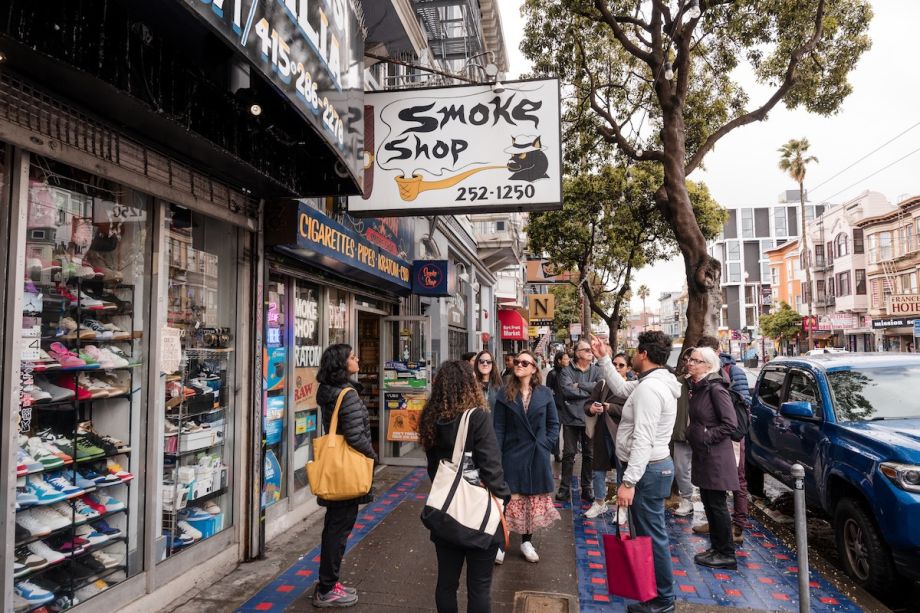
Above photo: Members of the Small Business Anti-Displacement Network on a site visit in San Francisco. SBAN.
The founder of the Small Business Anti-Displacement Network explains why commercial gentrification demands its own playbook of solutions.
Willow Lung doesn’t come from a background in finance or business. She’s a scholar and professor focused on gentrification, social inequality and urban development. But five years ago, near the height of the Covid-19 pandemic, she founded the Small Business Anti- Displacement Network (SBAN) at the University of Maryland, a member-based national network dedicated to helping small businesses survive and thrive as their neighborhoods change. Since then, SBAN has amassed 180 members and counting.
“We have a lot of attention paid to housing issues and gentrifying neighborhoods and affordable housing policies, but we don’t have an equitable amount of attention, resources and policymaking around issues of commercial gentrification,” says Lung, who is also the director of the Urban Equity Collaborative and the director of community development at the National Center for Smart Growth Research and Education.
The network has also brought together community development financial institutions, technical assistance providers, mission-driven organizations, and local and federal agencies to help work toward alleviating the largest threat to small business owners: soaring commercial rents.
Lung’s background helped the network develop a shared language to bring together stakeholders who have been working on this issue in siloes for decades – and to create space for the broader issues of inequality that leave small, immigrant- and minority-owned businesses vulnerable.
“It needs to be about all the ways in which small businesses are disadvantaged, not just in access to capital, but around commercial leases, around ownership, around zoning, and so much more,” Lung tells Next City. This interview has been edited for length and clarity.
Why is it important to address small businesses specifically to effectively combat displacement?
Small businesses are a vital part of the ecosystems of neighborhoods. If one part of that ecosystem is disrupted, then the whole system is disrupted. If small businesses leave a neighborhood, residents are far more likely to leave the neighborhood because those are the places they shop, those are the goods and services that they rely on.
Small businesses set the sense of identity and belonging that marks what that neighborhood is for them. Those are the third places where they go and meet neighbors. Those are the things that they identify as their neighborhood. Similarly…if the resident leaves the neighborhood — that’s the customer, that’s the place someone has shopped for decades, that’s the worker that works in the small businesses.
So all these things matter in terms of the stability and survivability of neighborhoods, and we have to treat each of those aspects of an ecosystem with attention, respect and care. We have tended to give more attention to housing and residents – these are vital parts of the ecosystem, and we have to continue to invest more in affordable housing and residential stability. But we also have to do that for other parts of the ecosystem.
I come out of housing and community development work, and have been doing work on gentrification. So I know that’s where the tension has been. But what I have seen on the ground in communities — and actually what inspired me, in part, to start this network — is that I was writing this book, “The Right to Suburbia,” about combating gentrification on the urban edge and in many of the communities that I was working in, the biggest issues were small businesses being pushed out of the neighborhood.
Yes, affordable housing was a concern, but these were areas that were built as mainly commercial centers. We were adding housing and office space. Those who were most affected by the increasing rents or direct displacement via eminent domain or other means, are the small businesses. So I began to ask the questions of, what are we doing to support these small businesses? And the answers were unsatisfactory to me.
We just don’t treat this in the same way. It doesn’t make any sense to me that we don’t think about these businesses as having a set of rights and as a vital part of our [neighborhood] ecosystem.
SBAN serves as a community of practice for individuals and organizations working on commercial anti-displacement. (Photo courtesy SBAN)
What’s your organization’s model for combating displacement? What does your organization do that other places may not be doing?
A big thing that we do is we build a network. We have about 180 organizations in the network. We really connect the network in order to support the work of folks on the ground. So we consider ourselves the community of practice. We not only build research and resources that support the network, but we also create a lot of venues for cross-sharing of information and problem-solving amongst organizations, like we do in working groups where folks that are working on similar issues, such as community ownership and trying to stand up new models can problem share together.
One person can say: “I’ve done this in Miami. This is what has worked. What are the challenges that are facing Philadelphia?” By building this network of folks that across the nation are facing similar problems, but have different approaches, different constraints, different opportunities, we’ve really been able to build people’s imagination. [We’re expanding] what they see possible in their local environments, but also be able to get support from folks across the nation.
Talk to me about what you all have accomplished. What has been your greatest success?
The biggest success is really garnering attention to this issue and making the language of anti-displacement more mainstream. When we started this network, there was literally no one in the nation that we could point to that was doing this kind of work explicitly. All the organizations that are a part of the network and that have joined us, many don’t [explicitly] do small business anti-displacement work, but they’re a local CDC or technical assistance provider. We are the only organization that really sits at the national space that’s calling attention to these issues.
When we started five years ago, we were like, can we even put anti-displacement in the name of the organization? Is that a thing that people do? And we were looking around the nation for models of other folks that were doing this, and we really weren’t seeing folks that had claimed this space.
One of the biggest things we do is just create the space that people [need] for having the conversation in their local communities on an everyday basis. [They’re] now part of a national organization that is claiming that this is an issue. We’ve signed on to national, state and local legislation, and we’ve seen bills that have been advanced as a result of our network.Having our name and presence there as a national organization that has a strong member base has been an important part of pushing local, state and national policy on the issue, and claiming it as an important issue.
What are the biggest challenges you all have faced in your work?
Some of the biggest challenges are capacity. We’ve grown quickly and we’re still a small organization. We rely on philanthropic dollars for the most part to do our work and so…can we be doing this work five years from now?
We hope that the answer is yes. Obviously now is a challenging time where the core mission of what we do and who we serve is being questioned at a national scale. We are also based in an academic university where the very premise of education and academic freedom is being challenged in ways that we haven’t seen in our lifetime. So there are many challenges in continuing to serve the organizations and the communities and businesses that are struggling the most and hardest hit.
I think it’s also really challenging for people to push policy at this time that really matters. We saw when we started in the post-pandemic moment, it was really a moment of clear attention to small businesses — particularly BIPOC and immigrant-owned small businesses and challenges that they face, for instance, in getting federal dollars.
It was a time where we saw creativity, especially on issues like commercial eviction issues, commercial tenant protections more broadly and more flexible funding going to support small businesses. Now we’re in a time of real constraint and precision on some of those fundamental ideas that small businesses should be supported and that there’s differential levels of vulnerability that need to be acknowledged and supported. There are member organizations that we serve whose very missions are being targeted.
Would you say it’s the consequences of the pandemic that led to the possibility of SBAN?
It wasn’t just Covid-19. It was also that we were in a period of a new civil rights era; there was attention being given to Black and Brown communities and the conditions of inequality in our country that we hadn’t seen quite before.
The organizations that are part of this network and the heart of this work – they’ve always been supporting small businesses to remain in place. We just haven’t really called it anti-displacement.
There’s a bigger conversation that we’re starting to have now about not just small-scale interventions, but larger-scale policy that we hadn’t seen before. Instead of just marketing technical assistance and small grants or low interest loans to businesses, we’re talking about commercial rent control or eviction protection, things that are part of a broader conversation about what small business means to a local economy.
We’re moving beyond the belief that fundamentally small business is seen as a luxury good to real conversations about a holistic framework of what is a good, healthy, strong and sustainable neighborhood. And if small businesses are part of that, then how do we support them in a more holistic manner?
That is what is different. We’re a different kind of frame, and the story that we’re trying to tell about the importance of small businesses as part of healthy ecosystems and part of strong economies is a narrative that’s beginning to catch on in a way that makes it beyond small businesses starting and dying of their own devices.
What is a metric that you use for measuring your anti-displacement success?
It’s people changing policy and practice. Sometimes it’s really hard to track metrics, because people starting a new legacy business program in their organization or deciding that they’re going to buy a building and keep it in community ownership — we don’t always get to hear those good stories of what people have done with the knowledge and networks that they’ve gained. But those are the most obvious things that we can point to and that make a difference.
Part of the joy and the success is members connecting and members telling us how much being a part of this network has mattered, and even [how] being able to claim that they are a member of a national organization that’s focused on this issue has brought attention to this issue in their local communities and in their own organizations.
What guidance would you give to other organizations that are thinking of starting work similar to what you’ve done? Is there any particular resource you would suggest tapping into?
Your best resource is always your members. So if I were to guide another organization and start a national network that’s mission-driven and focused on an issue like anti-displacement, I would say: Get to know your members and be very intentional about how your work is serving adds value to their everyday work that they do on the ground.
When we started, we started with about 100 members that we had reached out to, and we knew almost every member by name. We were just trying to understand what problems they were facing, what challenges and their interests. Our programming today still comes out of member interest.
If you were to start over, what would you do differently, knowing what you know now?
We’ve learned valuable lessons that we’ve implemented further on but I don’t know that we could have started there. My most valuable advice is to consistently learn, check in, evaluate and adapt to the present circumstance.
We couldn’t have anticipated 2025 or 2020, right? We couldn’t have been building for this moment back then. But what we have been able to do is to respond, pivot and sort of strategize with members about how we tackle this moment. So I don’t think I would have done it a lot differently. We had to learn the lessons that we learned in order to be where we are today.
Does SBAN have anything on the horizon that we should be keeping an eye out for?
We are excited about our climate displacement focused case studies happening in 2026. We’re supporting four case studies in doing climate displaced work that are doing amazing climate displacement work that is helping to support small businesses. We’ll be doing site visits in LA and Puerto Rico and inviting SBAN members to apply to come with us. We’ll also be doing a virtual summit around climate displacement in the fall of next year.