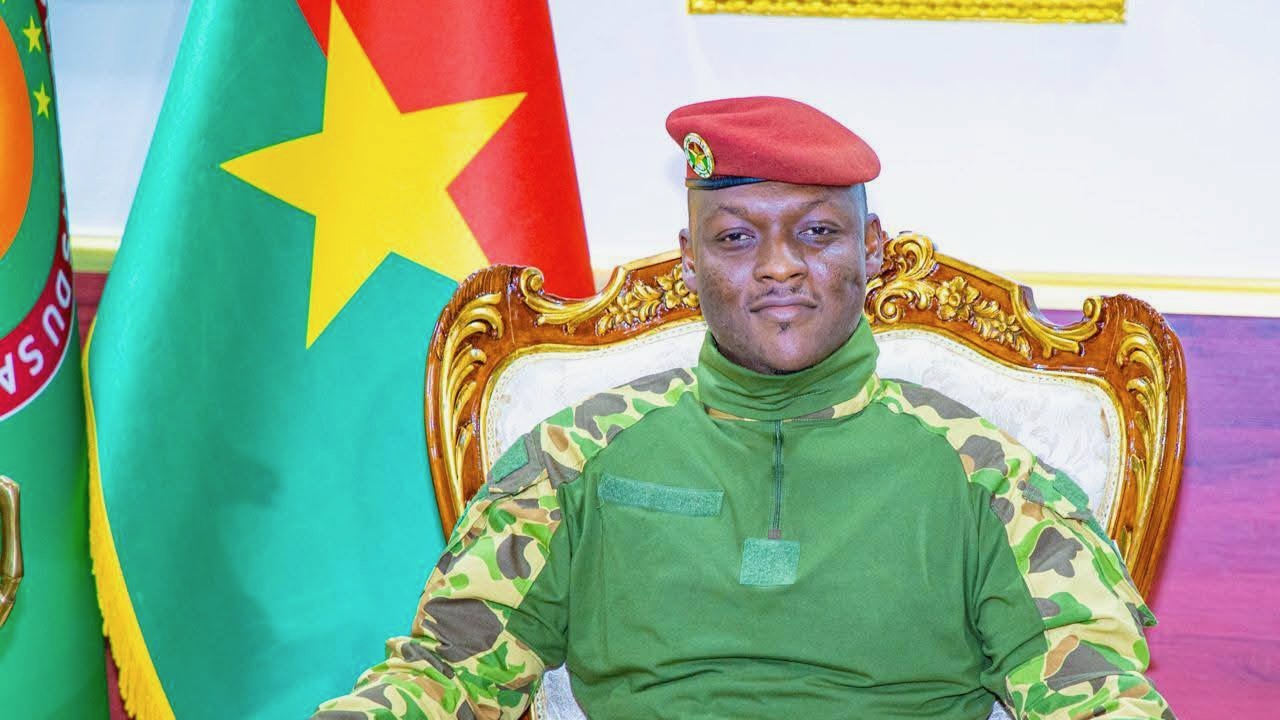
Above photo: Burkina Faso president Ibrahim Traoré. Government of Burkina Faso.
Another break from Françafrique.
The severing of ties to the France-led judicial council, announced on December 15 as part of Burkina Faso’s broader break from Françafrique.
In yet another move away from Françafrique, Burkina Faso’s High Council of the Judiciary (CSM) announced on December 15 its decision to suspend participation in the Francophone Network of Judicial Councils, known by its French acronym, RFCMJ.
Headquartered in Quebec, a French-speaking part of Canada, the organization seeks to “develop common standards” in judiciaries of Francophone countries. Over half of its 23 members are former colonies in Africa.
Burkina Faso’s CSM was one of the five judicial councils in RFCMJ’s current bureau, alongside Guinea, Lebanon, Quebec, and France, which presides over it.
Following the CSM’s first meeting in 2025, its president, Adama Ouédraogo, announced its decision to suspend participation in the RFCMJ, one of the platforms under the umbrella of the International Organization of La Francophonie (OIF).
Denouncing it as “a remote-controlled political instrument” operated from Paris to suit its “geopolitical considerations”, Burkina Faso, along with its partners in the Alliance of Sahel States (namely Mali and Niger) withdrew from OIF. The decision to part ways with the RFCMJ stemmed from this withdrawal from the OIF, Ouédraogo told the CSM members.
In his opening address to their meeting on December 15, Burkina Faso’s president, Ibrahim Traoré, spoke about the ongoing geopolitical shifts, the security challenges posed by terror groups allegedly backed by France, and the sovereigntist reforms underway since the expulsion of French troops.
“Readjusting to all these factors requires considerable selflessness and courage, and you are demonstrating this determination,” Traoré said, reasserting the commitment of his government to safeguarding the independence of the judiciary. Ouédraogo, in turn, reiterated that the judiciary remains “an essential pillar of the Republic and a sine qua non condition for lasting peace.”
Libre Info reported that CSM members in the meeting also deliberated on the centrality of lower courts and the ways to make them more effective. They also examined how customary law and traditional justice can contribute to the judicial system.
While thus focusing on lower courts and rethinking traditional systems of justice delivery on the one hand, Burkina Faso’s judiciary is also undergoing modernization on the other, with a digitization drive underway to improve transparency, accountability, and reach.
Digitization drive
On December 15, while CSM suspended its participation in the RFCMJ, the Ministry of Justice launched three new digital platforms. One of them allows citizens to file cases and track progress online, another to schedule visits to meet relatives in detention, and the third for businesses to obtain online certificates for registration, non-bankruptcy, etc.
“These initiatives aim to digitize administrative procedures, improve the efficiency and accessibility of the judicial system, and respond to strong public demand for greater transparency and efficiency,” said Émile Zerbo, the Minister of Territorial Administration and Mobility.
Earlier on December 12, the Justice Ministry showcased the success of the digitization efforts already underway. In just two years, the platform launched to acquire nationality certificates online had received 49,000 requests as of December 11.
418,000 applications were processed by another platform to facilitate the online procurement of a criminal record extract, a clean certificate of which is needed for professional vetting, visas, holding public office, etc.
Decades of underdevelopment under neocolonial regimes have left the country with poor connectivity and transportation, imposing a toll in time and money on its citizens, who have to travel to the offices of authorities to obtain these essential legal documents. This impediment is further compounded by insecurity in some regions, after NATO’s destruction of Libya spawned terror groups across the Sahel.
Facilitating online access to overcome this impediment, the two platforms have reportedly generated over USD 600,000 for the national budget.