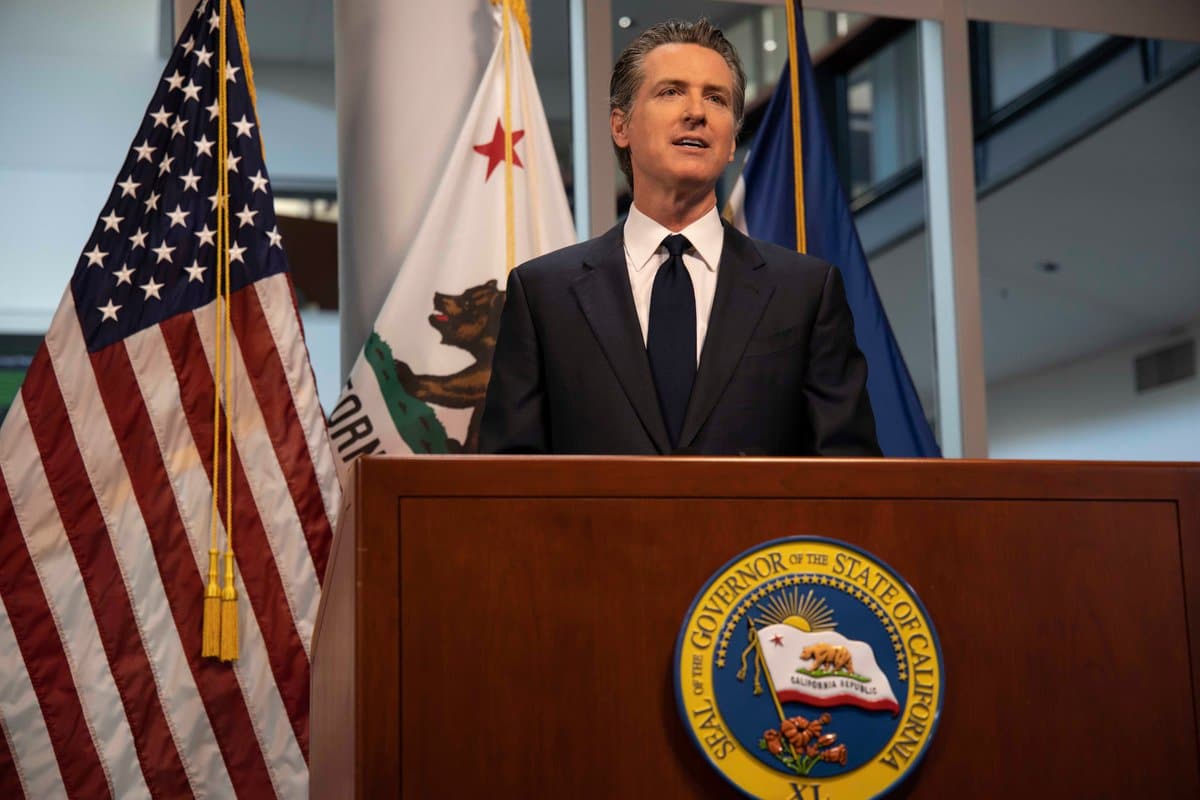
Above photo: California Governor Gavin Newsom. Wikimedia.
But is a direct attack on free speech regarding Palestine.
Proponents claim that California’s AB 715 aims to combat antisemitism by strengthening anti-discrimination laws in public schools, but a closer look reveals it directly targets free speech on Palestine.
It’s not just Washington, DC that has sold out to the Israel lobby. In October of this year, California Governor Gavin Newsom signed Assembly Bill 715 into law, amending California’s education code, despite significant public opposition. The ostensible purpose of the AB 715 amendments is to address the crisis of rising antisemitism by fortifying anti-discrimination law in public schools. A closer look says otherwise.
The bill was rushed through the state legislative process: at the legislative hearing, even its proponents acknowledged that it had been drafted rather hastily and would require “clean-up” legislation down the road to ensure compliance with constitutional requirements.
Most glaringly, AB 715 fails to define antisemitism. This is an astounding omission. How can one prohibit something without defining it? The Supreme Court has been very clear that laws must define key terms to pass constitutional muster. If people do not know what a law forbids, then they cannot conform their conduct to the law in question, and that constitutes a due process violation.
The American-Arab Anti-Discrimination Committee (ADC) is suing California Governor Newsom, Attorney General Bonta, and Superintendent of Public Instruction Thurmond, challenging the constitutionality of AB 715 because it is a direct attack on the free speech and due process rights of California public school teachers and students.
Courts view vague laws that regulate speech (as opposed to conduct) with even greater skepticism because, in that context, it tends to implicate First Amendment concerns. For example, in Reno v. ACLU, the Supreme Court deemed unconstitutionally vague certain provisions of the Communications Decency Act of 1996, which prohibited “obscene or indecent” messages to minors and material that “depicts or describes, in terms patently offensive as measured by contemporary community standards, sexual or excretory activities or organs.” Those terms were not defined in the statute, and a person of ordinary intelligence would not be on notice as to what could subject him or her to punishment, the Court explained.
Unquestionably, AB 715 is primarily aimed at speech, rather than conduct. It mentions as among its concerns antisemitic tropes, conspiracies, stereotypes, coded language, and distortions of Jewish religion, ancestry, history, and identity. Moreover, it also forbids the use of instructional materials that subject students to unlawful discrimination, whatever that means.
But not only does AB 715 entirely neglect to define antisemitism. It creates additional confusion by instructing school districts to follow a 2023 Biden White Paper on combatting antisemitism to identify, prevent, respond to, and counter antisemitism. The White Paper refers to the International Holocaust Remembrance Alliance (IHRA) definition of antisemitism, which conflates anti-Zionist and anti-Israel sentiment with antisemitism. AB 715 advances that conflation by referring to the discomfort students and educators feel on campuses for supporting Israel, and mentions as foundational to its philosophy the recognition of the connection Jewish people have to the land of Israel. Palestinians do not factor into the equation; they are not mentioned even once. Their erasure is not accidental.
The Legislature’s failure to define the key term in its bill was not an error. Rather, it is a cynical attempt to avoid explicitly imposing viewpoint-based restrictions on teachers’ and students’ speech in public schools, which would have hindered passage (as the bill’s proponents learned when earlier versions that expressly equated criticism of Israel with antisemitism led to too much opposition) and led to a greater public outcry.
Yet by requiring school districts to import the Biden White House’s strategy into antidiscrimination law, it has covertly achieved the same end. Teachers, students, and administrators are left with the impression that criticizing Israel and Zionism could land them before a disciplinary board. Rather than take chances, they will avoid these topics altogether, creating what is known as a chilling effect. In fact, two plaintiffs in our lawsuit, Prichett v. Newsom, have already been dragged through the mud for allowing classroom discussion that is critical of Israel. One of the plaintiffs has been investigated twice for a single showing of a video in which a Holocaust survivor states that she is ashamed of Israel. The second time, at the behest of the fanatically pro-Israel parent group StandWithUs, she was censured. Notably, she was initially vindicated, before AB 715 was introduced, and reprimanded the second time, while it was under consideration in the legislature. She believes that the mere introduction of the bill emboldened Zionist groups to go after her and put her school under pressure to appease them.
The pro-Israel and Zionist groups that pushed to get this law passed hope to have their cake and eat it, too: avoid getting the law enjoined for obvious viewpoint discrimination, which is prohibited under the First Amendment, while accomplishing their aim of suppressing pro-Palestine speech on campuses. Of course, there is no analogous provision for pro-Israel speech, so the law’s intent and effect will be to skew debate on the subject of Israel-Palestine in favor of Israel.
When asked about Americans refusing to vote for candidates that take money from the American Israel Public Affairs Committee (AIPAC), Governor Newsom was at a loss for words, claiming that the notorious Israeli lobby does not factor into his decision making. AIPAC, on the other hand, proudly boasts about its close friendship. In passing AB 715, the California legislature and Governor Newsom made it loud and clear: Americans, Californians, teachers, and students all take a backseat to Israel.
The AB 715 amendments have implications that extend far beyond California. Often, the state serves as a test case for the rest of the country: other state legislatures watch and see what happens with its laws. If AB 715 is upheld despite our challenge, that will send a message to other state legislatures that they may enact similar laws and get away with it. Wisconsin is already trying.
Free speech is the most fundamental of American rights. So are the rights of children to receive a well-rounded education free from the influence of political groups, especially those whose primary purpose is to protect a foreign government’s reputation. But these rights are on the chopping block because the Israel lobby is determined to silence those criticizing Israel’s ongoing genocide, ethnic cleansing, and occupation of the Palestinian people.
AB 715 is just one facet of a sweeping attempt to diminish free speech in this country by commandeering state and federal government agencies to twist civil rights law to protect Israel. Despite great opposition by American civil rights groups and unions, Israeli lobby-funded legislators have already forced multiple states to adopt the IHRA definition, and they show no sign of stopping. We must not allow this.