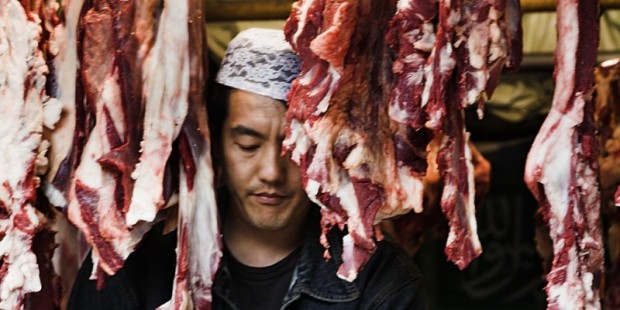
Above Photo: Meat seller at a market in Beijing. Image: Azzazello via Flickr
The Chinese government has issued guidelines to help wean its citizens onto a more vegetarian diet − offering huge potential health gains and cuts in greenhouse gases.
LONDON, 26 June, 2016 – In a bold challenge to individual appetites and societal norms, China says it wants to reduce its citizens’ consumption of meat by 50%.
The country consumes 28% of the world’s meat, including half of its pork, although its per capita consumption is much less than in at least 14 other countries. The average American or Australian eats twice as much meat as the typical Chinese citizen.
The Chinese health ministry has published new dietary guidelines recommending that people should eat from 40g to at most 75g of meat a day, which is close to the level recommended by British health authorities to limit the risk of developing bowel cancer.
The guidelines’ main purpose is to improve public health, but if they achieve their aim they will also give a significant boost to efforts to cut emissions of the greenhouse gases (GHGs) that are stoking climate change and global warming.
Livestock emissions
Worldwide, 14.5% of greenhouse emissions come from the livestock industry, which is more than the contribution from the entire transport sector. Livestock emit the highly-potent greenhouse gas methane, although there have been proposals to tackle the problem by changing the animals’ diets. Land clearing, fertilisers and slurry also release large quantities of GHGs.
The new guidelines could mean carbon dioxide equivalent emissions from China’s livestock industry would fall by 1bn tonnes by 2030, from a projected 1.8bn tonnes in that year.
“Through this kind of lifestyle change, it is expected that the livestock industry will
transform and carbon emissions will be reduced”
Li Junfeng, director general of China’s National Centre on Climate Change Strategy and International Co-operation, says: “Through this kind of lifestyle change, it is expected that the livestock industry will transform and carbon emissions will be reduced.”
Thirty years ago, the average Chinese consumer ate 13kg of meat annually, a figure more than quadrupled by growing wealth to 63kg a year today. That total is expected to rise by a further 30kg by 2030 if the new guidelines fail to achieve their intended effect.
There are concerns that unchecked Chinese meat consumption will also damage the country’s arable land, and will worsen its problems with obesity and diabetes. A study published in 2014 said almost 114 million Chinese adults had diabetes − almost 12% of the population, and more than any other country.
Given the downsides − both personal and planetary − of a heavily carnivorous diet, cutting meat-eating and the damage it entails may seem an obvious choice. But policymakers point to serious obstacles in persuading consumers.
Vested interests
Many people believe their choice of diet is their own business and nothing to do with governments. How far this is a belief they have reached independently and how far it is the product of persuasion by vested interests is debated. That persuasion applies not only to diet but also to tackling climate change.
A report from Chatham House, the UK’s Royal Institute of International Affairs, said in 2014 that China was expected to be eating 20 million more tonnes of meat and dairy products a year by 2020.