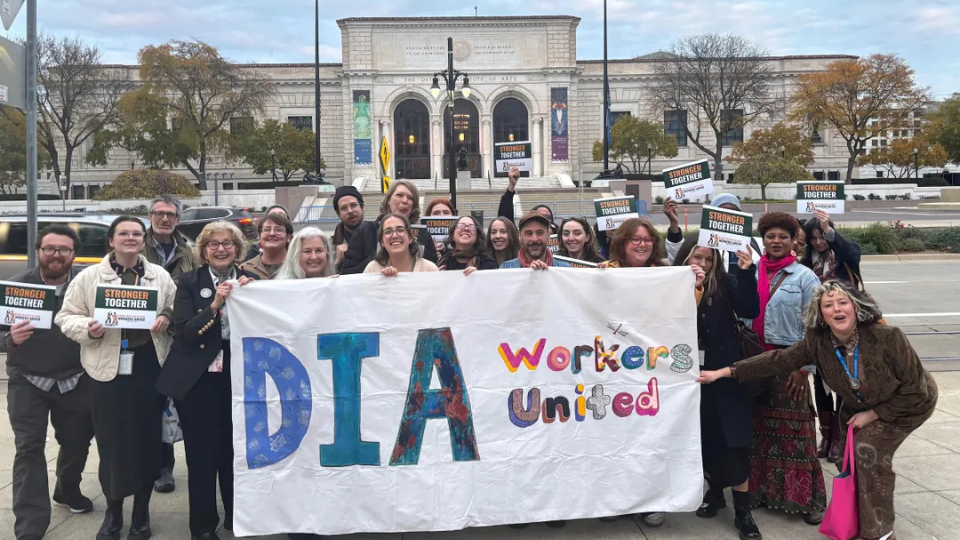
Above photo: Detroit Institute of Arts Workers United (DIAWU) standing outside of the DIA on Tuesday, November 4, 2025. DIAWU and AFSCME.
Shedding light on labor power in the art world.
Detroit – Another beacon has been raised in the art world as the workers of the Detroit Institute of Arts have announced their formation of a union: Detroit Institute of Arts Cultural Workers United. The news comes only a handful of days after workers at the Los Angeles County Museum of Art, or LACMA, announced their union.
Being represented by the Cultural Workers United branch of the American Federation of State, County, and Municipal Employees, or AFSCME, the DIA workers are fighting for better working conditions, better pay, and better management. Detroit and Los Angeles are not the only cities where the art world has organized. The Art Institute of Chicago and the School of the Art Institute of Chicago formed their union in 2022, and the Philadelphia Museum of Art formed a union in August 2020, ratifying a contract in late 2022.
“We have a lot of employees who struggle financially: People who work two jobs, people who are on contract and don’t know when or if that contract will end, and I just want to see all my colleagues thriving,” Sarah Burger, a museum technician who has worked at the DIA for 20 years, tells People’s World.
For workers like Burger, making ends meet is not the only issue, though. Not being heard by the administration has also made a lasting impact on employees.
“There have been surveys, there have been listening sessions, but people were feeling like they were not being heard,” Burger illustrates. “They were not seeing the actions being taken that were needed for them to be able to do their jobs well, and it got to a point where we needed something more solid. We are hoping that this can truly be a partnership with the administration.”
The much-loved DIA opened its doors nearly one hundred years ago and has been the heart of Detroit’s culture ever since. People from all over the globe know of its famous murals and travel thousands of miles to bear witness to the museum’s deserved place in history. Yet, some would argue that, despite the care shown to the art itself, something is lacking behind the scenes.
The idyllic view of the art world is one of excess and indulgence—a place of expression and enjoyment. From the outside, many see themselves as being invited into it or dismiss it as something to which someone else is more deserving. The art itself waivers between high and low, deep and excremental, and consumers are either drawn to it or fear that they won’t “get it.”
There is often a narrative that artists are expected to starve and suffer until they catch the eye of the upper-crust, who will turn their riches into the artist’s disposable income. Knowing when that will happen—let alone how to make that happen—is often too much to bear for many, and so it seems much easier to simply enjoy it.
The museums that display and maintain art, the extravagant shows that celebrate art, and the sharing and enjoyment of art are all sustained by an assemblage of people who ensure we get to see it.
From the people who work the front desk to security to those maintaining the buildings themselves, to the curators who are experts in their field, to editors reading through countless books and texts, to project managers who bring exhibits to life, there are countless behind-the-scenes faces that the art depends on.
“Putting on a beautiful exhibition for visitors is something the staff is able to do again and again, but we’re doing it without support and proper staffing, we’re meeting deadlines but without downtime, all the while being locked into uncompetitive salaries without new opportunities to move up into,” Isabelle Lauerman, an exhibitions project manager at the Institute, tells People’s World.
“We’re all familiar with the normal problems of a workplace where people are overworked, underpaid, and under-appreciated, where something beautiful is built on the backs of its workers,” explains Lauerman. “It is no different in a museum: Leadership disregards the well-being and sustainability of their workforce to bolster productive output. Unchanged wages, the cutting of benefits, and understaffing are deliberate choices leadership has made to save money.”
Unionized DIA workers are feeling hopeful about the changes it may bring to the culture within the famous cultural hub.
“What I hope [unionizing] does is that it creates a sense of unified importance with all the people on the ground–from the curators to the installation folks to visitor services to editors—so we all feel like we are part of this larger art world ecosystem and that our roles are essential,” says Aaron Bogart, an editor with the museum. “I hope it highlights our common interests and shared values, and helps us realize that we need a seat at the decision-making table.”
“I can see all my colleagues are working harder; we have these very difficult timelines, folks are overworked, and, importantly, our pay does not reflect the amount of time that we put into our jobs or the economic facts on the ground,” adds Bogart. “Even in Detroit, where the cost of living is low relative to other places in the U.S., people still struggle. It doesn’t need to be that way.”
The DIA did respond, recognizing the workers’ right to unionize, stating, “On Tuesday, November 4th, the DIA received a letter requesting that it recognize a union seeking to represent groups of employees who are currently unrepresented. The DIA continues to be committed to having a fair, supportive, and inspiring workplace.”
It was then announced on Thursday that the museum would work with the DIA employees through the process of voluntary recognition.