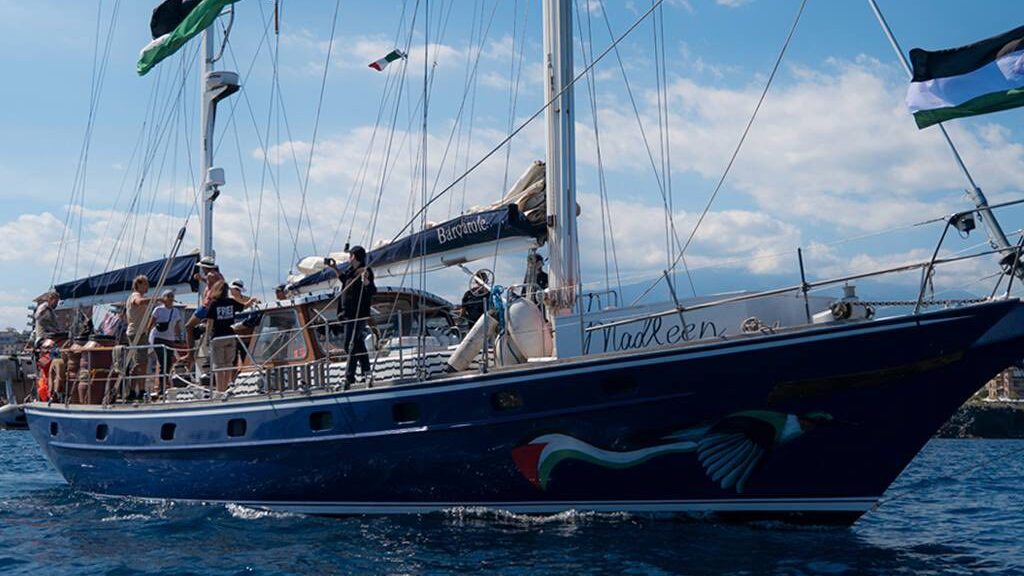
Above photo: Freedom Flotilla’s vessel “Madleen” in 2025. Freedom Flotilla Coalition/Facebook.
Interview with Pharmacist on Board the Global Sumud Flotilla.
Moroccan pharmacist and human rights defender Aziz Rhali explains how he joined the Global Sumud Flotilla to support Palestinian health workers during genocide.
In the coming days, dozens of civilian ships will depart from Tunisia, Spain, and Italy as part of the Global Sumud Flotilla – the largest effort yet to break Israel’s illegal blockade of Gaza. On board will be several health activists from the People’s Health Movement (PHM). Among them is Moroccan pharmacist and human rights defender Aziz Rhali. In this interview, physician Juliette Mattijsen, member of PHM Europe’s coordinating group and researcher on planetary health education, speaks with Rhali about his path in the global health movement and his commitment to supporting Palestinian health workers during the genocide.
Juliette Mattijsen: I am delighted to welcome Aziz Rhali, Moroccan health rights activist, long-time head of the Moroccan Human Rights Association (Association Marocaine des Droits Humains, AMDH), coordinator of the Collective for the Right to Health in Morocco, and member of the People’s Health Movement (PHM). He is joining the Global Sumud Flotilla to Gaza. Could we begin with you telling us a little about your background, particularly as an activist for human rights and the right to health?
Aziz Rhali: I’ve been with the AMDH since 1989, so I’ve been working on human rights issues for a long time. When you live in a country like Morocco, you need to work internationally – and AMDH was among the largest human rights associations in the region, so I joined them. I worked in different sections of AMDH after completing my pharmacy training.
When I returned to Morocco after my studies, I began to take a greater interest in law and health. Human rights are often discussed in very general terms, but I noticed that the right to health was rarely addressed. I started working on this within AMDH and from there, we broadened our focus, moving from the AMDH to the Collective for the Right to Health in Morocco. This collective is also the PHM circle in Morocco: an association of more than fifty organizations working on the right to health, not only in the limited sense treated by the Ministry of Health’s programs, but as it is recognized at the international level.
JM: And what motivated you to become so involved in the Palestinian cause, and most recently to join the Global Sumud Flotilla?
AR: Actually, my commitment goes back further. I was in Iraq during the 2003 war, at Al-Yarmouk Hospital, working as part of a group of Arab doctors. After the US invasion, we went there to support the Iraqis. The same happened during the 2006 war in southern Lebanon, where I worked mainly in Bint Jbeil Hospital.
The problem is that people often focus only on doctors, forgetting the role of other health workers, including pharmacists. In these situations, pharmacists have a lot to do. Many medicines are missing and coming in, and substitutions need to be made. Everyone knows Doctors Without Borders, but there was also an NGO called Pharmacists Without Borders – which was blocked and fought by Big Pharma. You don’t hear much about it anymore, even though pharmacists play a crucial role in humanitarian crises. They can substitute molecules, check labeling, and manage supplies when medicines arrive.
So I was in Bint Jbeil Hospital during the 2006 war and later in Gaza during the 2008–2009 war, working at Al-Shifa Hospital and Al-Awda Hospital. It was mainly humanitarian work, organizing and distributing medicines. I’m familiar with Gaza, it’s not the first time I’ve been there. I’m joining the Global Sumud Flotilla because I’ve worked there before and because, for us in the region, Palestine is a central issue. We’ve been involved in the Palestinian cause since middle and high school. Every year on March 30, Land Day, there are activities everywhere. The Palestinian question is a fundamental issue – it’s something we grow up with.
JM: Since the start of the genocide in Gaza, how have you and your colleagues in Morocco been mobilizing?
AR: In November 2023, I applied for a visa to go to Egypt, but the authorities refused to let us enter to deliver medicines and provide support. Since then, we’ve focused on mobilizing people here in Morocco. There are marches every weekend, demonstrations everywhere in support of the Palestinian cause, especially after the genocide. We are also trying to push international NGOs to join this movement. As a member of the International Federation for Human Rights (FIDH), I was part of issuing a statement in November 2023 condemning the genocide in Gaza – FIDH was among the first organizations to use that term – and since then we’ve been working on how best to respond.
Because the borders between Palestine and Egypt remain closed, our priority has been to mobilize awareness and solidarity. First, to ensure people talk about what is happening in Gaza, and second, to assume our responsibility as human rights defenders. Despite global silence, and as health workers, we have tried to act every day, working with Al-Awda Hospital or with the Palestinian Medical Relief Society (PMRS), which is also close to PHM. Mustafa Barghouti, who co-founded PMRS, was one of the founders of PHM back in 2000 in Bangladesh.
We’ve also been trying to mobilize colleagues to get medical supplies into Gaza, including through Jordan and by supporting the land caravan that groups in the North Africa–Middle East region tried to organize through Libya and Egypt. Unfortunately, that was blocked. After the experiences of the Madleen and Handala flotillas, we became even more aware of the importance of this approach. That’s why we’ve been discussing a broader flotilla with participation from many boats, because the sea is the route still open to try to break the blockade.
This idea also connects with earlier discussions in our region about creating a boat specifically for health personnel. It’s something we are still considering: a ship carrying only healthcare workers and medicines. I think that should be the next step after the Sumud Flotilla. We need more health workers to join this effort, and a dedicated medical flotilla could have a real impact in challenging and ultimately breaking the blockade of Gaza.
JM: This brings us to the next question: what role does health – and health workers – play in the struggle for justice in Palestine?
AR: I think the health situation is paramount. Just a few days days ago, I spoke with a doctor in Gaza who told me about 3,600 Palestinian children with type 1 diabetes who no longer have access to insulin. For a child with type 1 diabetes, insulin is a matter of life or death. Those 3,600 children face a death sentence.
At the same time, healthcare workers themselves have been deliberately targeted by the Israeli forces, precisely because their presence signals the presence of civilians. Why has Al-Awda Hospital been attacked so many times? Because the hospital’s existence in the north means Palestinians remain in that region. The goal is clear: to push Gazans to leave by destroying the healthcare system, and therefore eliminating the medical staff who sustain it.
Healthcare workers are also human rights defenders, because they are the first witnesses to what is happening on the ground. When you walk into a hospital in Palestine, from the injuries you can tell which weapons have been used, and so much more. Their testimony is essential. That is why Israel is trying to empty hospitals of medical personnel, because without them, it is easier to force people from their land.
We must also emphasize the role of Gaza’s healthcare workers, who remain on the front line of resistance. Despite everything, they stay, they work, they do their best to help the population. They need us, and we need them. Just as lawyers are pursuing justice through the courts – the International Court of Justice, the International Criminal Court – our role, as health workers, is to stand with our Palestinian colleagues. We can do that directly, by being on the ground with them. Many doctors have already traveled to Gaza, working in hospitals or providing medicines and medical devices during the genocide. Our solidarity must be shown through presence and action.
JM: You’ve emphasized how Israel is deliberately targeting the healthcare system as part of this genocide, and underlined the importance of solidarity with our colleagues on the ground in whatever ways we can contribute. Let’s return to the flotilla. What hope, and what purpose, does this flotilla carry?
AR: For me, the role of the flotilla is very clear. Around fifty boats will set sail from Spain, Italy, and Tunisia. The plan is to gather in international waters and then head towards Gaza. First, to break the blockade of Gaza. Second, to express our solidarity with the Palestinian people on the ground. And third, to show the world how the Israeli state, a state in quotation marks, treats humanitarians whose only intention is to stand in solidarity with the Palestinian people.
JM: And how can we support you, support the flotilla, to help end the genocide and the blockade?
AR: We need to put pressure on governments. For example, the Hague group, which has worked extensively on this matter, including with PHM support, will issue a statement to the UN in September, calling for an end to the genocide and for recognition of the Palestinian state. This will be an opportunity for us to pressure our governments to support a declaration of the Palestinian state and an end to the genocide. It’s about making noise and spreading the word.
Secondly, we need to prepare a flotilla of medical personnel, bringing medicines and equipment we can gather to take to Gaza. That could mean sailing across the Mediterranean or pressuring Egypt to open the Rafah crossing so we can deliver aid through there.