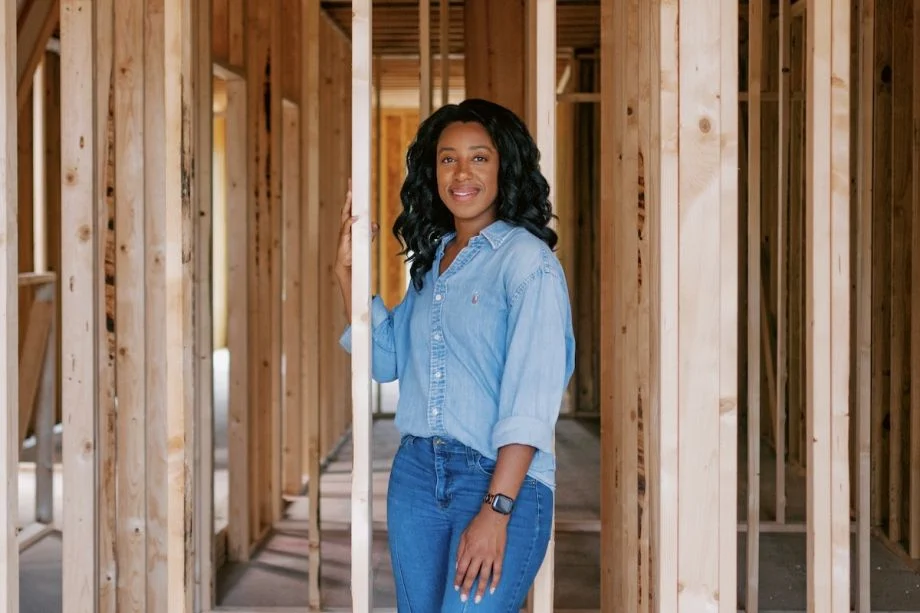
Above photo: Bree Jones is the founder and CEO of Baltimore-based nonprofit Parity Homes. Zara Israel / Parity Homes.
Parity Homes is revitalizing abandoned blocks with a model designed to build Black community wealth.
And address historic harms – before it’s too late.
In cities across the country, revitalization often comes at a cost: longtime residents priced out or forced out of their homes. In West Baltimore, Bree Jones founded Parity Homes to prove that another path is possible.
Like many other housing nonprofits, Parity Homes is revitalizing dilapidated housing and selling them at more affordable rates. Unlike similar initiatives, it is doing so in a neighborhood that hasn’t been overrun by abandonment quite yet. Baltimore has seen one of the country’s highest rates of gentrification, but Jones says West Baltimore hasn’t experienced peak gentrification. That makes it easier to proactively keep neighborhoods affordable and protect people local to those neighborhoods from being displaced.
Founded in 2022, Parity Homes has three guiding principles that shape its work: a focus on a historical lens, protecting and enriching existing residents’ well-being, and offering a pathway to generational wealth for those residents through homeownership. As part of that, Parity’s sister organization, The SOS Fund, is rapidly responding to longtime residents’ financial needs to keep them housed.
In the first installment of our new series, Lessons from the Field, Next City spoke to Jones about Parity Home’s “social approach” to revitalizing neighborhoods and what she’s learned through this work. This interview has been edited for length and clarity.
What issues is Parity Homes trying to address, and how did Parity Homes get started?
Parity was born from the gentrification that I experienced in my hometown growing up in Westchester, New York, and Bronx, New York, and seeing how a lot of those areas became unaffordable and people started to be displaced as those areas started to redevelop and receive investment. I had started my career on Wall Street, so I had this upwardly mobile career ahead of me, but I was feeling connected to what was happening on the ground in my neighborhood.
So I decided to use some of my finance background to try to tackle what I was experiencing in terms of revitalization and gentrification. And so I started Parity with the core question: Can we do development in a way that doesn’t displace people in the process?
Yes, we want healthy neighborhoods, we want walkable neighborhoods, we want amenities, but we don’t want that to [come at the expense] of people who have been in those neighborhoods for decades. That is what brought me to Baltimore, because what I learned along the way is that, unfortunately, once gentrification starts, it is really difficult to stop it. I don’t think you can stop it. You just try to mitigate the harm at that point.
I wanted to be in a city and in neighborhoods that have not yet started to gentrify, but that still had a lot of opportunity for healthy redevelopment. That’s what brought me to Baltimore, which is a city of 15,000 vacant buildings. Part of my thesis is that if you are working in cities where the market has collapsed, à la vacant buildings, the presence of vacants is an indication that the market is not functioning. It’s usually due to redlining and systemic racism and all kinds of structural reasons, particularly in historically Black neighborhoods.
Whether it’s Baltimore, Chicago, St. Louis, Cleveland — there are a lot of cities with hyper-vacancies, I think maybe 6 million across the country. That’s a really interesting opportunity to repurpose those vacant buildings into something positive and productive, instead of traditional private equity that just seeks to flip the houses and make as much money as you can, even if it comes at a human cost.
Tell us about your framework. What sets your organization apart?
We pre-sell all of our homes and that is what makes our work distinct. How do you pre-sell a vacant, dilapidated, collapsed house? We create what we call our collective: people who are supporting each other as they’re going through the mortgage process, navigating the homebuying process, navigating how to be engaged citizens and engaged neighbors together.
We pre-sell all of our homes to our collective, and these are folks who are one and two degrees removed. So we’ve had mother-daughter combos, cousins, best friend purchase homes together. And these are folks who are saying like, ‘Hey, there’s 50 abandoned properties on this block. I could do it by myself and renovate this home and live on this block by myself, but how about we all collectively work to ensure every single vacant building is renovated and occupied?’ By taking that approach, Parity is considered a really innovative model, because for cities that are experiencing hyper vacancy, it’s a tough nut to crack.
By taking this kind of social approach to home ownership into neighborhood building, we’ve found that we actually have very high demand, and we are just trying to scale up our operations to meet that high demand.
What is your metric for ensuring that the work you are doing isn’t adding to the possibility of displacement?
If no one was in that building before then the question is, who are we bringing back to live in that vacant building? How we measure that is that they are reflective of the characteristics of people who would have lived there prior, but for all of the structural reasons that people were pushed out to begin with. For us, the main metric is income, and that’s from a fair housing perspective. We want to be very careful that we’re not going to be targeted by an administration that is saying that you can’t support certain races and things like that, but we are very adamant about addressing historic harms caused in Black neighborhoods and building Black wealth.
Anyone can buy a Parity Home, but our 501(c)(3) mission is to address historic harms. That’s one metric when it comes to rehabilitating the vacant properties and creating a pipeline of people who will be able to purchase those vacant properties, or the renovated versions of the previously vacant properties.
Another metric is thinking about legacy residents who have been there prior. That’s more of an art than a science, because sometimes people self-choose to leave the neighborhood. What we can control is making sure that the people who want to stay have all of the means to do so. What we’ve done is create a sister company called The SOS Fund. They provide wrap-around support to legacy residents who might be experiencing a variety of displacing forces, whether it’s tax sale foreclosure, property rights issues, high water bills or high property taxes. They raise funds from individuals, corporations, philanthropy — and then they redistribute that money to people who are at risk of losing their homes, specifically by paying off their bills.
If you have a $700 unpaid property tax bill because you’re 85 years old and you missed the bill in the mail, an investor can purchase that $700 unpaid debt and then go foreclose on your home. Then the month of foreclosure proceedings starts. It’s no longer just a $700 bill. They’ve now tacked on attorneys’ fees and all kinds of interest expenses, so that $700 debt can become $4,000 almost overnight. [The SOS Fund] will pay that off so that homebuyers can stay in their homes. They essentially act as a defender of people who are at risk.
We measure that by the number of people who want to stay in their homes, that can stay in their homes, and people who receive support in challenging times and neutral times. For example, the SOS Fund also helps people set up wills and estates. So [they’re] helping elders know how they’re going to pass their assets down to the next of kin.
What’s the biggest challenge you all face doing this work?
Even though we have high demand, the high interest rates have destroyed our homebuyers’ purchasing power. For every 1% of interest rate increase, it wipes away about $30,000 of purchasing power. It doesn’t matter how much we discount the houses — we’d have to knock off $100,000 to $250,000 of additional value of the home, just to offset the interest rate issue.
We’re thinking of creative ways to get around that, but it’s challenging. That’s the biggest hurdle, and it’s a bummer, because for a long time, people have said there was just no interest in Baltimore. No one wants to live here. There’s no demand. That’s not true – there is demand. We have hundreds of people who have raised their hands to buy a Parity Home, but because of the interest rates, a lot of the people who otherwise would have bought a home are struggling to move forward.
We went from like 2% to 3% interest rates in Covid-19 to about 7% and 8% in interest rates currently. While they’ve slowed down, they haven’t turned around. Until we’re at 5% or 6%, it’s going to be a big challenge for our homebuyers.
Parity Homes has so far purchased and completed redevelopment of seven West Baltimore homes. (Photo courtesy Parity Homes)
The work of renovating vacant buildings and selling them is probably the most difficult type of development you could do. I know every developer probably feels that way, but it really is. You have every single barrier against you when you’re trying to do vacant buildings, because for a traditional developer, you just need to buy that one parcel. You need to raise the money and do the lawyering and get the architectural drawings, but you just buy that one parcel and you can build 200 units of multifamily housing.
Now, if I wanted to build 200 homes, I’d have to purchase 200 distinct parcels, which are owned by 200 distinct owners. With vacant buildings, many of those owners are deceased. No one’s been paying their property tax debt, which means in some cases, there’s over $100,000 of unpaid property tax, there’s water bills, there’s liens, there’s interest. To purchase that parcel, I’d have to clear $100,000 worth of debts, even though the land itself might be worth $2,000. And then, for me to not have to pay the whole $100,000 but just a portion by petitioning the courts on some of it, that court process can take two to three years. And then to raise the capital to be able to not only run your operations, but sit on properties for two or three years as you’re assembling the whole block of 50 or multiple blocks of 50 each — it requires so many moving parts to be in place all at once.
It’s just incredibly difficult. And then the sales side, making sure that the buyers are ready but dealing with the interest rate environment and the construction side simultaneously. How do you renovate a collapsed or partially collapsed building? How do you get insurance on a partially collapsed building? It’s a lot, but that’s where the wins are, too.
Tell us about your wins. What have you accomplished, and what has been your greatest success so far?
We’ve now completed seven homes. We got our first big grant in 2022. That’s what allowed me to purchase the buildings and to hire a team. We’re a young team, but in two and a half years, we have built seven homes. We have 20 under active development, so we’re growing quickly.
Right now we’re focusing on putting gas in the tank by raising capital. I just closed on a $1 million 1% interest loan, which is really transformational. It took us a year to close that, and now I’m working on another capital raise for $5 million, and that’ll take another year as well.
Do you have any advice or resources for people starting to do similar work?
If you’re focused on vacancy in your housing model I would check out the Center for Community Progress. They are the subject matter experts nationally when it comes to figuring out how to tackle vacant buildings. If you’re interested in home ownership, shared equity structures and creative financing to support homeowners or homeownership, I would look into the Grounded Solutions Network.
I will share one hack that I used early on, before I had raised capital, when everything was still just an idea. I didn’t have a single building. I didn’t have any money, and I didn’t have any architectural drawings. I went on to Craigslist and found a graphic artist who could do architectural renderings. I sent him a picture of the block — the vacant, dilapidated block that I was daydreaming of — like, man, if we could just buy every building on this block and renovate it, it would be beautiful.
I sent him that picture from my cell phone, and he created a digital rendering of all the buildings that were boarded up and partially collapsed. He built a rendering of the houses finished, renovated, people walking on the street, and street trees planted. That picture cost me $100.
I took that $100 rendering from Craigslist and I showed it to anyone who would look or listen. That’s how we got the wind in our sails and we got people to say. ‘Yeah, I would buy a home there. I would live on that block.’ Then we showed it to investors, and that’s how we eventually got funded.
If you were to start over, is there something you would do differently, knowing what you know now?
I’m a solo founder, and I had never done development before. Everything was new to me. Everything was really hard. I’ve known a few co-founders who crashed and burned, but I’ve also known a lot of co-founders who wouldn’t have been able to do it without one another.
Entrepreneurship is the most difficult thing you’ll ever do, and to do it alone is really hard and scary. It was probably the lowest point in my life, in terms of mental and physical health. If I had had someone alongside me in the trenches, I think I might have fared a lot better. Maybe the business would have grown quicker than it did.
But I’m still here, and it still worked, and everything is okay. If I were to do things differently, I would have made sure to hire a chief of staff first, instead of letting it be my 10th hire.
This Q&A is part of Lessons from the Field, Next City’s new series of interviews with anti-displacement practitioners across the country. Each conversation features practical insights and hard-earned wisdom from urban leaders who have built innovative, locally-rooted strategies to keep residents in place.