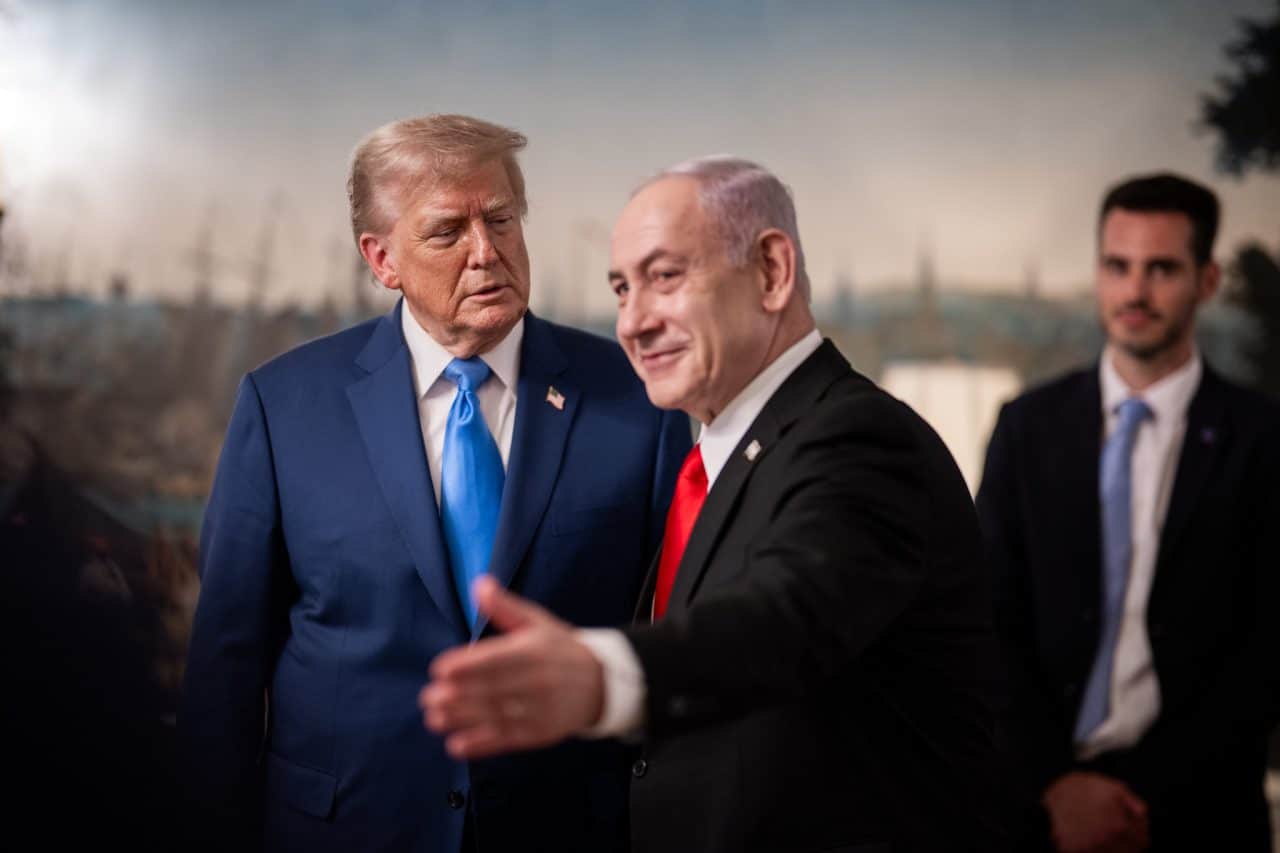
Above photo: President Donald Trump and Israeli Prime Minister Benjamin Netanyahu speak in the Diplomatic Reception Room before a dinner, Monday, July 7, 2025, at the White House. Official White House Photo by Daniel Torok.
As pressure builds to end the Gaza genocide
As Donald Trump touts his “21-Point Plan” to end the war in Gaza, Benjamin Netanyahu aims to convince the White House to support the ongoing genocide and possible Israeli annexation of the West Bank. Can he persuade Trump?
“This is my most important meeting,” U.S. President Donald Trump said on Tuesday.
He was not referring to his long, rambling, and incoherent address to the United Nations, but to the meeting he later held with Arab and Muslim leaders from around the world at which he presented what he is calling his “21-Point Plan” for ending the Israeli onslaught on Gaza.
Leaders from Qatar, Saudi Arabia, Indonesia, Türkiye, Pakistan, Egypt, the United Arab Emirates, and Jordan attended. The idea was to get buy-in from all these countries before Trump meets with Israeli Prime Minister Benjamin Netanyahu on Monday.
There is no indication that any meeting with any Palestinian group or leader is part of this process.
The countries Trump met with seemed to like the plan. Everyone described the meeting as productive and positive, with one anonymous Arab official telling Axios that, “For the first time we felt there was a serious plan on the table. President Trump wants this chapter to be over so that we can move forward to better things in the region.”
That statement reflects more than appeasing Trump; it indicates that the Arab states involved believe this plan could work and are willing to cooperate to make it happen.
While the Trump plan has not been revealed publicly, key points and core conditions that the Arab and Muslim states demanded have been shared.
The principles that have been publicized are:
- The release of all remaining hostages.
- A permanent ceasefire.
- Gradual Israeli withdrawal from all of the Gaza Strip.
- A post-war plan that includes a governing mechanism in Gaza without Hamas.
- A security force that would include Palestinians but also soldiers from Arab and Muslim countries.
- Funding from Arab and Muslim countries for the new administration in Gaza and for the reconstruction of the enclave.
- Some involvement of the Palestinian Authority.
There is also reporting that suggests this plan shares many features with plans put forth recently by Tony Blair and by the international conference earlier this month, the latter of which has been backed by the UN General Assembly.
In response, the Arab and Muslim states presented the following conditions, which seem to have been acceptable to the Americans:
- Israel will not annex parts of the West Bank or Gaza.
- Israel will not occupy parts of Gaza.
- Israel will not build settlements in Gaza.
- Israel will stop undermining the status quo at the Al-Aqsa Mosque.
- Humanitarian aid to Gaza will immediately increase.
Trump appears to have agreed to these, which would seem to reinforce the Arab countries’ buy-in, although, of course, their stance would likely be different if the Palestinians reject it. But this growing international consensus is finally seeming to place Israel under pressure to end its genocide and perhaps abandon plans to formally annex the West Bank. With Trump at the head of that group, Netanyahu cannot afford to simply ignore it or outright reject it. So, as Trump and Benjamin Netanyahu prepare to meet at the White House on Monday, the Israeli leader might be facing one of his largest political challenges yet with the U.S. since the genocide began two years ago.
Palestinian response
Palestinian Authority President Mahmoud Abbas agreed to cooperate with the plan, after he had already condemned Hamas for October 7 and pledged that Hamas would have no role in a Gaza that the PA governed.
While Abbas has lost virtually all the legitimacy he once had among Palestinians, he remains the head of the PLO, which is still the only body globally recognized as representing the Palestinian people. His endorsement, though given by a man who long ago lost his popular mandate and so can’t be said to necessarily reflect the will of the Palestinian people, does give other Arab states sufficient cover to move forward with Trump’s plan, if they remain committed to it.
Yet while Abbas’s agreement to these ideas might provide the needed cover, on the ground, it will be much more difficult to implement this plan without Hamas and other militant factions in Gaza agreeing to it. Indeed, Hamas announced its rejection1 of the plan on Thursday, which could very well throw the entire idea into the dustbin.
While Hamas is certainly being genuine in their objection to plans that are not decided by the Palestinian people, they also know that the people of Gaza desperately want the genocide to end. Thus, they could be enticed to agree to some plan to do that, especially ones like the Blair and UN plans, which are rooted in a transition to independent, or at least autonomous, Palestinian governance.
The immediate issue for Hamas, apart from these broader questions, is the “gradual withdrawal of Israeli troops.” Abbas may agree to that, but Hamas has a great deal of influence on how that plays out. They are likely to insist on, at the very least, a clear timetable for the replacement of Israeli forces with multi-national ones.
Israel, by contrast, would be able to work very well with a “gradual” withdrawal, especially one that is implied to take place after all the remaining Israeli hostages, living or dead, are released. Graduality, in Israeli terms, can stretch out for many years. Hamas must be concerned about that.
While the Americans and many of the Arab and Muslim leaders who attended that meeting might hold Hamas in contempt, the group is quite capable of continuing to launch guerrilla attacks and thereby aborting this plan before it even starts. Third-party countries are not going to send their troops into a combat zone in Gaza as anything but peacekeepers. Their role in any of these plans is nullified if they are expected to take Israel’s place as an occupying, even an invading, force.
Indeed, according to at least one report, the force Trump is proposing was specifically referred to as “a peacekeeping force,” indicating that they anticipate only small-scale confrontations at most.
So, the U.S. might want to ignore Hamas and satisfy itself with Abbas’ pledge that the Islamist group would not be part of governing a post-genocide Gaza, but Hamas still has a say regarding events in Gaza. Trying to broker an agreement they are not party to is unlikely to succeed.
Israel’s balancing act
Israeli Prime Minister Benjamin Netanyahu has been keeping his cards close to his chest ahead of his meeting with Trump at the White House on Monday. His silence about these proposals is a strong indication that he believes Trump is very serious this time about closing a deal. That doesn’t change his opposition to a ceasefire, nor does it make him care one whit about the remaining Israeli hostages. But it does mean he will need to tread very carefully in Washington this time.
One Israeli official told Axios, “There will be bitter pills we’ll have to swallow.” That refers to the involvement of the PA in some, unspecified way in a post-genocide Gaza, as well as other points.
Netanyahu has been adamant in his opposition to PA involvement in Gaza. But it’s not really that big a problem for Israel; Abbas has been a pliant, not to say a quisling, actor, and for all his bombastic ranting, Netanyahu knows this. But it gives Netanyahu a way to pretend he is making a difficult sacrifice to please Trump, and those in Israel who are pressing him to end the Gaza slaughter.
Still, it’s a good bet that Netanyahu will start with that objection, knowing that if Trump gives in to it, the Arab and Muslim states will have a much harder time cooperating. If that fails, he will find another way to set conditions to scuttle the deal, while appearing to accept it, swallowing the “bitter pills.”
The most likely path there will be to insist that Israeli troops not withdraw until Hamas has been disarmed or has surrendered. He will try to find a way to get Trump to accept this, and, given the ease with which Trump is regularly manipulated by other leaders, he might succeed.
But Netanyahu will have to tread carefully. He can’t afford to say “no” to Trump outright unless it sounds like “yes.” Trump demonstrated again this week that weighty world affairs can turn on his feeling neglected by those he thinks he has a “relationship” with when he completely reversed himself on Russia and Ukraine. By way of explanation, he noted that the relationship with Vladimir Putin was a disappointment to him, personalizing the matter, as he so often does.
The goal in Gaza for Netanyahu at his meeting with Trump will be to continue the genocide without rejecting Trump’s plan to end it. The “gradual Israeli withdrawal” is likely the way he will do that, proposing a phased withdrawal that will start after the Gaza City operation is completed and will then depend on Palestinian “quiet,” i.e., no attacks on the redeploying soldiers.
That’s a condition that is easily broken, whether by provoking a response to some action by Israeli soldiers or fighting with the various mercenaries or Palestinian gangs in Israel’s employ in Gaza. Even without such a disruption, Israel can always slow walk the redeployment.
Netanyahu will also confront the issue of annexation of the West Bank, which Trump has said he “would not allow.” This is a political danger to Netanyahu, not so much a material one on the ground. Trump has given no indication that he would limit Israel’s settlement expansion, press for a halt in Israel’s plan to finally build its long-anticipated settlement in the E-1 Corridor, or take any other action that would limit Israeli expansion on the West Bank.
Netanyahu will need to ensure that he can take the steps he needs to take to appease his far-right ministers, Bezalel Smotrich and Itamar Ben-Gvir. Again, he will not be able to ignore Trump if Trump says, “Do not annex the West Bank.”
But annexation is, at this point, more of a formality than anything else. Israel has control over the entire West Bank. It has destroyed more Palestinian villages and placed many others, as well as the cities, under a tightened occupation.
De facto annexation of the West Bank has been ongoing since the 1967 war. That Israel does not declare sovereignty over it is a diplomatic nicety and a way to avoid sticky questions like denying Palestinians within Israel’s declared sovereign territory their right to vote and other civil rights.
If Netanyahu is seen as caving to Trump on annexation now, he will be attacked from his right. But Smotrich, for all his ideological ranting, knows how this game is played. If Netanyahu can get a promise from Trump not to interfere with more settlement expansion and continuing Israeli aggression on the West Bank, and perhaps some other measures to herd Palestinians there into ever smaller enclaves, Smotrich and Ben-Gvir might simply say a few nasty words about Netanyahu and end it there.
The Arab and Muslim leaders who met with Trump this week have learned the tricks of flattery and appeasement of this childlike president. But Netanyahu knows better than anyone how to do that. His meeting on Monday is probably the most consequential one he’s had with Trump to date.
Netanyahu might return to Israel having lost a lot if he does not play this meeting correctly. But he may also come back with all he needs to extend the genocide in Gaza and continue his relentless march to crush the Palestinians in the West Bank.
Notes:
- Hamas later was reported to have reversed their position and accepted the Trump plan in principle. This was then contradicted by Hamas’ own statements saying that they had not even received a full proposed plan. ↩︎