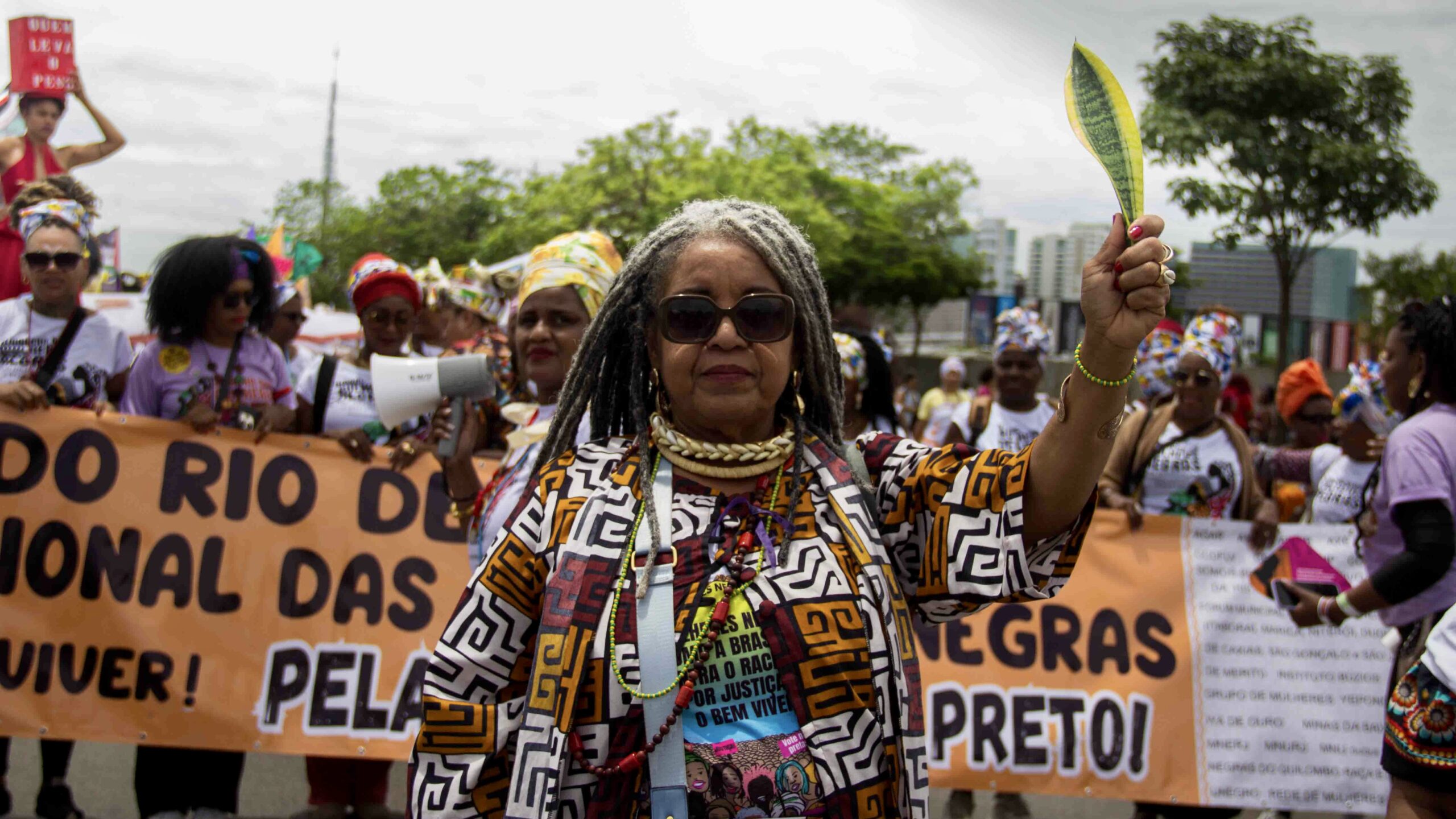
Above photo: 300,000 marched in Brasília on November 25 in the Black Women’s March. Gabi Barraza / @gabitabza.
For Reparations And An End To Racism.
Over 300,000 women marched in Brasília on November 25 and launched a manifesto denouncing colonialism and demanding reparatory policies
After ten years, Brasília once again became the center of Black women’s struggle. On Tuesday, November 25, according to organizers’ estimates, more than 300,000 people filled the Esplanade of Ministries for the 2nd National Black Women’s March, a decade after the historic 2015 mobilization, this time under the slogan “for reparations and good living.”
From all over the country and from more than 40 nations, Black women began to arrive in the federal capital last week for one of the most important political mobilizations of the decade. This new edition of the National Black Women’s March brought not only the symbolic weight of memory, but also the affirmation that the historical moment calls for more protagonism, more confrontation of institutional racism, more public policies, and more spaces in power for those who sustain the country and continue to be most affected by inequalities.
The march’s gathering began at 8 am at the National Museum, followed at 9 am by a formal session in Congress honoring the role of Black women in Brazilian democracy. On the Esplanade, the atmosphere was one of reunion, celebration, and also a call to struggle.
Steps That Come From Afar
“All of this is the result of the work of those who came before us,” stated historic activist Iêda Leal of the Unified Black Movement (MNU), emphasizing that the day’s achievements are the fruit of more than five hundred years of resistance. For her, the march is a direct message to the country: “We will occupy all spaces, from neighborhood associations to the presidency of the Republic.”
Leal’s speech captures the spirit of the gathering: this is a march of continuity, not a restart. She recalls that the movement wasn’t born in 2015, but is the heir of generations who fought even without recognition. “We have already suffered too much. Today, the march is for good living, and it’s good living for everyone, because we don’t have any kind of selfishness,” she affirmed.
Representing the Luba Bakwa Luntu Kingdom in southern Democratic Republic of Congo, Queen Diambi Kabatusuila highlighted to Brasil de Fato DF the historical and international dimension of the Black Women’s March, stating that violence is not a reality isolated to Brazil, but a phenomenon that crosses territories and centuries. According to her, “there is no justice for Black women in the world, not only in Brazil, it’s in Africa too, this struggle is not only for Brazil.”
She reinforced that the mobilization of Brazilian Black women inspires and echoes beyond the country’s borders. “Brazil is showing that it is a model of resistance, a model of strength, a model of Black women’s unity, to show the strength, the capacity to unite, to gather a very great power in this country,” she added.
For her, the movement is also an affirmation of identity and ancestry: “as I am representing the strength of our past, our culture, our heritage, to show that we are resistance.”
Reparations And Good Living
The March is organized around a political project for society: good living. Inspired by Latin American and Afro-diasporic conceptions, the concept advocates for a communitarian society that prioritizes care, dignity, respect, sovereignty, and collective policies that guarantee basic rights.
Rosilene Costa, from the Autonomous Mothers Movement of the Federal District (Mama-DF), emphasized that this march takes place at a political moment laden with memory and recent pain: “We suffered a coup [in 2016] that affected people’s lives in an unparalleled way, we had many deaths during this period [since the pandemic], many families were torn apart.”
For Costa, the march also symbolizes historical recovery. “But we won, and when I say we won, Black women won. Black women raised up democracy again, they raised a new march, and now we march for reparations and good living.”
She further stated that reparations is not an abstract concept: “Reparations are in the woman’s right to have daycare, in the child’s right to have a playground, in the right to live in a good city.”
Black Women For Climate
The socio-environmental agenda was also highlighted this year. “The climate crisis is effectively a Black women’s issue, because the majority who suffer the consequences are disadvantaged Black communities and especially women,” stated Zézé Pacheco, from the Black Voices for Climate coalition in Bahia.
Pacheco argued that it’s not enough to recognize the impact; it’s necessary to change who makes decisions. “We are in few decision-making spaces. We need to invert this logic, this development model toward a perspective of good living.”
She also emphasized that the environmental debate cannot continue being led by those who will never feel the weight of floods, droughts, disasters, and forced displacement. “Involving women in the discussion and ensuring funding for things to happen is a basic condition of environmental justice.”
Plurality Of Voices
Another striking element of the march was the plurality of agendas and demands. Among the participants were quilombola women, mothers of victims of state violence, rural women, teachers, union members, artists, intellectuals, students, and also Black LGBTQ+ women.
Self-identified travesti Maya Alves Rodrigues, from the Black Women’s Forum of Maré in Rio de Janeiro, recalled that the movement has always had many voices, even when the country tried to erase them. “It’s an opportunity for us to rewrite this story together, making a future much more possible for us in the present,” she said.
Rodrigues emphasized that the presence of Black trans women and travestis is not a late addition to the movement, but a fundamental part of a broader struggle against the political, economic, social, and also moral violence that has structured the country for centuries.
Democracy
The march also directly addressed contemporary political disputes. Legislators present reinforced that, despite advances, Black women continue to be the most affected by hunger, unemployment, precarious work conditions, and the absence of public policies.
For Pernambuco state representative from the Workers’ Party Rosa Amorim, there’s no way to speak of democracy without budget and political decisions aimed at confronting structural inequalities. “Brazil has the face of the Black woman, but unfortunately to this day we are the ones who suffer the most from hunger, who lack food sovereignty policies, and who hold the worst jobs,” she stated.
To Brasil de Fato DF reporters, the legislator added: “If we truly want to deepen our democracy, we need Black women to be at the center of political decision-making.”
Continuation Of The Struggle
Luyara Franco, executive director of the Marielle Franco Institute, said that the event reaffirms that Black women’s struggle is permanent and insurgent. “Marching today alongside thousands of Black women is affirming that they will not accept silencing our voice or erasing our history. This March is about reparation, about good living, and about the certainty that we continue transforming my mother’s memory into movement, into politics, and into future,” she affirmed.
The executive director of Amnesty International Brazil, Jurema Werneck, made a point of remembering that the march also takes place on the International Day for the Elimination of Violence Against Women, which gives another dimension to the event. “Racism brings in its wake much violence. Femicide, police violence, street violence – all of this primarily affects Black women and Black communities.”
Werneck also highlighted that this march is yet another organized response to a reactionary wave advancing in the world. “This is the time to say once again: enough. It’s the time to say once again that things must be done differently for the end of violence and with reparations.”
This article by Brunna Ramos and Flavia Quirino was first published in Portuguese at Brasil de Fato.