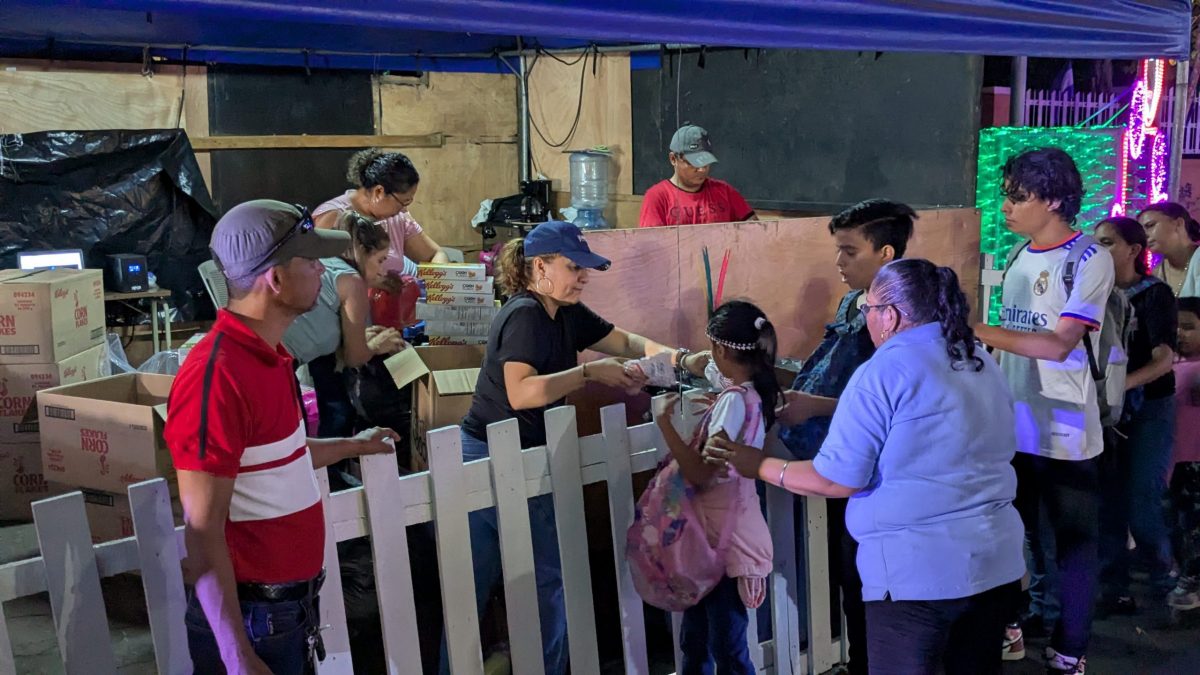
Above photo: 2025 Purisima altar Managua Ministry of Promotion of Commerce and Industry. Sarah Junkin Woodard.
When 25-year-old Dayana Martinez graduated from university earlier this year and began applying for jobs in her field of graphic design, she made a promise to the Virgin Mary. For Martinez, who had been running her own printing business from home all through college, the chance to earn a steady salary and have health care and retirement benefits was important.
“If I get a job, I will give toys to children in December.”
Martínez got the job she applied for and has been setting aside a portion of her salary since to fulfill her promise to the Blessed Virgin. She has purchased toys for 50 boys and 50 girls, and will give them to children in a rural village. For Martinez, giving to others is a natural way to show gratitude. Growing up, she often accompanied her mother, who owns a café, in handing out plates of food in December to people who wash windshields at stoplights.
Martínez’ family isn’t the only one in Nicaragua with this tradition. Starting on 30 November when legally-mandated Christmas bonuses – equivalent to one month’s salary – are paid, Nicaraguans from all walks of life share their bounty in their communities.
This culture of giving back is inspired by celebrations of the biggest holiday of the year in Nicaragua, Purisima, the Feast of the Immaculate Conception of Mary.
Purísima is a Catholic holiday, but over the past decade, Catholicism has plummeted in Nicaragua. Recent polls show that only 28.3% of Nicaraguans today identify as Catholics, as opposed to 94% in the mid-90s and 48.9% in 2017.
Today there is a rift between the Catholic hierarchy in Nicaragua and its abandoned base. This rupture started with the U.S.-led coup attempt in 2018, when violent criminals held the country hostage for months through thousands of road blocks. In addition to crippling the country’s economy and causing the loss of thousands of jobs, these roadblocks were centers of terrible violence where Sandinista supporters were beaten, raped, tortured and murdered with priests watching and sometimes participating in the horrifying violence. There is video evidence of priests storing weapons in churches, beating people, dousing people in gasoline, and directing gangs to disappear bodies.
Many of bishops, priests, seminarians and lay people associated with the Church were later convicted of treason, money laundering and other crimes. They, as well as a priest convicted of raping a 12 year old girl and another convicted of beating his girlfriend were released into the custody of the Vatican in late 2023 and early 2024, at the request of Pope Francis. The Nicaraguan people, however, had seen what the priests did with their own eyes, and have been less forgiving than the Holy See. Unsurprisingly, many parishioners have since turned away from the Catholic Church.
They are not, however, necessarily turning away from tradition and belief. Of those that have left Catholicism recently, polls show that about half turned to Protestant churches (38.3% of Nicaraguans are now Protestants), while the other half now identify as “believers with no denomination,” a category held by 33.3% of Nicaraguans today.
In fact, many young people like Martínez are picking up and carrying on Catholic cultural traditions, even while eschewing the Church. Purísima is the largest of these traditions
The Blessed Virgin of the Immaculate Conception became the de facto patron of the country during Spanish colonization. According to Luis Morales, the Co-Secretary of Creative Economy, her image was first brought to the country by the captain of a Spanish fleet, Pedro Cepeda, who fell ill in route and stopped for several days in the port of El Realejo in Chinandega. Cepeda carried the image of the Immaculate Virgin in his luggage, and it was brought out of the ship’s hold while they were anchored to avoid damage. When Cepeda had recovered his health, he set sail once again, but was turned back by a storm.
“Three times he left with the intention of continuing his journey, and three times a storm turned him back, until Cepeda decided that the image of the Virgin wanted to stay in Nicaragua,” recounts Morales.
Another popular legend tells of an image of the Blessed Virgin of the Immaculate Concepcion at her namesake fort near Nicaragua’s southern border on the San Juan River. During an attack on the fort by English pirates, the image of the blessed virgin was taken out of the fort’s chapel, put into a wooden box and thrown into the river to protect it.
Instead of floating downriver as it would naturally have done, the box reappeared upriver and across Lake Nicaragua in Granada, where it floated past two women washing clothes. The box remained out of their reach, however, until a priest came along, opened it, and found the image of the Virgin. A cathedral was built in her honor in Granada.
With belief in these and other miraculous tales of the Blessed Virgin, the Nicaraguan people began to adopt her as their patron.
Originally, the Feast of the Immaculate Conception on 7 December was celebrated inside churches by praying the rosary. Afterwards priests would give the faithful food and drink. During the national war from 1852 to 1856, however, when Nicaragua was defending itself from William Walker and his U.S. mercenaries, the people were unable to celebrate the Feast.
As the war was ending, Morales says, Monsignor Gordiano Carranza in Leon decided to take the Purísima altars out into the streets and homes. Parishioners were worried about the danger of going door to door singing when violence was still rampant.
“The priest told them, ‘Go out in groups so you are not alone,’” says cultural researcher Wilmor Lopez. “When you run into another group, you shout ‘Who causes so much joy?’ And they will answer, ‘The Immaculate Conception of Mary!’ It will be a spiritual slogan.”
This was the first recorded instance of celebrating Purísima with the Gritería, the Shouting.
“This joy was meant to counteract the sadness of the war,” explains Morales. Since the 1850s, the Feast of the Immaculate Conception has been celebrated in the streets, in people’s yards and homes, with a characteristic spirit of joy that is vibrant enough to counteract the sadness and hardships of daily life.
People of all economic backgrounds make promises to the Virgin Mary, then scrimp and save all year to fulfill those promises by giving gifts to those who come to sing at the altars they put up on 7 December. Candy, toys, food, even Tupperware and plastic brooms are given to groups of carolers – as many as 5,000 people might visit a single altar in one night – in a tradition of sharing good fortune with the community.
In the 1980s, Nicaragua’s revolutionary government began the practice of public institutions sponsoring altars along Managua’s main street. Today, visitors from all over the country come to take in the incredible light display along the Bolivar to Chavez Avenue at night.
This year, amid fireworks, noise makers and singing, my family and I walked the length of the avenue with thousands of other families. We watched the Ministry of the Environment give trees to carolers, the Ministry of Electricity and Mines give out traditional candies at their altar of the Virgin flanked by wind mills, and the Ministry for the Promotion of Commerce and Industry handing out boxes of Kellogg’s cornflakes and traditional toasted corn drinks.
Driving home over cobblestones painted in the white and yellow colors associated with the Blessed Virgin, cheerful flags flew over entire blocks, confetti littered the streets, singing floated out over the hazy clouds of fireworks smoke, and even late into the night long lines of faithful waiting to sing to the Virgin – and receive gifts – stretched from houses with homemade altars. Nearly every second block there was a vibrant altar decorated with Christmas lights and madroño flowers, and next to it stood a family busy sharing their bounty with their neighbors.
The following day, none of the beauty, joy or even sheer numbers of the celebration were report by the international press, who couldn’t decide whether the Nicaraguan government had “stifled or co-opted” Purísima celebrations amid what they called “intensifying persecution of religion” as reported by the “exiled priests and the U.S. government.”
This reaction from convicted criminals claiming to represent the people of Nicaragua is unsurprising, however, because what this year’s ongoing and growing celebrations demonstrate is the utter irrelevance of the Catholic Church hierarchy in the spiritual and cultural life of the country. They show that, in fact, Purisima doesn’t belong to the Church, it belongs the people of Nicaragua.
“This is how we Nicaraguans show our gratitude,” says Lopez. “I celebrate because the Virgin gave to me all year, because my harvest was good, because my sales were good…We Nicaraguans are grateful. Our humble, working people are grateful.”
Becca Renk Foster is originally from Idaho, USA. For 25 years, she has lived and worked in sustainable community development in Nicaragua. She coordinates the work of Casa Benjamín Linder in Managua and serves on the coordinating committee of the Nicaragua Solidarity Coalition.