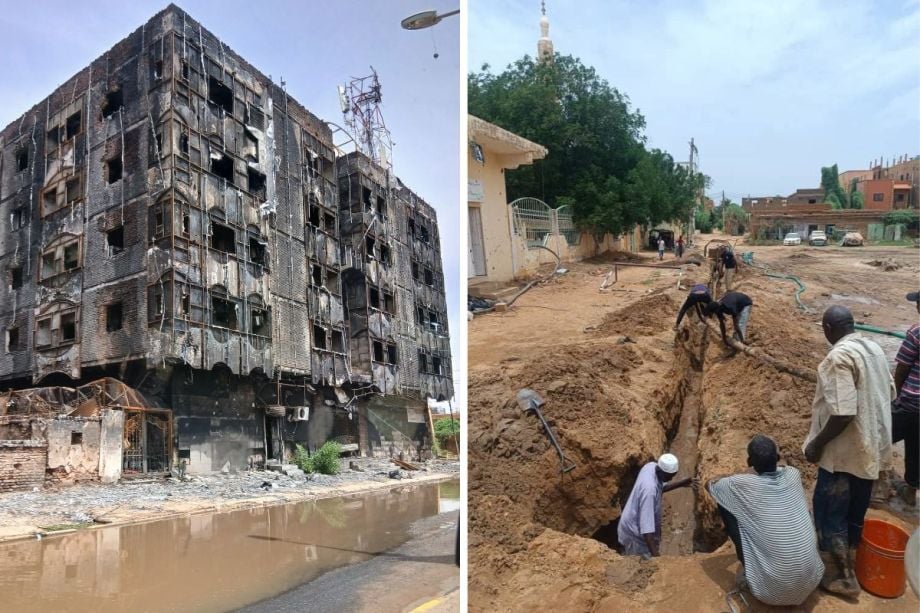
Above photo: On the left, a tower building that contained medical clinics, grocery stores, residential apartments and offices was completely burned down by rocket fire in southern Khartoum. On the right, civilians work to reconnect water lines in the neighborhood of Buri Al-Mahss. Aunnab Elma and Ahmed Kamal.
U.S. aid has evaporated and government promises remain unfulfilled.
But Khartoum’s residents are making their neighborhoods livable again, with or without institutional backing.
On a scorching morning in Al-Kalakla, southern Khartoum, Mohammed Rizq stood among rubble with a notebook in his hand, directing dozens of volunteers half his age. The 21-year-old high school student with metalworking training pointed toward a broken water station, its generator stolen by Rapid Support Forces during the paramilitary’s occupation of Sudan’s capital. He divided the group into teams: clear the rubble, salvage usable bricks, dig trenches to repair pipes the RSF had destroyed.
“When I rebuild my neighborhood, it feels like I am rebuilding my life from the ground up,” Rizq says, standing where his elementary school once stood before artillery reduced it to debris.
Nearly a year after Sudanese forces recaptured Khartoum from RSF control, the capital remains devastated. Humanitarian reports estimate between 60-70% of hospitals, schools, and residential areas are damaged or destroyed.
In May 2024, Prime Minister Kamal Idris toured the wreckage — Khartoum International Airport, the Al-Halfaia and Shambat bridges, water stations, hospitals, the Cabinet headquarters, Omdurman market — and promised comprehensive reconstruction. “Our top priorities are to restore water and electricity services and secure the capital, and we are working to restore Khartoum as a proud national capital,” he said in a televised speech. The government estimates reconstruction will cost $700 billion nationally, half required for Khartoum alone.
Those plans never materialized. Instead, in July, the United States shuttered USAID operations abruptly and withdrew over $8 billion in aid, even as 30 million Sudanese require humanitarian assistance. The government’s absence created a vacuum that citizens filled themselves, launching hundreds of grassroots initiatives rebuilding neighborhoods, universities and health facilities without institutional support.
Rizq returned to Al-Kalakla in May 2024 to find his home’s walls destroyed by artillery and doors stolen by looters — the same fate that befell most neighborhood houses. He collected money from wealthy residents and volunteers’ pockets to buy shovels, brooms and building materials. His group worked by hand without bulldozers or specialized equipment.
“I found the walls of my house completely destroyed and the doors looted and stolen, like most of the houses in our neighborhood,” Rizq tells Next City. “I didn’t wait for the government to help us rebuild the house or clean up the area or maintain the water and electricity lines.”
His team joined local committees to repair destroyed water and power infrastructure. They faced material shortages and funding gaps but pooled resources, borrowed equipment from neighbors, and salvaged usable materials from debris. When the broken water station needed a replacement generator, they found free alternatives — including carrying dirt by hand when wheelbarrows weren’t available.
This pattern repeats across at least 10 Khartoum neighborhoods. Communities coordinate across generations: youth provide labor, elders offer expertise, women organize logistics and food preparation, local businesses donate materials. Volunteers have rehabilitated dozens of homes and schools without equipment or government support.
The most ambitious model
In Bouri al-Mahas, residents launched what organizers describe as the most comprehensive initiative, addressing one sector completely before moving to the next: water systems, education, housing, community kitchens providing free meals, health facilities, lighting and solar panels. They repaired two schools that resumed classes, connected water and electricity lines, and established food distribution for neighborhood residents.
“All of us who live in the area got together, wrote to expatriates from the area, and appealed to generous people to collect donations for reconstruction,” says Ahmed Kamal, the initiative’s media director. “The government did not help us, and we did not expect it to. Today, Buri Al-Mahas is completely livable. All basic services are available.”
The initiative receives financial support from wealthy regional donors and charitable organizations. Work is distributed among community segments, with specialists appointed to lead each sector. They purchased water pumps, solar panels, building materials, and kitchen supplies from collected donations. The initiative owns materials and machinery for their work.
Kamal identified fundraising difficulty as the primary threat to continuity. “We continue to give everything we have in the region,” he said, making urgent appeals to individuals and organizations for help sustaining operations.
The reconstruction movement’s methods are simple but organized. Volunteers use shovels, hammers, wheelbarrows, and basic carpentry equipment borrowed or purchased through pooled donations. Every stone, pipe, and plank salvaged from rubble is repurposed—nothing wasted.
Teams have defined responsibilities: debris removal, material collection, repair, food preparation, and communication. Leaders like Rizq and Arwa emphasize rotation preventing overburdening. Daily tasks are recorded in notebooks tracking progress and ensuring accountability. When professional skills are needed — welding, pipe repair, heavy carpentry — local workers join voluntarily or for minimal pay supported by student contributions.
WhatsApp groups coordinate schedules while word-of-mouth spreads information where internet remains unreliable. Publicizing work through local media and photos builds credibility and encourages more volunteers.
Students reclaim their futures
At the University of Khartoum’s Faculty of Pharmacy, students divided into teams on their first workday. One group tackled administration offices, collecting scattered papers and arranging furniture in the dean’s suite. Another cleaned Professor Yahya Muhammad Al-Khair’s lecture hall and the pharmacy laboratory, storing equipment in designated places and stacking damaged ceiling panels.
“The initiative has succeeded in bringing the facilities of the Faculty of Pharmacy back to life after three years of destruction, confirming the role of students and young people in leading volunteer work and rebuilding institutions,” Hiba Ahmed and Fatima Abakar, two students involved in the campaigns, tell Next City.
The work proceeded despite government delays granting permission and severe funding shortages for cleaning supplies and food. Students collected donations from their own pockets. The local Karri team cut overgrown vegetation from the faculty courtyard, removed debris from the graduate studies hall and pharmacognosy laboratory, filled holes in the courtyard, and reinstalled air conditioners torn from walls during the fighting.
At Neelain University’s Faculty of Arts, 25-year-old English Department student Arwa Salah returned to Omdurman in November 2024 expecting to resume her studies. Instead, she found destroyed classrooms and scattered books. She became coordinating director of the reconstruction initiative.
“We saw our classrooms destroyed, our books scattered,” Arwa says. “Waiting for officials meant losing more years of our lives.”
Arwa divided students into groups on the initiative’s first day: One worked with professional laborers the faculty provided, another cleared debris and swept halls, a third arranged salvaged furniture. She handled administrator liaison and media outreach — a critical task after national television ignored their efforts. She personally contacted a local station until coverage arrived.
Funding remained scarce. Students bought cleaning supplies and paid for food and water with modest donations and pocket money. Arwa skipped online classes to dedicate full days at the site, often working until dusk before walking long distances home through damaged streets. After Al-Khartoum TV covered the first day’s work, other initiatives joined and the college was thoroughly cleaned within days.
“Rebuilding these halls means rebuilding our future,” Arwa says. The faculty now awaits only a government decision to resume classes.
These methods offer a blueprint emerging across conflict zones: start with available resources, organize transparently, rotate labor, repurpose materials, claim ownership of recovery. As international aid evaporates and government promises remain unfulfilled, Khartoum’s residents demonstrate that reconstruction doesn’t require institutional backing — only community will and organizational discipline.
This story was published in collaboration with Egab, an initiative empowering local journalists across the Middle East and Africa to publish stories in regional and international media outlets.