Skip to content

Student Debt

Larry Summers: Student Debt Is Slowing The U.S. Housing Recovery

Former White House adviser Lawrence Summers said Wednesday that student debt is slowing the housing recovery and the broader economic recovery, adding a prominent voice to the debate in Washington over whether Congress should reduce Americans’ student-loan burdens. Mr. Summers, a Harvard University economist who previously led President Barack Obama’s National Economic Council, said high student debt is preventing households from spending money to fuel economic growth. Mr. Summers is the latest to weigh in on a debate about the economic effects of student debt, which has roughly doubled since 2007 to roughly $1.1 trillion, reflecting rising school enrollment during the weak job market along with higher tuitions. But other leading economists and academics have been unable to show a causal link between higher student debt and the weak economy. That’s largely because student debt enables many Americans to ultimately boost their incomes by going to college, a benefit to the economy. His comments came during a conference call arranged by Sen. Al Franken (D., Minn.) and other Democrats rallying support for legislation to allow Americans to refinance their federal student loans at lower interest rates.
Time For Students To Revolt

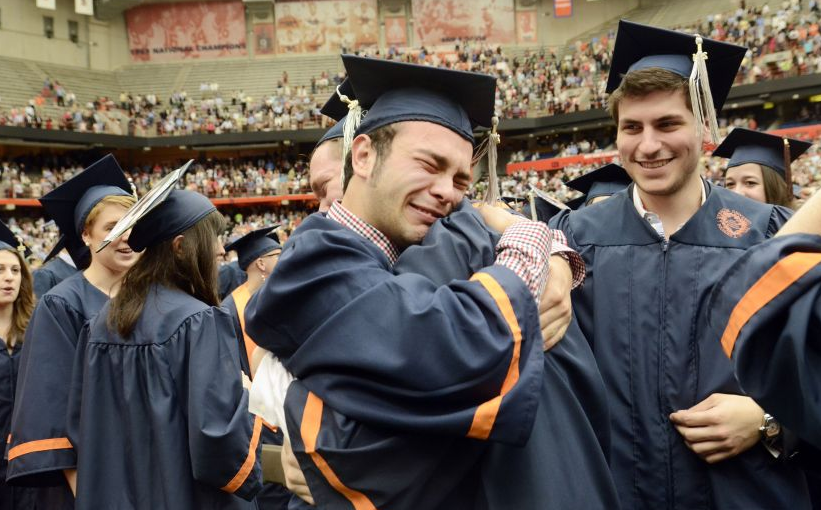
Not for graduating — though that's nice, too — but for earning one of the more dubious distinctions in recent memory: You've officially been named "the most indebted class ever." According to the Wall Street Journal and data compiled by analyst Mark Kantrowitz, the average loan-holding 2014 college graduate will have to pay back $33,000. That's up from around $31,000 in 2013 and under $10,000 in 1993. What does this mean for your future? Luckily, a college education is still a worthwhile investment. Not only are college grads generally more employable, they earn significantly more than their degree-less counterparts. The problem arises when you consider the widening rift between average post-college salaries and how much students go into debt to earn them. Between 2005 and 2012, for instance, average student loan debt jumped 35%, adjusting for inflation, while the median salary dropped 2.2%. So what can be done about this? You can try "rocking the vote," but it probably won't get you far. The federal government seems pretty committed to its slew of moronic multi-billion dollar investments, whether it's our massive prison system or the trillion dollar F-35 fighter jet program. And colleges are just fine continuing to jack up tuition costs like it's going out of style. Basically, no one cares about your problems. But take heart, graduates, and consider the silver lining: Your "most indebted" title will almost certainly be overtaken by the class of 2015!

Faces Of Student Debt Raise Alarm

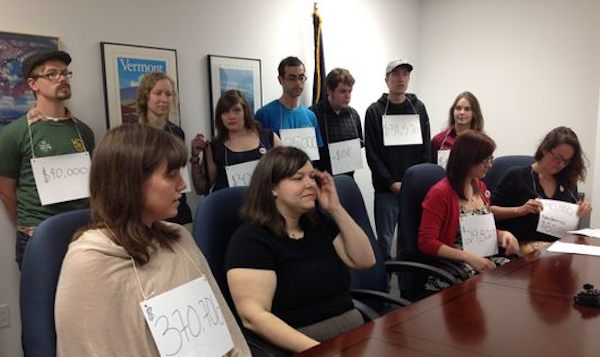
The student loan debt problem becomes less abstract when it comes with a face and a number. Sen. Bernie Sanders, I-Vt., went a step further Monday in his effort to raise public concern about this issue. He presented 13 faces and 13 numbers. The faces belonged to Vermont college students or graduates who are accumulating, or living with, college loan debt. They wore placards with the numbers, which ranged from about $20,000 to more than $300,000. "What's the crime?" Sanders asked. "What did they do to incur $300,000 in debt? Did they go on a shopping spree? Did they go to Las Vegas and lose all their money? Their crime was that they wanted to get a good education." Sanders sat among them at a news conference at his Church Street office and offered brief prologue before four of them told their stories. He said that student loan debt amounts to $1.2 trillion, more than credit-card debt, and that one in eight graduates owes more than $50,000. Meanwhile, the cost of getting a college degree has increased about 12-fold in the last 30 years. Sanders called the debt burden a tragedy for the middle class and a big problem for the U.S. international competitiveness, as other nations invest more in higher education. Moreover, he said, rising debt levels and college costs discourage many capable young people from pursuing higher education at all.
assetto corsa mods

Urgent End Of Year Fundraising Campaign

Online donations are back! Keep independent media alive. 

Due to the attacks on our fiscal sponsor, we were unable to raise funds online for nearly two years.  As the bills pile up, your help is needed now to cover the monthly costs of operating Popular Resistance.

Urgent End Of Year Fundraising Campaign

Online donations are back! 

Keep independent media alive. 

Due to the attacks on our fiscal sponsor, we were unable to raise funds online for nearly two years.  As the bills pile up, your help is needed now to cover the monthly costs of operating Popular Resistance.

Sign Up To Our Daily Digest

Independent media outlets are being suppressed and dropped by corporations like Google, Facebook and Twitter. Sign up for our daily email digest before it’s too late so you don’t miss the latest movement news.