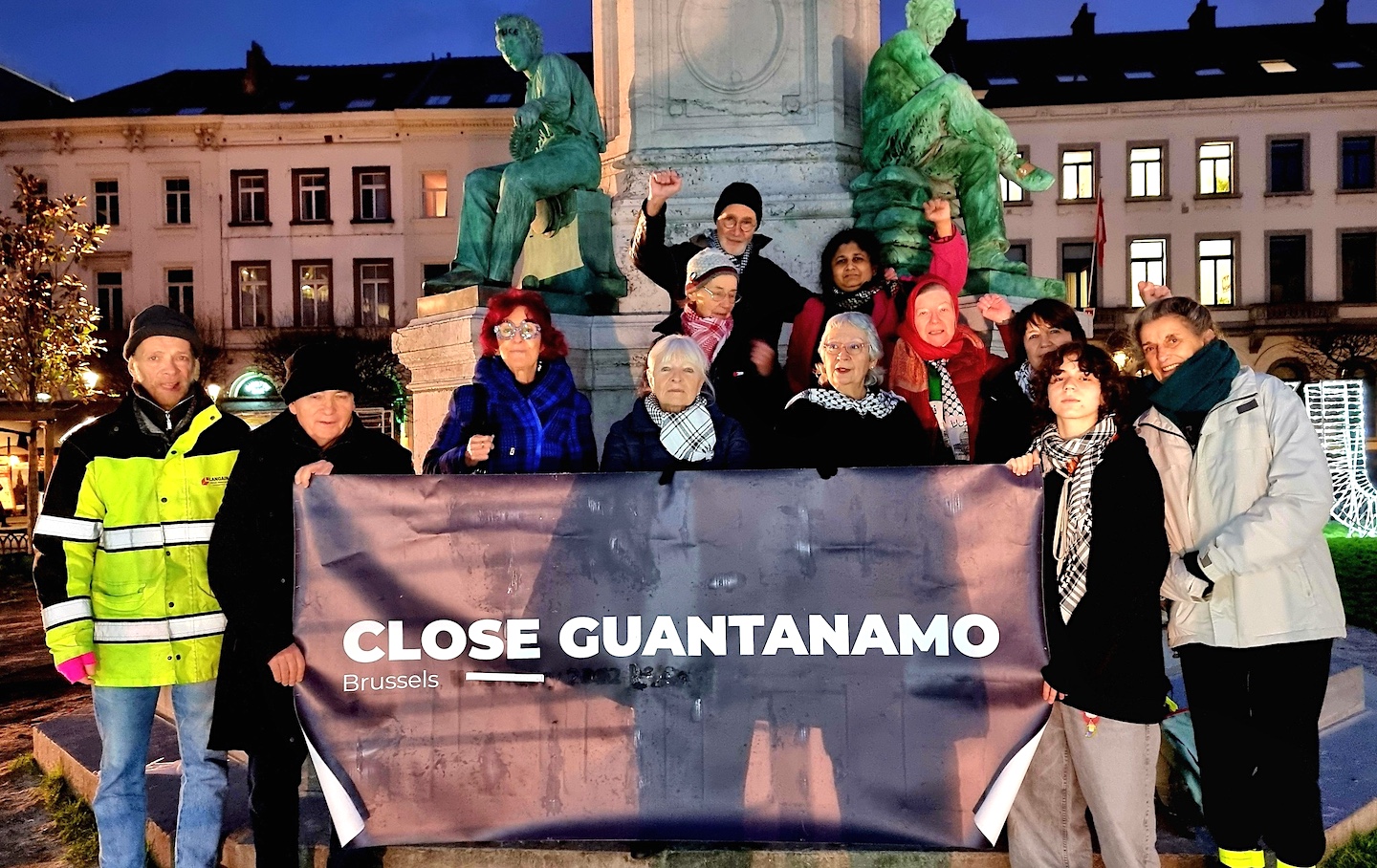
Above photo: Campaigners in the Place du Luxembourg in Brussels on December 3, 2025. At the top, with fists in the air, organizer Luk Vervaet is joined by trade unionist and academic Deepa Govindarajan Driver, visiting from the UK.
Before the 24th Anniversary of the Prison’s Opening on Jan. 11, 2026.
Last Wednesday, December 3, groups of stalwart campaigners gathered across the US and around the world for the 35th monthly global vigils for the closure of the “war on terror” prison at Guantánamo Bay.
The “First Wednesday” vigils took place outside the White House in Washington, D.C., and in London, New York City, Brussels, Detroit, Los Angeles and Portland, OR, with former prisoner Mansoor Adayfi also holding a solo vigil in Belgrade. Further vigils took place in Cobleskill, NY on Saturday December 6, and outside the Howard Zinn Book Fair in San Francisco on Sunday December 7.
As usual, the vigils involved committed campaigners from various Amnesty International groups, Close Guantánamo, the UK Guantánamo Network, Veterans for Peace, Witness Against Torture, the World Can’t Wait, the Peacemakers of Schoharie County, and various activist groups in New York City, with support from numerous other organizations, including NRCAT (the National Religious Campaign Against Torture), whose banners feature prominently at some of the vigils.
Please see below for the photos, and comments from the participants, and read on for my reflections on the grimness of this particular milestone, as we near what ought to have been unthinkable — the 24th anniversary, on January 11, 2026, of the opening of the Guantánamo prison, where 15 men are still held in various states of fundamental lawlessness.
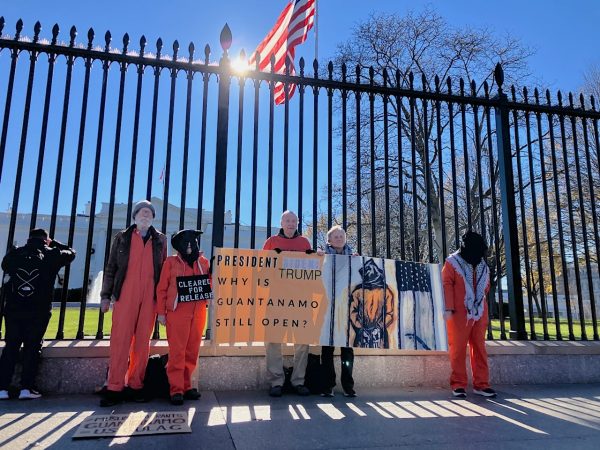
The vigil outside the White House in Washington, D.C. on December 3, 2025. Helen Schietinger of Witness Against Torture noted that the campaigners were, from left to right, Steve, Judith, Art, Colleen and herself, and asked, with reference to the super-high fence and Trump’s ever more shielded presence, “Is he locked in, or are we locked out?”
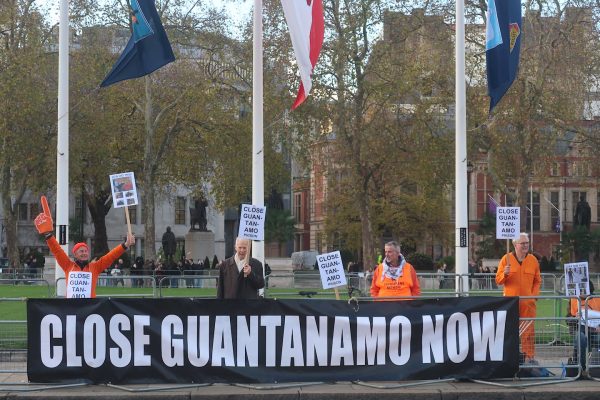
Campaigners with the UK Guantánamo Network in Parliament Square, opposite the Houses of Parliament in London, on December 3, 2025. As ever, it was a wonderful opportunity for our little group of like-minded individuals to get together and to reaffirm that we’re not alone in caring about Guantánamo and the general state of the world, and, across the road, one of our number, David, took up a post outside the entrance and exit to Parliament, handing out over 500 leaflets to those coming and going. As Paul, on the left of the photo, said afterwards, “Obviously they are the sort of people we need to get our message out to, and his dedication made him the star of the day.”
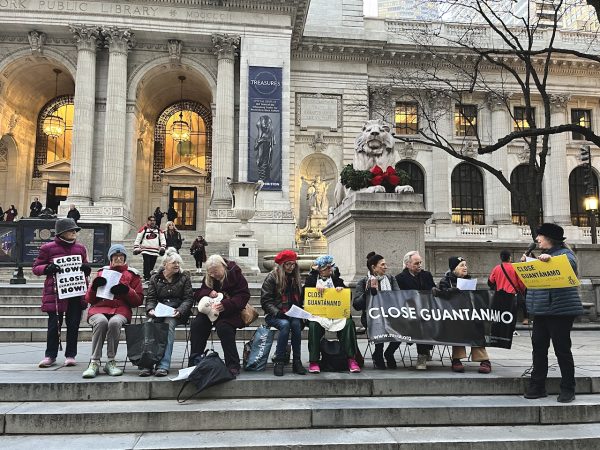
Campaigners at the vigil on the steps on the New York Public Library in Manhattan on December 3, 2025. Activist and photographer Linda Novenski wrote, “Our numbers grew over the first 20 minutes, and then Debra Sweet [the national director of the World Can’t Wait, on the right of the photo] took the mike and powerfully spoke of Guantánamo and its unconvicted prisoners still there after 24 years! Then we were led in song by Paul Stein and his trusty accordion. Thank you, Debra, for speaking so passionately against fascism, torture prisons, and kidnapping of immigrants … and more.”
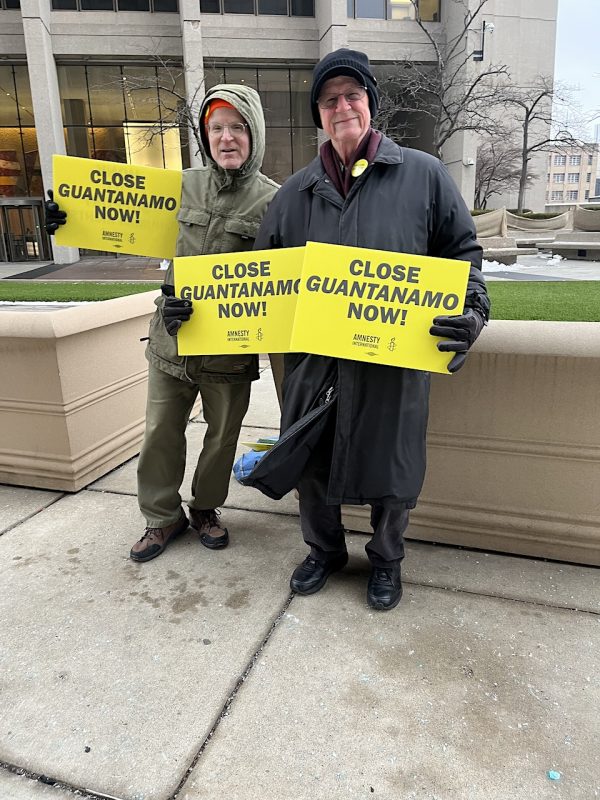
Campaigners outside the Federal Building in Detroit on December 3, 2025. Geraldine Grunow, who took the photo, said, “Today’s vigil was very cold, and we few were not very brave, leaving a little bit earlier than scheduled. We promise to do better next month! Much gratitude to all the groups in other places whose presence is longer and more meaningful.”
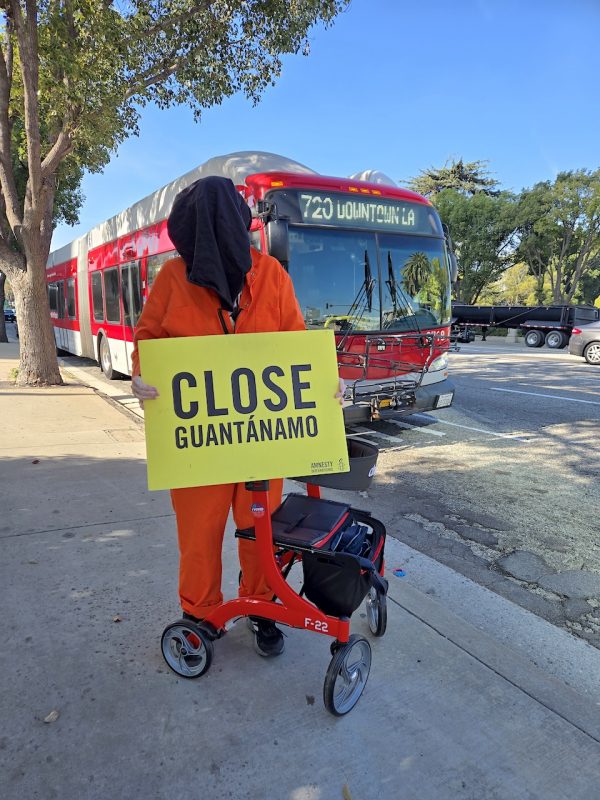
Campaigner Julie Alley at the vigil in Los Angeles on December 3, 2025. Jon Krampner wrote, “Julie and I did our vigil on Wednesday in front of the Westwood Federal Building. We got some honks of solidarity and a few people yelled insults at us, one of them using the ‘f’ word. As usual, there was very little pedestrian traffic, but a man walking along asked me how many prisoners are still at Guantánamo. Being an Andy Worthington adept, I said 15. Right, he said, you pass the test. It was astonishing to find a random pedestrian who knew that.”
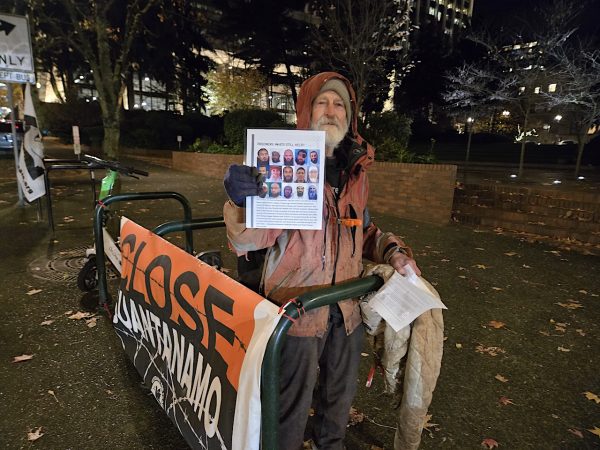
Campaigner Jack Herbert from the Portland Central American Solidarity Committee (PCASC) joined Dan Shea of Veterans for Peace for the vigil in Terry Schrunk Plaza in Portland, OR on December 3, 2025. He’s holding a print-out of the Close Guantánamo page showing the 15 men still held.
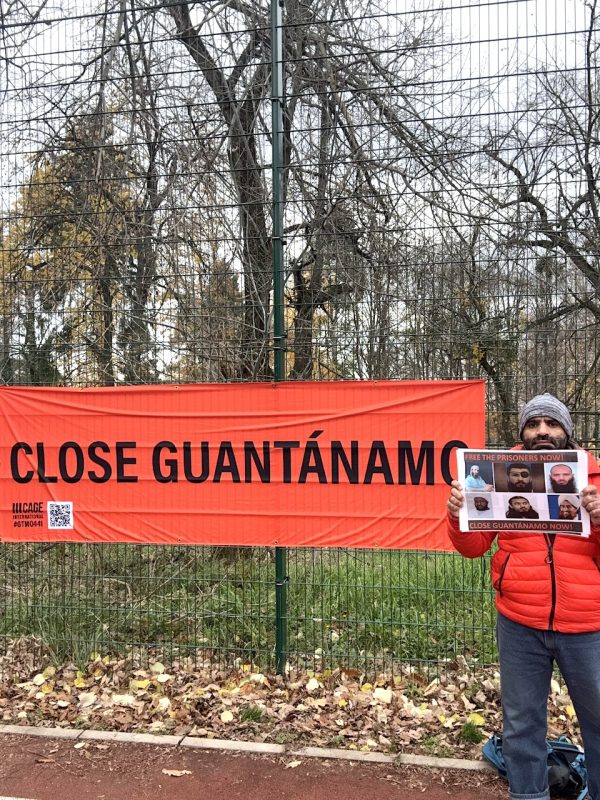
In Belgrade, former Guantánamo prisoner Mansoor Adayfi held a solo vigil, holding up a poster showing the six men, out of the 15 still held, who have never been charged with a crime; three approved for release by administrative review boards, and three others held as “forever prisoners.” Check out Mansoor’s video message here.
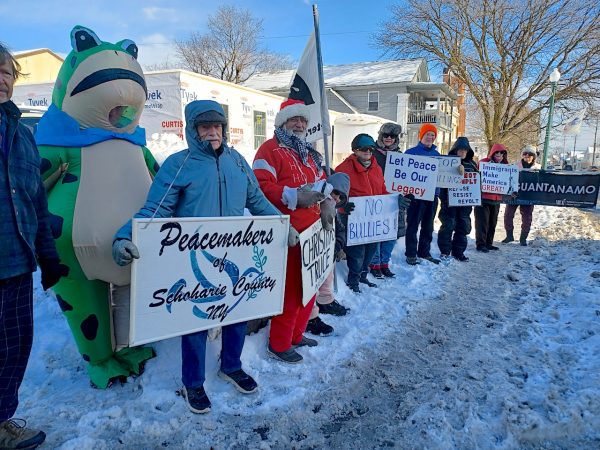
The Peacemakers of Schoharie County at their vigil in Cobleskill, NY, which took place on Saturday December 6, 2025, featuring their activist frog, and also Santa Claus. Sue Spivack wrote, “13 Peacemakers of Schoharie County showed up to call for GITMO closure and a hard STOP to any further illegal transfers by ICE of migrants and asylum seekers to the infamous prison. Thanks for faithfully coordinating this.”
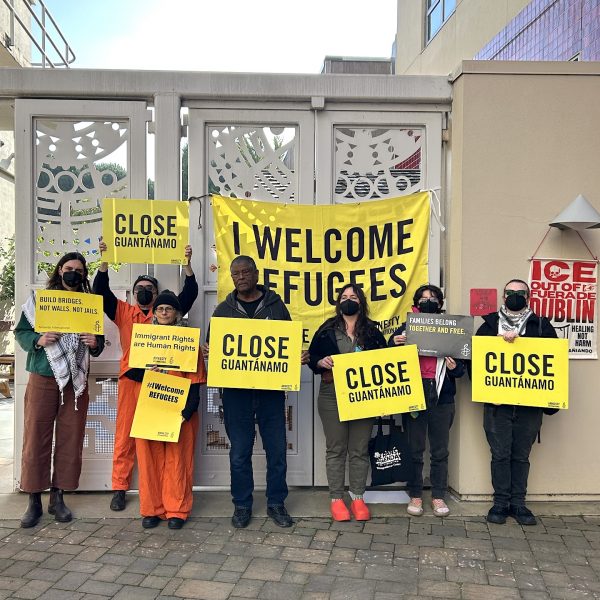
Campaigners in San Francisco outside the Howard Zinn Book Fair at the City College of San Francisco Mission Campus on Sunday December 7, 2025. The organizers describe the book fair as “an annual celebration of The People’s History — past, present, and future”, adding, “We bring together left authors, readers, organizers, and community members to debate and discuss strategies for a better world.” This year’s theme, appropriately, was “Fight Supremacy: Actions Against Authoritarianism.”
As always, I’m deeply impressed that, across the US and in other locations globally, many dozens of people are prepared, once a month, to invest their time in taking a stand to try to pierce the veil of amnesia that has largely engulfed the prison at Guantánamo Bay.
Our reasons are as essential as ever. The “war on terror” prison at Guantánamo Bay is the last bastion of a terrifying lawlessness that gripped the US after 9/11, when, largely under the direction of George W. Bush’s vice president, Dick Cheney, who escaped any future hope of accountability when he died last month at the age of 84, the entire world was reimagined as a “battlefield”, all domestic and international laws and treaties regarding the treatment of prisoners were discarded, a global kidnap and torture program was established, and the 779 men and boys sent to Guantánamo to be held by the US military slipped into a legal black hole.
At Guantánamo, the Bush administration asserted that all these prisoners, rounded up in a largely arbitrary and indiscriminate manner, could be held indefinitely without charge or trial, even though no effort was made to establish whether there were any grounds for having detained them in the first place. For those regarded as significant enough to face trials, a parallel justice system — the military commissions — was established in a fortunately failed effort to swiftly try and execute men using information derived through the use of torture.
I’’m pretty sure that all of us who have campaigned for many long years — even decades — for the closure of Guantánamo find that our actions are inspired by a message popularized by Dr. Martin Luther King Jr., drawing on the words of the 19th century abolitionist and Unitarian preacher Theodore Parker, that “The arc of the moral universe is long, but it bends towards justice.”
Fundamentally, addressing longstanding injustices requires not only patience, but also hope, an essential antidote to either despair or an indifference brought about through a perceived, and deliberately engineered sense of powerlessness from those who claim to be our leaders, and the mainstream media who support them, which has become ever more dominant throughout the 21st century, as attempts to distract us from ever-increasing greed, barbarism and inequality have become ever more pronounced.
It is, however, sometimes hard to hold onto hope, to believe that, against the odds in a moral landscape dominated by increasing savagery and unfairness, justice can eventually prevail.
In Gaza, for example, where a western-backed genocide still rages, it can be difficult to imagine that, after 77 years of the brutal colonial occupation of the Palestinians’ land by Israeli settlers, that moral arc will ever locate justice.
At Guantánamo, the persistent injustice is fresher, even as we prepare to mark 24 years of its existence, but it is still an extraordinary amount of time for such an icon of chronic injustice to still be in existence — and still with no end in sight to its incessant erosion of the rights of the men still held.
On a more optimistic note, however, as I will be writing about in more detail soon, the moral arc of Guantánamo’s more recent additional use — as a cynical way station for migrants deported by the Trump administration via the invented urgency of an entirely manufactured “war on migrants” — has located justice in a much shorter period.
In June, in Luna Gutierrez v. Noem, a case in the District Court in Washington, D.C., various NGOs challenged the Trump administration’s use of Guantánamo to hold migrants with final deportation orders, and on December 5, in the District Court in Washington, D.C., Judge Sparkle L. Sooknanan ruled definitively that the Trump administration’s policy was both “impermissibly punitive”, as a violation of the Fifth Amendment’s Due Process Clause, and was also completely unauthorized under the Immigration and Nationality Act.
It remains to be seen if the Trump administration will appeal, but for now it is commendable that the moral arc of justice has been recognized in a court of law with regard to Guantánamo and immigration detention, and, although the ruling has no impact on the 15 men still held in the “war on terror” prison, and entombed under Donald Trump, it is also reassuring that, in her ruling, Judge Sooknanan made a point of noting that, since the prison opened, it “has been synonymous with pervasive mistreatment and indefinite detention.”
We hope you can join us next month, to mark the 24th anniversary of the opening of Guantánamo on January 11, which is a Sunday. As usual, we’ll be moving our “First Wednesday” vigils to the day of the anniversary — or, in some locations, the day before, Saturday January 10 — before resuming the “First Wednesday” vigils on Wednesday February 4.