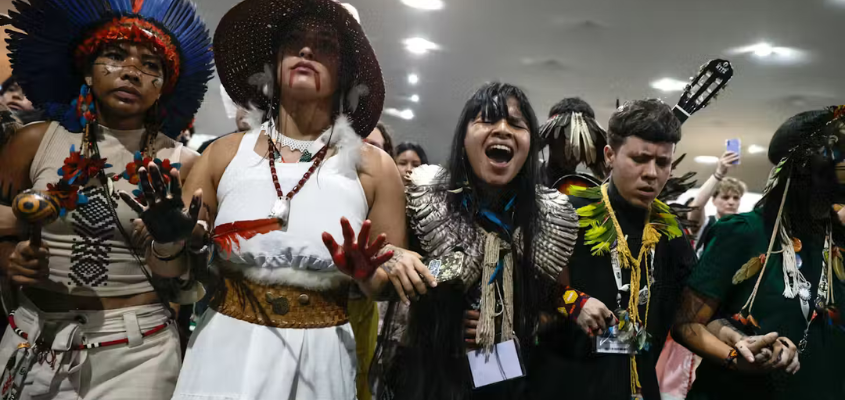
Above photo: _Pablo Porciuncula / AFP / Getty Images+.
And The Case For A Global Bottom/Up Collective Intervention Of Oppressed And Colonized People.
The path to climate liberation requires a radical break from failed leadership and a serious commitment to class analysis.
“We are responsible for the world in which we find ourselves, if only because we are the only sentient force which can change it.” – James Baldwin from No Name in the Street
The first Conference of the Parties (COP) summit I attended was back in 2015, COP 21, which took place in Paris, France. At this point in my climate and environmental justice journey I was wide-eyed and perhaps even a bit naive as I believed that nation states, international bodies like the United Nations, and so-called Civil Society Organizations contained the requisite mettle and principles to take on the crisis of climate change at scale while and the root causes that maintain and exacerbate it – white “supremacy” ideology, patriarchy, and colonization – contemporaneously. Following COP 30, which just concluded in Belem, Brazil – a climate summit that Brazilian president, Luiz Inácio Lula da Silva (known commonly as “Lula”) proclaimed would be “the COP of truth” as part of his speech to the United Nations General Assembly this past September.
Though likely not for the reasons that Lula would prefer, COP 30 was indeed the COP of truth in that it provided a veracious elucidation that when it comes to the climate crisis, nation states, the United Nations, and the neoliberal menagerie of think tanks, corporate lobbyists (including the over 1600 fossil fuel lobbyists, lurking, like the vulture capitalists that they are, over the carcass of an anodyne global climate summit), and so-called civil society organizations (CSOs), are not fit enough, able or or willing to adequately and efficaciously address the climate crisis and dismantle its root causes. The biggest reason for this being that these same actors, and especially CSOs are, too often, be it consciously or unconsciously and/or intentionally and unintentionally, agents of controlled opposition.
This being said, my time here in Brazil has revealed a panoply of truths, of the reality of the polity of the global climate “movement,” but especially the contingent representing the United States, and the profound conclusion that should we continue to allow the climate fight to be led, overly influenced by, guided by, or even influenced by the elements that make up the petit bourgeois, the climate fight is already over, and these COP summits are a resounding indication of this.
As the comrade and co-founder/Director of Cooperation Jackson, Kali Akuno, sees it, “[The COP] lost its legitimacy well over a decade ago. A deeper interrogation of the social movements that have engaged it is in order if we’re being honest.” He goes on to say, “The Chochabama Accords were the last real shot we had and that was 15 years ago! We need to assess why we wouldn’t push the Pink Wave further and globalize its momentum. This is part of the serious questions we need to pose to ourselves so we can recalibrate our praxis to win this war or suffer the consequences – i.e. extinction”
The “deeper interrogation” of what comrade Akuno speaks to, in some ways, has already been conducted. And the results of that analysis surfaces who may be the largest impediment to the efficacy of the COP and who may be the grand exemplar of why each COP since the 21st summit in Paris has been an exercise of co-optation. For while the presence of fossil fuel cartel interests and those of industrial agriculture as well as big tech continue to contaminate the COPs, there is another contingent that contributes to the elements that render these summits inert, perfunctory, and inefficacious, possibly, more so than the corporations – the petit bourgeois.
Karl Marx and V.I. Lenin remind us how the petit bourgeois operates and, if unchecked and undermined, the deleterious effects they can have on movements. As part of their address to the Central Committee of the Communist League in 1850, they reminded attendees, “We told you already in 1848, brothers, that the German liberal bourgeoisie would soon come to power and would immediately turn its newly won power against the workers. You have seen how this forecast came true. It was indeed the bourgeoisie which took possession of the state authority in the wake of the March movement of 1848 and used this power to drive the workers, its allies in the struggle, back into their former oppressed position.”
In turn, we must name that at this moment in the struggle for climate and environmental justice, the petit bourgeois is leading the global climate “movement,” which may represent the biggest reason for its consistent inability, if not unwillingness, to attack the climate crisis and center those most impacted by climate change and cede leadership to these communities – Black, Brown, Indigenous, and the poor.
Elements of the Palestinian resistance, offer sage advice for why it’s imperative to identify the petit bourgeois actors who take part in social justice struggles, as a means to knowing how best to navigate and utilize them in service to the masses as part of altering and improving the material conditions of those most impacted by climate change and the racial capitalism that fuels, fosters, and sustains it. These elements of the Palestinian resistance suggest, “To be able to triumph over this [the petit bourgeois] class in our struggle of the revolution, its programs and organizational frames – without allowing this struggle to affect our main battle against the enemy, we must know when how to accept it as an ally and fight against it.”
This analysis is of the utmost salience when it comes to addressing and dismantling the variables that form, uphold, and maintain toxic elements of the climate change equation. Most so because it could be argued that the petit bourgeois is posing as legitimate leaders of the movement for climate and environmental liberation in ways that adulterate the precepts of principled struggle while, at the same time, bamboozling far too many into believing that these petit bourgeois actors possess the same goals as those of the masses. We will be able to identify these actors by how they characterize and articulate the final outcomes of COP 30. Those that determine COP 30 contained “victories” and “wins” most certainly vindicate why the aforementioned elements of the Palestinian Resistance conclude, “Our analysis of this class [the petit bourgeois] is that by virtue of its class structure, it sometimes adopts vague, compromising or vacillating positions. This analysis means that specific occasions will arise when the organizations of this class will adopt such positions.”
We saw this preciously when certain petit bourgeois “environmental” organizations declared that Biden’s so-called Inflation Reduction Act was a “historic climate bill” even though, as we at Black Agenda Report, this sentiment was proven to be an exercise of abject fallacy. And we also see the same attitude being applied by far too many in the context of COP 30. Worse yet, many of these climate justice advocates who are Black/African believe that we should celebrate and do our happy dance because COP 30 used the phrase, “people of African descent” in a few sentences, in a few frameworks that are not even legally binding, and will certainly result in no improvement of the material conditions currently shouldered by Afro Descendant, nor most colonized and oppressed peoples of the Global South. This much was noted in the Black Alliance for Peace’s (BAP) recently released press statement reflecting on the outcomes of COP 30. Therein, BAP names that the failures of COP 30 not only questions the efficacy of these summits, but also their very relevance.
So why would certain Black/Afro Descendant-led groups characterize COP 30 as a series of “victories” and “wins” for the people they purport to be accountable to? Elements of the Palestinian resistance may provide the answer in their description of the petit bourgeois, “A portion of this class enjoys comfortable living conditions, assuring it of the basic necessities with some surplus, which makes it always look up to rising to the level of the upper bourgeois, while another portion of this class is barely capable of ensuring its basic living conditions.” As I noted in a previous piece Basis for Climate and Environmental Liberation there is indeed a cabal of Black/African petit bourgeois agents who operate at the pleasure of the upper bourgeois and at the expense of grassroots organizers and the poor and working class communities they claim to represent in the larger climate struggle. These petit bourgeois entities must be navigated adroitly if we are serious about altering and improving the material conditions of those most impacted by the climate crisis and its root causes.
It’s not so much that we can’t work with the petit bourgeois, it’s more that we must be cognizant of the fact that they cannot and must not lead the masses in fostering a larger climate and environmental liberation initiative that strives to emancipate poor and working class oppressed and colonized people from the inevitable cataclysmic calamities of climate change. As elements of the Palestinian resistance remind us, “…during the stage of democratic liberation, it is generally possible for side to say that this class may be an ally to the force of the revolution and to its basic material represented by the workers and peasants, but alliance with this class must be so alert as to prevent it from infiltrating into the position of command, because that would expose the revolution to vacillation and deviation or slack.” Hence, while we know that this means the Big Green and corporate environmental organizations, we must also be equally aware of the Black/Afro Descendant elements who are declaring COP 30 victories as a function of appeasing their philanthropic alabaster puppet masters who will, in turn, provide resources for them to attend future COP summits and continue the illusion of “wins” and “victories.”
These petit bourgeois elements cannot continue to be in positions of leadership, authority, or influence. We must embark on a “Theme From the Bottom” mentality that aligns with the second of six Jemez Principles for Democratic Organizing, Emphasis on Bottom-up Organizing, which stipulates, “We must be continually building and strengthening a base which provides our credibility, our strategies, mobilizations, leadership development, and the energy for the work we must do daily.” The only entity we observed that adhered to this sage aphorism during COP 30 was the grassroots and proletariat-led People’s Summit as indicated by their declaration that was praised and endorsed by BAP.
The People’s Summit declaration makes the case for why we simply cannot rely on nation states, international bodies like the United Nations, nor agents of controlled opposition in the form of so-called CSOs to deliver or engender a climate and environmental liberation framework that serves the masses more than individuals and certain organizations who reduce “climate and environmental justice” to talking points rather than a collective call to action in the vein of BAP’s overarching ethos, “No Compromise/No Retreat.” We must, therefore, identify all of the petit bourgeois elements in the climate “movement,” while also understanding how they operate and why they operate in the ways they do. But, most importantly, we must exercise the requisite interventions, whenever necessary, even if the culprits are Black/African, to ensure that we do not allow for the petit bourgeois to whitewash or water down our demands and praxis as climate and environmental liberation practitioners. . This is especially true for our young people who are consistently let down, demeaned and extracted from far too many of the Black/African petit-bourgeois elements of climate and environmental justice spaces.
An hour out from boarding my flight back to the U.S I am reminded that all that we need and desire is possible, a full circle introspection of my attendance at COP 21 when I met with students from the Historic Black Colleges and Universities (HBCU) Climate Change Initiative proves this. While in Paris, we were attempting to convince then President Obama to keep the crude oil export ban in place. While Obama denied our requests, as you can see in this video, it’s clear that the only chance we have to avert the worst impacts of the climate crisis is to adhere to the voices and demands of the grassroots masses of colonized and oppressed peoples. Because while we lost that battle, the inexorable principles demonstrated by members of the HBCU Climate Change Initiative planted seeds of resistance that are starting to produce fruitful results. Yes, we are consistently put in the inconvenient position of having to fight the system, as well as the system that is supposed to be fighting the system. But we can and will emerge victorious when we collectively comprehend how to navigate the petit bourgeois elements of environmental and climate justice spaces such that they are utilized, while not permitted to lead and determine the outcomes of our struggle. This is and must be the way.
We are actually witnessing elements of the masses gleaning the fruits produced by principled seeds of resistance as they are taking on some of the most powerful entities in the world…and they are winning without having to compromise or capitulate. And they are winning without the participation of Big Green groups who have proclivity for watering down and whitewashing the radical praxis of grassroots movements. Everyday people in “red” and “blue” congressional districts alike have defeated Big Tech cartels including Google, Meta, and Amazon – and, in the process, they have, in many cases, prevented the proliferation of natural resources extractive data centers in their communities. In fact, these grassroots formations have cost Big Tech cartels upwards of an estimated $64 Billion. This is what bottom up organizing that delivers true victories for the masses without ceding leadership or otherwise capitulating to the petit bourgeois looks like. And it’s important to note that In some cases, the petit bourgeois was likely utilized in the ways suggested by elements of the Palestinian resistance – they took part l, but they didn’t take over.
This praxis must be replicated as part of the larger struggle for climate and environmental liberation. For, as COP 30 demonstrated, if we continue to wait for nation states and international bodies as well as other elements of the petit bourgeois in the form of so-called CSOs to characterize what does and does not qualify as wins and victories, we will never achieve climate and environmental liberation – not just from the climate crisis but from the vanguards of racial capitalism and their minions. A “Theme from the Bottom”, grassroots, poor and working class led approach to organizing and mobilizing oppressed and colonized people of the Global South is the only thing left that can intercede climate barbarism. And deep down inside, whether they have the fitness to agree with this sentiment or not, the petit bourgeois elements of the global climate “movement” knows this better than anyone – it’s on us to remind them of this truth.