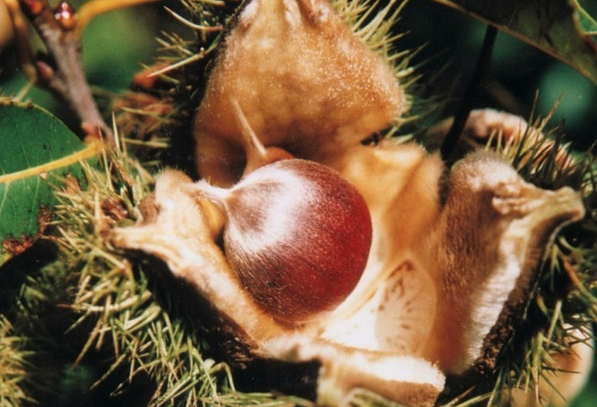
A nut rests in the spiny bur of a rare surviving American chestnut tree. A fungus wiped out almost all of the trees, which once numbered in the billions. (The American Chestnut Foundation/Via Associated Press)
In a society rising up against the corporate capture of our food supply in the form of GMOs, a new untested and not-yet-approved GMO food is being promoted: the GMO chestnut.
A recent op-ed in the Washington Post, however, makes the silly assertion that this emerging new GMO food will be the answer to hunger and a step toward reconnecting with our food supply:
Repopulating our woods — and even our yards, our commons and our courthouse lawns — with [GE] American chestnuts would put a versatile, nutritious, easily harvested food source within reach of just about everyone. For those living on the margins, it could be a very real hedge against want. For everyone, it could be a hedge against distancing ourselves from our food, which can be the first step toward a diet low in the whole foods that virtually every public health authority tells us we should eat more of.
Really? A food source for the poor? People are going to be heading out with their burlap sacks collecting GMO chestnuts to roast, grind into flour or boil into candy? This is the answer to hunger? And what is the health impact of eating GMO chestnuts? Is this even being assessed? No.
The scientists developing the GMO chestnuts argue that they have been modified only with the insertion of a single wheat gene, so what can possibly be the harm? We eat wheat, right? But as any ecologist, or thinking geneticist knows, genes outside of the genome in which they evolved can do highly unpredictable things. And the genome into which they are inserted is damaged in the process resulting in mutations. These mutations in turn lead to unanticipated consequences. So no, just because it is a single gene from wheat, it is not inherently safe.
The author of the Washington Post op-ed goes on to make the utterly uninformed assertion:
[The GMO Chestnut] wasn’t created for personal profit or for the benefit of corporations or farmers. It contributes to a wholesome, healthful diet. And it’s intended solely for the public good.
Yeah, not quite. A look at the partners and funders of this program at SUNY ESF over the years reveals some very disturbing bedfellows. Monsanto and ArborGen among them. ArborGen is a GE tree research and development company based in South Carolina that has requested permission from the USDA to sell GE eucalyptus trees by the billions for planting across the Southern US from South Carolina to Texas. Oh yes, and ArborGen is jointly owned by International Paper and MeadWestvaco–timber multinationals.
A recent article in the Mint Press even quotes an ArborGen spokesperson promoting GE American Chestnuts:
…after the diminution of the American Chestnut by chestnut blight, this [GMO] technology offers great hope in the possible restoration of this tree to the US.
ArborGen’s GE Eucalyptus trees will be an ecological disaster. They are non-native, invasive, water-greedy, suppress the growth of other vegetation, provide no habitat for wildlife, and are explosively flammable. And ArborGen wants to see them in huge plantations along the US Gulf Coast.
So if the GE chestnut tree is truly “intended solely for the public good,” why is ArborGen involved? Why are they promoting them? For one reason. The GE American chestnut tree is being used to try to convince the public that GE trees can be beneficial. The hope is that they will help change the extremely powerful public opposition to GE trees and open up markets for new GE tree “products” that could mean big big profits for timber and biomass companies.
GE Chestnut trees are part of a public relations strategy to open the door for other GE forest trees including GE eucalyptus, poplar and pine.
And what will be the impact on the forests of releasing GE American chestnut trees into them? The scientists envision these GE trees growing by the billions throughout the Eastern forests of the US. To achieve this, they plan to release these GE trees in a fully fertile state to spread their pollen and seeds widely, invading the forests and contaminating any wild American chestnuts in their path. This means remaining American chestnuts that have natural blight resistant will be contaminated along with the rest, eliminating the possibility of restoring the true American chestnut.
How would the damaged genomes of these GE trees, that can grow for centuries, react to the various environmental stresses they encounter? How would drought, extreme cold, floods, etc impact them? What if the gene were to stop working suddenly (known as “gene silencing”) and these trees again became susceptible to the blight? And what if this newly blight-suscepible wheat gene was transferred back to wheat, threatening the wheat crop?
No, far from helping us achieve food sovereignty and food independence, this GE American chestnut tree is a Pandora’s box of potential disasters best left closed. Fortunately, it has not yet been approved for large-scale release. We are working to ensure this never happens.