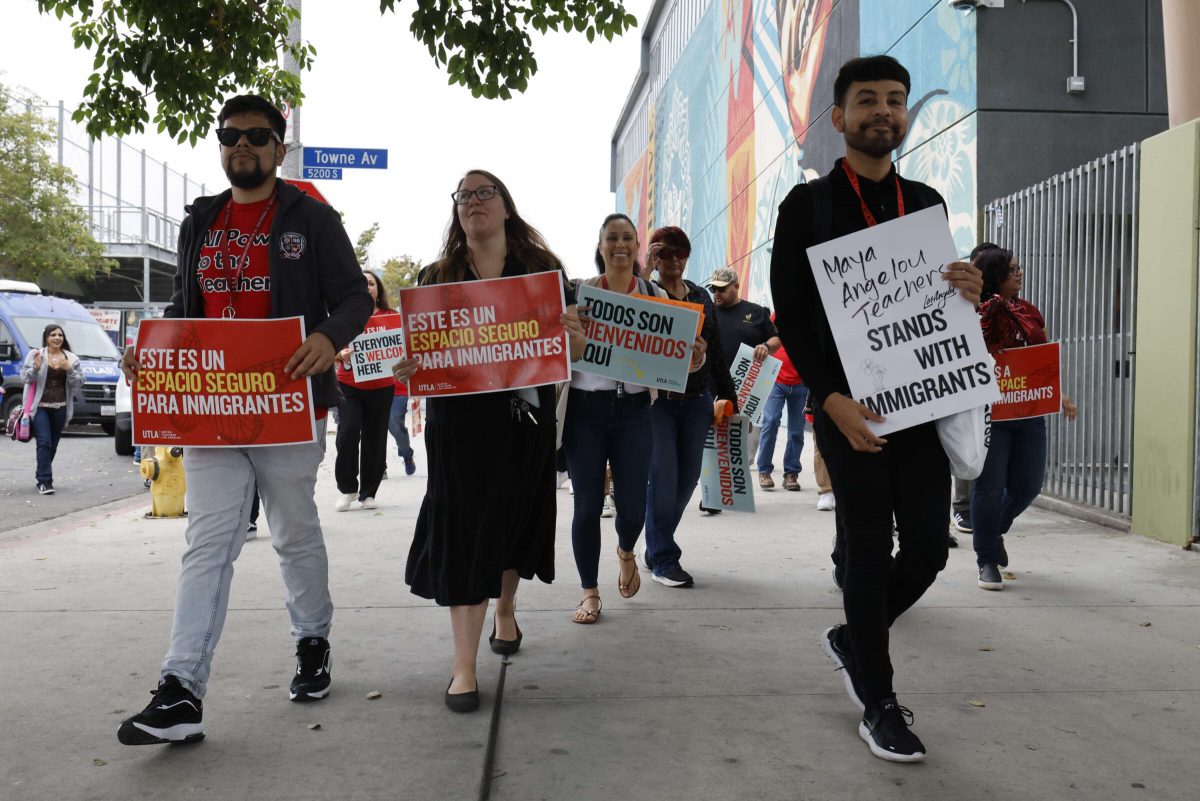
Above photo: Community organizations and teachers rally outside for immigrant rights on the first day of school at Maya Angelou High School on Thursday, August 14, 2025, in Los Angeles, California. Carlin Stiehl / Los Angeles Times via Getty Images.
The Trump administration is on the defensive as educators demand action to protect students from immigration police.
When Immigrations and Customs Enforcement (ICE) arrested a 38-year-old chiropractor while he was dropping his daughter off, they reportedly smashed out the windows of his car. The arrest, which happened on July 15, took place outside the child’s preschool in South Beaverton, Oregon. The father, originally from Iran, is married to a U.S. citizen who said he has applied for a green card to remain in the United States legally, according to Oregon Public Media.
Randy Kornfield, who witnessed the arrest while taking his grandson to the same school, told a reporter it was “heartless” to arrest a father dropping his kid off. ICE said in a statement that the child was “unharmed.”
“These poor kids don’t know what’s going on,” Kornfield said at the time.
School principal Amy Lomanto witnessed the violent arrest and managed the school’s emergency response to the incident. The arrest has led to a decrease in attendance and “has shaken our community to the core,” according to a statement from the school and a complaint filed in federal court on September 10. Along with the National Education Association and the American Federation of Teachers, two unions representing about 5 million educators, Lomanto is among the latest plaintiffs to join a lawsuit challenging immigration enforcement in spaces where safety is considered a sacred value, such as hospitals, houses of worships, and schools
Originally filed in April by a coalition of churches and community groups, the lawsuit challenges a Trump administration policy implemented in January that allows ICE agents to make arrests at school and churches, which were previously considered off limits. With students returning from summer break, educators and parents are calling on school boards to swiftly take steps to protect children and their families from ICE in and around schools as President Donald Trump’s accelerating mass deportation campaign spreads fear of racial profiling and state violence.
“By targeting schools, Donald Trump’s ICE is creating fear and chaos, and our students, their families and communities are paying the price for these traumatic and extreme immigration actions,” said Becky Pringle, president of the National Education Association, in a statement on September 10. “We have a professional and moral responsibility to keep our students safe.”
As the challenge makes its way through the legal system, education and racial justice advocates are searching for other ways to protect school communities from ICE. Leidy Robledo, a youth development specialist at the Alliance for Education Justice, said school leaders should demand that local police and city leaders do not work with ICE and provide staff with protocols and training for what to do if ICE agents show up at school. School officials and city leaders should also invest in counselors and after school programs for kids, not surveillance, punishment, and policing, Robledo said.
“ICE has been reported outside of schools, at bus stops, and in neighborhoods where children are walking to and from class,” Robledo said during a webinar on September 10. “For immigrant students, simply walking into school can feel like stepping into danger, and we believe that no young person should have to choose between their education and their family’s safety.”
Trump’s Department of Homeland Security (DHS), which oversees ICE, issued a statement on September 9 accusing the media of “force-feeding” the public stories about children and parents being “scared to return to school” and claimed that ICE does not “raid or target schools.” The statement includes screengrabs from news reports about educators navigating fear of ICE among students and parents and preparing for potential encounters with immigration police as the new school year begins.
“ICE is not going to schools to make arrests of children,” DHS Assistant Secretary Tricia McLaughlin said in the statement. “Criminals are no longer able to hide in America’s schools to avoid arrest.”
However, McLaughlin and DHS provided no evidence that “criminals” are using the nation’s schools as a hiding place. About 70 percent of the more than 61,000 people currently by ICE have no criminal convictions, and many others were convicted only of misdemeanors, including traffic tickets. While large-scale immigration raids have swept up people in public areas and adults at places of work, ICE is also arresting people at immigration hearings inside public buildings, and reports of ICE agents targeting parents dropping kids off at school and detaining high school students have sparked fear and confusion in communities across the country.
Students who are undocumented immigrants or live in mixed-status households are not the only youth impacted by the immigration crackdown. Adaku Onyeka-Crawford, senior attorney and director and of the Opportunity to Learn Program at Advancement Project, a civil rights group, said the Trump administration policies aimed at terrorizing immigrant families have made schools less safe for all students.
“The latest Supreme Court decision allows ICE to use racial profiling to violate the constitutional rights of Black and Latine Americans, disrupting the lives of immigrant families across the country when they should be celebrating their children at the start of the new school year,” Onyeka-Crawford said.
On September 8, the Supreme Court paused a ruling by a federal judge in Los Angeles that imposed restrictions on federal agents making immigration stops and arrests that plaintiffs and critics say amount to blatant racial profiling. The initial ruling was made on July 11 by a federal judge for the Central District of California, and barred ICE and Border Patrol agents from stopping people without “reasonable suspicion” that they are undocumented.
The judge ruled that “reasonable suspicion” cannot rest solely on any combination of four factors: “apparent race or ethnicity,” speaking in Spanish or accented English, being present at a location where immigrants “are known to gather” (such as Home Depot locations, where day laborers often come together and which have become noted areas for ICE raids), and working at specific jobs, such as landscaping or construction. The Supreme Court’s liberal justices dissented with the decision to overturn the lower court order. In a 21-page opinion. Justice Sonia Sotomayor described the decision as “yet another grave misuse of our emergency docket.”
“We should not have to live in a country where the Government can seize anyone who looks Latino, speaks Spanish, and appears to work a low wage job,” Sotomayor wrote. “Rather than stand idly by while our constitutional freedoms are lost, I dissent.”
Trump’s mass deportation campaign is a nationwide effort, but the administration has singled out Los Angeles, Chicago, Washington, D.C., and other large cities with Democratic leadership for immigration sweeps and raids, which has sparked mass protests and community self-defense efforts.
As litigation over the administration’s crackdown continues, advocates say immigrants — and people who are perceived as immigrants — are at risk of being disappeared into remote immigration jails without due process, as viral videos of masked agents making violent arrests fuel fears. The Congressional Hispanic Caucus announced a new “Learning Without Fear” campaign on September 9, an effort to call attention to drops in school registration and attendance “caused by fear of irresponsible federal immigration enforcement.” The caucus announced the campaign on social media but did not elaborate on what it would accomplish. Research shows that anxiety and fear around immigration status fuels disparities in academic achievement among students who are undocumented or live with undocumented family members.
As a result of Trump’s crackdown, children are afraid to leave home, parents are making plans in case they are disappeared, and teachers across the country are adopting protocols in case of an encounter with ICE, according to Vanessa Cárdenas, executive director of the immigrant rights group America’s Voice.
“This is the high cost of Trump’s mass deportation agenda — not just economic devastation, but educational chaos and psychological scarring,” Cárdenas said in a statement on Wednesday. “The worst part? It’s by design.”
Robledo said educators are stepping up to the challenge, but they need support from school boards and local political leaders, who should loudly oppose cooperation between ICE and local law enforcement.
“If one [school] district can protect immigrant youth, all districts must,” Robledo said.