Skip to content

TIME Covers CODE PINK

Photo-Bombing for Peace

How an antiwar protest group learned to hack Congress

Medea Benjamin’s Capitol Hill townhome is like a life-size version of Barbie’s Dreamhouse: pink door, pink cabinets, pink bedspread, pink chairs. It is festooned with peace slogans and painted in hues of salmon and coral. Benjamin, 61, is the co-founder and chief provocateur of the antiwar group Code Pink. At 7 a.m. on Sept. 9, she was preparing for a day of protest against U.S. military intervention in Syria when three women trickled downstairs for breakfast. “Even if we don’t win,” she says, “we change the game.”

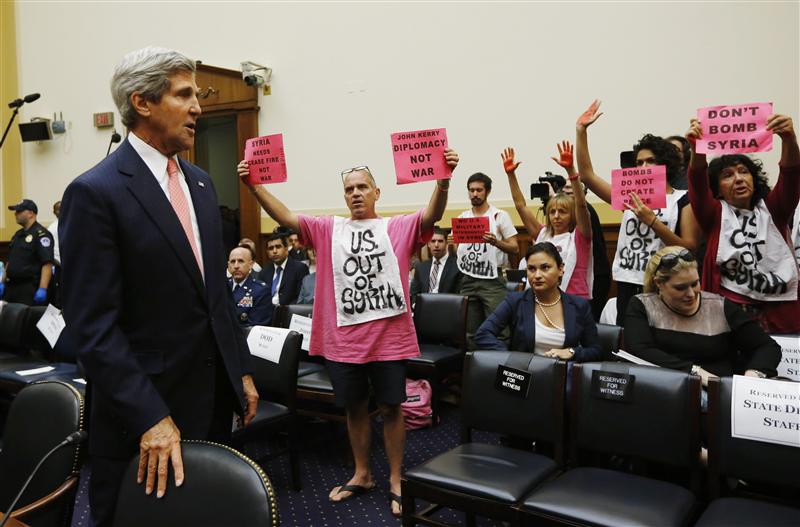
Secretary of State John Kerry arrives to address the House Foreign Affairs Committee and is confronted by protesters from Code Pink on Capitol Hill in Washington, Sept. 4, 2013.

Since its inception in 2002, Code Pink has added a colorful page to the protest playbook. Its members have demonstrated topless, hurled shoes at an effigy of George W. Bush, organized dancing flash mobs and donned vagina costumes. But these zany theatrics mask the group’s real contribution to the protest canon: Code Pink has figured out a hack for Congress.

For all its flaws, the Legislative Branch is the only arm of government that allows ordinary citizens to show up and watch as the nation’s business unfolds, ever so slowly. Opening its doors to even the best-known troublemakers is not a bug in the system but rather a philosophical pillar.

Code Pink activist Tighe Barry disrupts the begining of a Senate Foreign Relations Committee hearing in Washington, Sept. 3, 2013.

“It’s an amazing feature” of Congress, says Benjamin, who has crashed more than 100 hearings. “It’s getting harder to reach our government. Maybe Congress is the one exception.”

Publicity is the lifeblood of an activist movement, and Congress has proved an ideal spot to generate it. Code Pink’s tactic is simple: it shows up at hearings to confront the powerful whenever it can find a camera to document the clash. All the formula requires is a protester with the time to stand in line and the will to make a scene.

When John Kerry went to the House Foreign Affairs Committee on Sept. 4 to make the case for military action in Syria, Code Pink was ready. “The world is watching,” Kerry said. If so, it saw more than just the Secretary of State. Behind Kerry’s head were the red-stained palms of Code Pink protesters, carefully positioned to catch the cameras carrying the shot around the globe.

A Code Pink protester interrupts National Rifle Association Executive Vice President Wayne LaPierre as he called on Congress to pass a law putting armed guards in every American school during a press conference at the Willard Intercontinental Hotel in Washington, Dec. 21, 2012.

Congressional security has long been wise to Code Pink’s antics. But it “respects and protects the First Amendment and supports groups” that wish to peacefully assemble, says Capitol Police spokesman Shennell Antrobus. Even when it is obvious that a disruption is coming, members of Congress never prevent the group from grabbing seats in a hearing room.

As Congress weighs whether to authorize military force against Bashar Assad’s government, Code Pink has launched a frenetic campaign to piggyback on the publicity. That means lobbying wavering Representatives with phone calls. It means leafleting outside House buildings and inside its cafeterias. And it means promoting peace with its typically outré approach.

“You can’t work inside the box,” explains Diane Wilson, a shrimper from Seadrift, Texas, who recently escaped with probation and a paltry fine after punctuating a 57-day hunger strike over Guantánamo Bay policies by scaling a White House fence. Says Benjamin: “You can get away with a lot as an older woman.”

Protesters stand behind Central Intelligence Agency Director, David Petraeus, as he attends a House Select Intelligence Committee and Senate Intelligence Committee joint hearing, on September 13, 2011 in Washington.

When Benjamin moved to Washington five years ago, the antiwar movement was surfing a wave of momentum from Bush’s military adventures. Code Pink had a mailing list of 200,000 members and a rented clubhouse on Capitol Hill where peaceniks could gather.

But many interpreted the election of an antiwar President in 2008 as a cue to pack up their signs. Most failed to notice when Barack Obama adopted large swaths of his predecessor’s foreign policy. Not Benjamin, who heckled Obama when he gave a speech on drone policy in May.

When the debate over U.S. military intervention in Syria erupted, “we put everything else on hold,” says Benjamin, a petite woman with blond bangs. Her daughter had just arrived in Washington from overseas, along with her new husband. Benjamin doesn’t expect to see them much during the visit. “Maybe dinner,” she says with a shrug.

Members of Code Pink hold signs to protest as Wisconsin Gov. Scott Walker takes his seat during a hearing before the House Oversight and Government Reform Committee April 14, 2011 on Capitol Hill in Washington.

If Bush was good for business, running a liberal protest movement under a Democratic President has been an uphill battle. Code Pink has few full-time activists now, and its members pay their own way on protest trips. “We often take a minority position,” Benjamin concedes. “But we feel very deeply about these issues.”

This time, however, the American public is on her side. A recent Pew survey found that just 28% of respondents supported launching missiles into Syria to punish Assad. As Code Pink rallied between the Capitol and the Longworth House Office Building, cars speeding down Independence Avenue honked their horns at banners preaching peace. A small group of protesters hoisted signs and chanted slogans. Benjamin wore a don’t bomb syria belt and cradled a laptop. At 8:30 a.m., under gray skies, she stepped to a microphone. “Good morning, Congress!” she began. “What a beautiful day to stop a war!”

Members of Code Pink hold signs in protest as U.S. Army General David Petraeus and U.S. Ambassador Ryan Crocker deliver testimony on April 08, 2008 before the U.S. Senate Armed Services Committee on Capitol Hill in Washington


Secretary of Treasury Timothy F. Geithner testifies to the Congressional Oversight Panel created to oversee the expenditure of the Troubled Asset Relief Program funds as a protestor waves a placard behind him on Capitol Hill in Washington, April, 21, 2009.


Edward Liddy, Chairman and Chief Executive Officer, American International Group, shakes hands with CodePink members as he arrives for the Subcommittee on Capital Markets, Insurance, and Government Sponsored Enterprises hearing on American International Group, March 18, 2009


A member of Code Pink protests as U.S. Secretary Condoleezza Rice testifies during a hearing before the State, Foreign Operations, and Related Programs Subcommittee of the Senate Appropriations Committee on Capitol Hill April 9, 2008 in Washington.


A protester wearing a shirt that reads on the back "Pink Slip Gonzales" holds up a banner while U.S. Attorney General Alberto Gonzales sits at the witness table during a Senate Judiciary Committee hearing April 19, 2007 on Capitol Hill in Washington.
A protester wearing a shirt that reads on the back “Pink Slip Gonzales” holds up a banner while U.S. Attorney General Alberto Gonzales sits at the witness table during a Senate Judiciary Committee hearing April 19, 2007 on Capitol Hill in Washington.


Code Pink, is led away by a Capitol Hill police officer after she protested during a hearing before the Senate Armed Services Committee.


assetto corsa mods

Urgent End Of Year Fundraising Campaign

Online donations are back! Keep independent media alive. 

Due to the attacks on our fiscal sponsor, we were unable to raise funds online for nearly two years.  As the bills pile up, your help is needed now to cover the monthly costs of operating Popular Resistance.

Urgent End Of Year Fundraising Campaign

Online donations are back! 

Keep independent media alive. 

Due to the attacks on our fiscal sponsor, we were unable to raise funds online for nearly two years.  As the bills pile up, your help is needed now to cover the monthly costs of operating Popular Resistance.

Sign Up To Our Daily Digest

Independent media outlets are being suppressed and dropped by corporations like Google, Facebook and Twitter. Sign up for our daily email digest before it’s too late so you don’t miss the latest movement news.