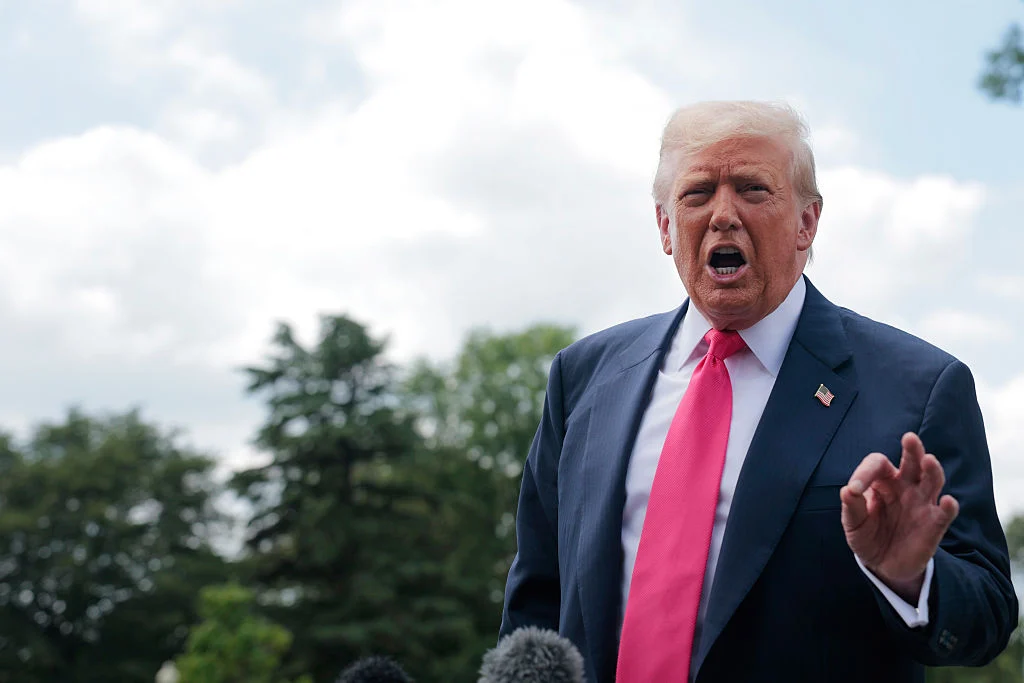
Above photo: President Donald Trump speaks to the media as he departs the White House on July 15, 2025, in Washington, D.C. Anna Moneymaker/Getty Images.
And Replace It With A Police State.
It’s time to return to the kind of bottom-up struggle that helped establish modern public health in the first place.
From the streets to town halls and the courts, it’s a race now.
The Trump administration is fighting to remain a step ahead of the growing popular backlash to its draconian cuts to social programs that millions of Americans depend on — at least until the administration operationalizes enough of the police state it’s practicing on immigrants to put down any such objection.
Budget proposals and “Department of Government Efficiency” (DOGE) cuts switching out the public commons for a police state make the regime’s objectives clear. Under the “One Big Beautiful Bill” budget signed into law July 4, all that will be removed from Medicaid, food stamps, and student loans will be reallocated nearly dollar-for-dollar to the Pentagon, Immigration and Customs Enforcement (ICE), and subsidies and tax cuts for the rich.
The deeply unpopular White House is confronted with a second problem of its own making. It’s a trap already apparent during Donald Trump’s first term. In letting go federal employees or replacing them with incompetent sycophants, the administration is having difficulty running its political relay to the fascist finish line.
As Homeland Security Secretary Kristi Noem’s failure to deploy federal search and rescue until more than 72 hours after the recent deadly Texas floods underscores, the incompetence on display is likely to blow back upon the administration time and again. Within only the last month:
- Health Secretary Robert F. Kennedy Jr.’s “Make America Healthy Again” team used artificial intelligence to write a report plotting out a new vision for health policy that strips out childhood vaccines, ultra-processed foods, and pesticides. The report included false information and fake citations.
- David Richardson, the Federal Emergency Management Agency’s (FEMA’s) new head, shocked FEMA staff when he shared his surprise there was a hurricane season.
- Casey Means, a wellness influencer and Trump’s pick for surgeon general, never completed her medical residency.
- Against their Hippocratic oaths, Veterans Affairs doctors are now allowed to refuse to treat Democrats, the unmarried, or people of any characteristic not presently protected under law.
The U.S. has long suffered the consequences of failing to offer access to well-run federal programs to all Americans. But the new administration’s rollbacks reach another order of abandonment, rejecting any notion of our shared fate.
The solution isn’t the Democrats’ promise to run immigration camps more efficiently. Instead, everyday people in the U.S. need to return to thinking through shared problems together. We need to get back to the bedrock of a society — the kind of organizing that, despite its difficulties and contradictions, this past century helped produce a public commons and a public health infrastructure ostensibly dedicated to protecting us all.
Thinking and planning aren’t abilities limited to the rich and their professional-managerial hires that a separate labor class acts on only by order of a paycheck.
A Brief History Of Public Health
In aiming to turn the federal government into a corporate state that we, the people, have little say in, the Trump administration is trying to offload the state’s contributions to help a society it supposedly represents.
Offload where? Depending on the administrative function, to the states, individual Americans, corporate governance, or the dumpster of history. This includes public health interventions nobody else can provide, however laudable individual efforts are in local mutual aid or philanthropic charity.
The administration, for instance, appears intent on zeroing out the federal infectious disease program.
During his own presidential campaign, RFK Jr. promised to end such research, mentioning the exact diseases with which the U.S. is now besieged. NBC News reported that he promised to order the National Institutes of Health “to take ‘a break’ from studying infectious diseases, like Covid-19 and measles, and pivoting the agency to the study of chronic diseases, like diabetes and obesity.”
This zero-sum budgeting, which turns such research programs into an either-or proposition, emerges only with the intent of gutting the government. “I’m gonna say to NIH scientists, God bless you all,” Kennedy said, according to NBC. “Thank you for public service. We’re going to give infectious disease a break for about eight years.”
As Trump’s secretary of health, Kennedy has followed through:
- He’s accelerated huge cuts to the Centers for Disease Control and Prevention (CDC) and other units focused on infectious disease.
- In late April, the Department of Health and Human Services (HHS) closed down the National Institute of Allergy and Infectious Diseases’ Integrated Research Facility, which conducts experimental work on some of the world’s deadliest diseases, including, presently, Lassa fever, SARS-CoV-2, and Eastern equine encephalitis.
- Last month, Kennedy replaced all 17 members of the CDC’s Advisory Committee on Immunization Practices (ACIP) largely with anti-vaxxers looking to industrialize wellness fads.
- The new ACIP fomented skepticism around influenza vaccines.
- Next generation vaccines for COVID and bird flu were scuttled.
But infectious diseases have always been — and will always be — a social problem. Societies have to do something about them, over and over. Wishing away suddenly resurgent measles and tuberculosis helps make the infections resurgent.
Pathogens, long humanity’s greatest source of mortality, have served as our surest fellow travelers, certainly back to the origins of modern humans 55,000 years ago at the end of the Middle Stone Age when a push in neurological and cultural development produced societies capable of the kinds of civilizational organization we now see all about us.
When groups of humans began to settle into towns and later cities, the more acute infections, such as influenza and diphtheria, spilled over from wild waterfowl and newly domesticated livestock into humans, who now lived at population densities capable of supporting such fast and deadly pathogens over many multiple transmission events.
As societies changed from there, so did the kinds of pathogens they supported.
From the 1890s on, but especially since World War II, when large livestock and poultry monoculture began to be instituted, influenza entered a new phase — its Industrial Revolution. In the course of industrializing livestock production, agribusiness industrialized pathogens — increasing the deadliness of the viruses and bacteria, the rate of their evolution, and the speed and extent of their spread.
Domesticated stock also served as sources for human diphtheria, measles, mumps, plague, pertussis, rotavirus A, tuberculosis, sleeping sickness, and visceral leishmaniasis. Ecological changes brought upon landscapes by human intervention reset circumstances in favor of malaria, dengue fever, and yellow fever, among other diseases, spilling over into human populations from birds, wild primates, and other species.
For most of its history, the cholera bacterium survived eating plankton in the Ganges Delta. Once humanity became urbanized and later integrated together by 19th-century transport, cholera found success in the world’s cities. The bacterium succeeded as long as municipalities drew drinking water from the same places they dumped their sewage. We can see such epidemiologies return when cities today stop protecting their water.
The simian immunodeficiency viruses (SIV) infecting monkeys, chimps, and other non-human primates emerged from sub-Saharan forests when turn-of-the-century colonial logging broadened the wildlife-human interface. It appears HIV, one of the SIVs, evolved when logging expanded the market for butchered bushmeat.
Logging roads also better integrated the deepest African forest with new regional cities. Subsistence farmers driven off their land were forced into faraway labor markets and, separated from their families, bought into the burgeoning sex trade for comfort. With this combination, SIVs successfully spilled over into humans and spread upon the global travel network.
Public Health As Social Struggle
People responded to the new diseases in turn. We see different forms of collective choice organized at varying scales — from workplace to neighborhood and village to the state — undertaking different countermeasures against each new disease.
The novel pathogens placed demands upon societies from imperial China to the Italian city-states and beyond to improve their medical technologies and public health interventions: quarantines, cordon sanitaire, isolation wards, contact tracing, community health officers, errand helpers, early health and unemployment insurance, and population statistics, among other new practices.
In turn, a daisy chain of innovation in agricultural and industrial methods, accelerating demographic shifts, and new settlement reset regional ecologies, disconnecting and reconnecting pathogen and host populations. The new epidemiologies promoted new rounds of disease spillover.
Sadly, the levels of disease control pursued have often been limited by the societal value placed upon who was thought to be infectious or suspiciously infection-free. Jews were burned at the stake for the sorcery of washing their hands. But it wasn’t just ancient prejudice. During the early days of the AIDS pandemic in the West, the “four H’s” were discriminated against as a matter of official epidemiology: homosexuals, Haitians, hemophiliacs, and heroin users.
Even now the Trump administration is searching for diseases to pin on immigrants in order to rationalize sealing off the U.S.-Mexico border.
That is, the modern state almost invariably has a class and a racial/ethnic character. It acts largely in favor of one group over others, including in matters of public health. It’s more complicated than that, of course. For philosopher Alain Badiou, class bears such pressure on social cohesion that the state is organized less around social binding than around its unbinding: how to mush together the system’s lucrative divide kept between rich and poor.
Those of us outside the wealthy classes can arrive at the conclusion that the choice the state now makes isn’t our choice. If we decide so, what are our choices as a collectivity? What are we to do about an ongoing deadly pandemic — COVID-19 — into which the state now no longer cares to intervene but continues to force people to be infected with in order to keep an extractive economy going in the interests of the wealthy?
History offers multiple examples of methods by which those in power have been forced to act in the public’s interest — from public health’s very origins through ongoing efforts to push back against the Trump administration’s campaign to destroy health protections today.
Accumulation Cycling Into Bunker Money
But why are the bedrock basics of pandemic preparation and response such a source of societal friction? The U.S. is the world’s richest country in history by its nominal GDP, wealth concentration, and number of billionaires. Isn’t there plenty to go around, including enough to cover the basic measures that help reproduce the society upon which its wealth depends — from union contracts to pandemic preparedness?
The abandonment is built in. World-systems theorists describe capitalism as a series of cycles of accumulation. Empires first turn money into capital, with which the state supporting these efforts builds out imperial infrastructure. When empires decline, the rich cash out: capital is turned back into money to hoard or invest elsewhere. The infrastructure is left to rot, be monetized, or sold off in a form of asset stripping.
With the emergence of neoliberalism in the 1970s, the U.S.’s postwar empire began to sell off its infrastructure and public commons as a matter of organizational principle. That included the public health system — from disease surveillance to prevention and treatment.
In 2018, Trust for America’s Health reported on the effective decline of health funding. The CDC’s budget then was $7.15 billion, which, adjusting for inflation, had remained flat from the previous decade.
The report described the Public Health Emergency Preparedness (PHEP) cooperative agreement program as the only federal program that supports state and local health departments to prepare for and respond to emergencies. Except for one-time bumps for the Ebola and Zika outbreaks, core emergency preparedness funding had been cut by more than one-third (from $940 million in 2002 to $667 million in 2017).
Trust for America’s Health placed particular focus on pandemics and the need to fully fund the Pandemic and All-Hazards Preparedness Act, the Hospital Preparedness Program, the Project BioShield Act, and PHEP.
The report recommended increasing funding for public health at all levels of government — federal, state, and local. It called for preserving the Prevention and Public Health Fund; funding preparations for public health emergencies and pandemics; establishing a standing public health emergency response fund; and surge funding upon an emergency to avoid the delays that were apparent in the Ebola outbreak, the swine flu pandemic, Hurricane Sandy, and the Zika outbreak.
Trust for America’s 2024 report repeated the call for more funding, noting the added fiscal pressures the COVID pandemic presented, including on the Advanced Molecular Detection program, public health workforce and infrastructure, the Center for Forecasting and Outbreak Analytics, wastewater surveillance, vaccine coverage for people without insurance, and public health communication.
The latest Trump budget instead cuts over $700 million from PHEP, $370 million from global health, and $77 million from sexually transmitted diseases prevention. A new Annals of Internal Medicine report estimated the cuts to Medicaid, leading to as many as 7.6 million Americans losing their coverage, will kill over 16,000 Americans annually. More recent estimates place the lost coverage at 17 million Americans.
There are signs the epochal asset stripping at this end of the cycle of accumulation is now accelerating by the month, including of government itself. The boy wonders that Elon Musk left behind at DOGE are still striking out essential services line item-by-line item.
Are such destructive efforts unprecedented? Can the public health demolition be rolled back?
Remembering Our Revolutionary Selves
Political scientist Corey Robin spoke repeatedly of the first Trump administration’s deeply American nature. White supremacy, environmental destruction, and separating children from their parents in the name of scripture — from Native genocide and Black enslavement to Obama’s ICE — are indeed at the core of the country’s legacy, despite the present administration’s efforts to suppress such histories.
Many people, however, including more recently Robin himself, have since been disabused of thinking of Trump’s autocratic bluster as just part of a historical continuity. In this second Trump administration, behavior, belief, and opportunity have folded together into the beginnings of actually acting out the most fascistic of fantasies.
From day one in the White House in January 2017, Trump launched a long campaign — across tweets, speeches, ceremonies, and personnel appointments — to turn governance into a matter of orders rather than law, expertise, policy, or even lucrative optimization beyond his familial bourse. Both Trump administrations have always been in shambles. But like his real estate business and bankruptcy upon bankruptcy, a well-oiled machine is never the point.
Competence isn’t enough. Liberals, philosopher Alain Badiou explained, mistakenly fetishize a smoothly operating capitalist parliamentarianism as the only means by which ideas about our collective fates can be formed and judged. Judged for whom? we need to ask. Congress has long been bought by capital. Sen. Cory Booker symbolically followed his record filibuster by voting in favor of industry-written cryptocurrency regulation and helping confirm Charles Kushner — Jared Kushner’s dad who has been convicted of illegal campaign donations, tax evasion, and witness tampering — as U.S. ambassador to France.
If the outcome of keeping capitalism trucking is shared across the political class, fascism subjectivizes the future for ruler and ruled alike into an event horizon of no return, one ICE 1099-paid raid or stochastic assassination at a time. Fascism’s aim is to get millions to find their identities not in their neighbors’ well-being — the core of public health practice — but in bashing in their neighbors’ heads.
In between these poles, in an age of shared internet isolation, the left must somehow support everyday people in finding new means by which to actualize their best ideas and interventions for all when once they were told by their liberal “betters” that they shouldn’t trust themselves.
The public health infrastructure now rotting away was once a revolutionary project to which the labor movement and community organizations successfully bent the U.S. political class. Together, everyday people helped construct the better parts of the modern state that first neoliberalism and now Trumpism is winding down at this end of the cycle of accumulation.
Working people can demand the public commons they deserve — but they need first to remember what they accomplished together over many decades against all odds.
This piece was adapted from Pandemic Research for the People Dispatch #10 on collective choice and public health.