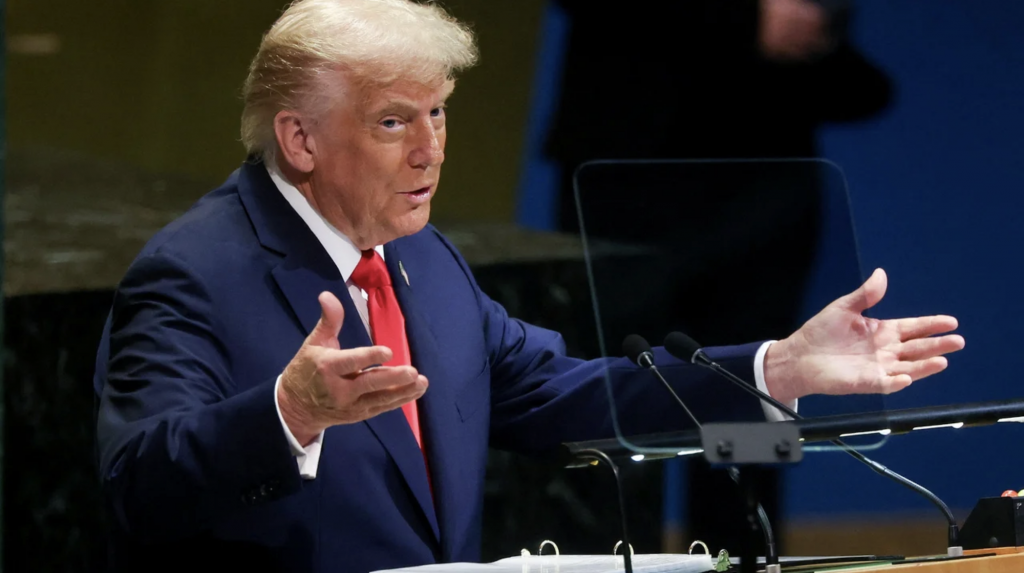
Trump spoke to the United Nations General Assembly on September 23.
His speech named the countries in his crosshairs, doubled down on some of his most aggressive and disruptive policies, and challenged the very idea that the UN still matters.
With multilateralism increasingly in the past and an international system riddled with crisis, President Trump addressed the United Nations General Assembly on September 23. Despite his largely unenthusiastic delivery, the content of Trump’s speech was, to put it casually, absolutely bonkers. This does not mean it shouldn’t be taken seriously.
Trump began with the standard triumphant rhetoric about his return to the presidency that marks many of his speeches: The United States is coming out of four years of chaos, no more “invasion at the border,” there’s never been a better economy. These claims contrast with a starkly different reality. The president is in a moment of significant weakness with a historically low approval rating, economic indicators increasingly signalling disaster, and important cases of resistance to his agenda from Los Angeles to D.C. to Chicago.
It was then that Trump began to address his more international concerns, beginning with a takedown of the UN. While Trump briefly suggested that the organization could be valuable and is simply not meeting the moment, everything else he said gave the impression that the UN is destined to be irrelevant. He claimed that he had to take the initiative to end seven wars because as he put it, “All [the UN] seem to do is write a really strongly worded letter and then never follow that letter up.”
In line with his “peace through strength” approach to foreign policy, Trump bragged about militarily attacking Iran’s nuclear program as an action that only the United States has the power to use. He then denounced the symbolic calls for a Palestinian state from countries including France, Canada, Australia, and the United Kingdom, arguing that this would only strengthen Hamas, and that countries should instead call for the release of Israeli hostages in Gaza. This rhetoric will likely have real consequences at a time when an emboldened Israel is moving forward with an expansionist agenda from Gaza to the West Bank to Syria, directly attacking other Middle Eastern powers such as Qatar, and threatening all opposition to its genocide such as its smearing of the Global Sumud Flotilla.
Trump then spoke about Ukraine, the other main conflict discussion at the UN this week. While Trump has been somewhat erratic in his approach to the war and all parties involved, this time he took a much more antagonistic approach to Russia. He went as far as to threaten sanctions if Russia remains unwilling to negotiate an end to the war. This threat was limited, however, and more directed at dominating Europe, with Trump saying the EU would need to stop buying Russian oil for him to enact sanctions. Not mentioned was that Trump’s close ally, Hungary, is Europe’s main importer of Russian fossil fuels. Trump also named China and India as the “primary funders” of the war due to their purchasing of Russian gas. In a later part of the speech Trump added Brazil to the list of countries that he sees as uncooperative; an important reminder that the country is still in the Trump administration’s crosshairs for convicting his ally, former president Jair Bolsonaro.
In one of the most dramatic parts of the speech, Trump went on a screed against immigration. This screed was international in scope, arguing that every country should see immigrants as a threat and close their borders. As he put it, “Your countries are going to hell.” It was an appeal to his own xenophobic base in the United States, and a call to similar far-right movements in Europe to wage further war on immigrants. Trump brought the discussion of artificial intelligence into the mix, lauding the role it can play in carrying out surveillance and deportation.
The last topic of focus was “green energy” which Trump deemed a threat to economic prosperity. He directly challenged the legitimacy of climate change, joking about how it was first called “global cooling,” then “global warming.” Against the idea that countries should prioritize a transition to green technology, Trump posited that this is impossible in a system where other countries will keep using fossil fuels. He argued that the result is that countries that don’t take advantage of fossil fuels will fall economically without even being spared from pollution. As he sees it, “air flows,” “water flows,” so pollution from one country will inevitably reach another.
Overall, Trump’s speech shows that as his far-right program proves insufficient to resolve the crises that the United States is facing domestically and internationally, he will double down on the pillars of his reactionary program. These include a foreign policy marked by unilateral military and economic aggression towards making strategic countries submit to U.S. demands, as well as quickly intensifying domestic war on immigrants which remains one of the stronger parts of his agenda.
Despite the reactionary, nationalist ideas he put forward, Trump’s speech highlighted an important truth: The United Nations is incapable of resolving the crises of the moment. This was a system designed to advance the interests of U.S. imperialism when the United States was on the rise as a world hegemon, and capitalism was organized through the now dying model of neoliberalism. Instead of the imperialist “internationalism” of the UN or the reactionary unilateralism Trump puts forward, it will take a workers’ internationalism to address the wars and crises that are tearing the world apart.