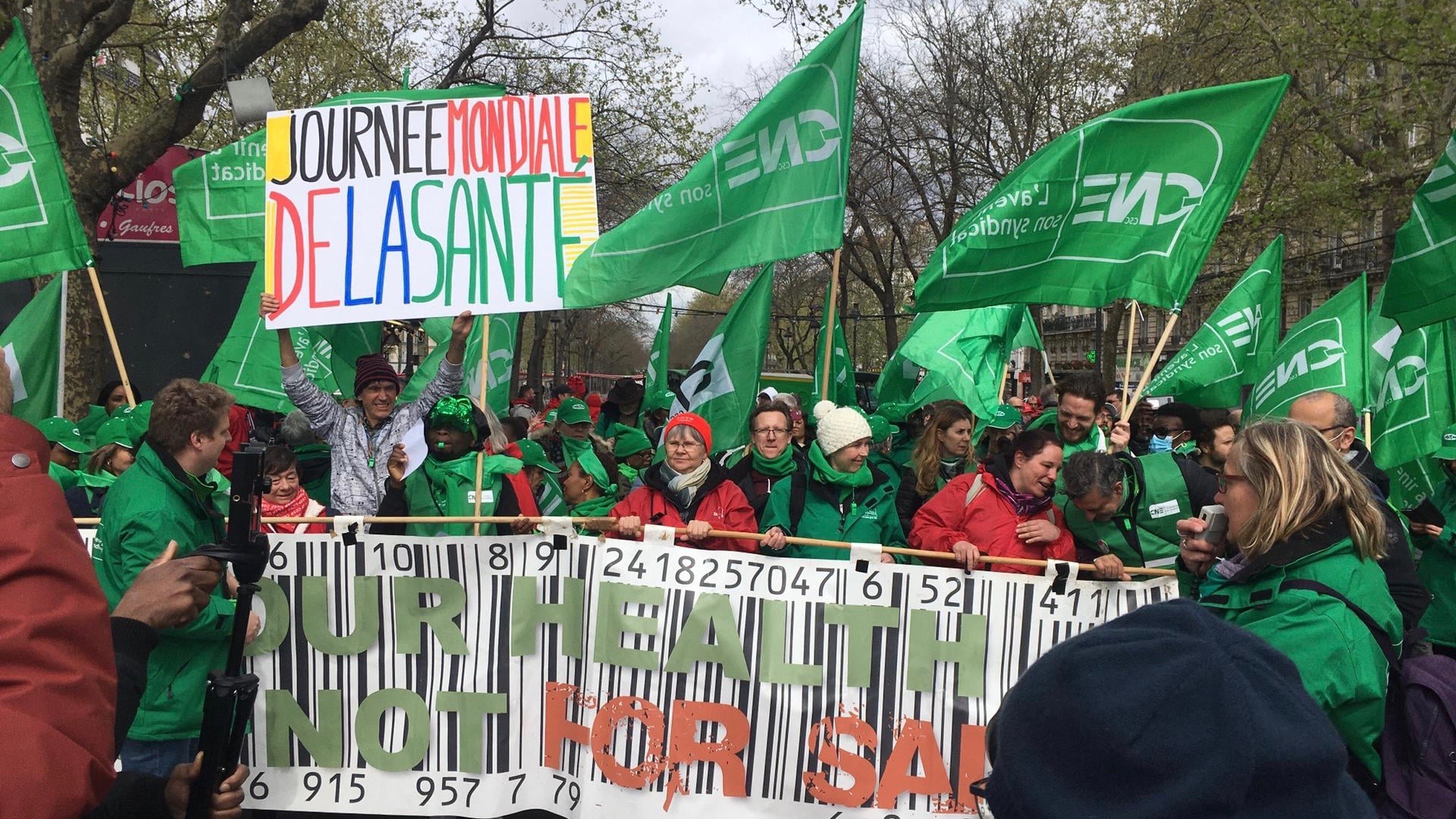
Above photo: Health workers and activists during a World Health Day 2023 protest. European Network Against Commercialization of Health and Social Protection.
Reclaiming the right to health from market logic.
Universal Health Coverage dominates global health policy, yet millions remain excluded as governments fail to address issues of power and justice in health.
Universal Health Coverage (UHC) continues to dominate the global health agenda. At this year’s World Health Assembly (WHA78), UHC was again hailed as the cornerstone of resilient health systems. However, while governments reaffirmed their commitments, millions of people continue to face catastrophic health costs, essential services remain out of reach, and primary healthcare systems are stretched beyond breaking. The world is not on track to achieve UHC – and it is not because of a lack of guidance. It’s because of the wrong strategy.
From selective packages to strategic purchasing, the dominant UHC model has been hijacked by a market logic that treats health not as a right but as a commodity. Public financing is channeled into insurance schemes that contract private providers. New “impact investment” platforms offer concessional loans to build primary health care while deepening debt burdens. Across World Health Organization (WHO) reports, health is discussed as a technical delivery problem, rarely as a question of power, justice, or democracy. There are some notable exceptions to this, e.g., the 2008 Marmot Report and the 2025 Social Determinants of Health Equity Report, which demonstrate evidence-based work generated by the WHO secretariat showing that the unequal distribution of power, money, and resources is driving health disparities – and this trend has been worsening over time.
UHC is not failing because governments are incapable: it is failing because the current model was never designed to serve the public in the first place.
Austerity and the outsourcing of care
The UHC strategy promoted by WHO and global financial actors reinforces privatization through the back door. Under the guise of “efficiency,” services are outsourced, and profit is prioritized over people. Publicly funded health insurance schemes now subsidize corporate actors, even as public hospitals and primary care clinics continue to be under-resourced. This is not a gap in implementation, but a systemic feature of a design that puts markets before people.
Health care is not a commodity. Yet medicines, diagnostics, and essential technologies remain governed by monopolistic patents, controlled by pharmaceutical giants, and priced far out of reach for most of the world. WHO’s own resolutions have failed to challenge these structural barriers to access. The absence of serious engagement with TRIPS flexibilities, public production, or price regulation reveals a dangerous silence.
Debt, dependency, and false solutions
One of the biggest contradictions in today’s UHC agenda lies in its financing mechanisms. The Health Impact Investment Platform, the UHC Partnership Reset, and the new Trust Fund for the Health Workforce are built around the same flawed logic: de-risk public investment to attract private capital. Instead of canceling debts or enabling fiscal justice, low- and middle-income countries (LMICs) are pushed into new layers of structural dependency. As public health systems collapse under debt payments, financial protection deteriorates, and health inequalities deepen.
These are political problems, yet the current model of UHC is increasingly governed by elite technocracies – global consultancy firms, philanthropic funders, and remote policy platforms – rather than by the people most affected. The sidelining of civil society and community health workers in health policy decision-making mirrors a broader erosion of democratic governance in global health. It is also fundamentally at odds with WHO’s own resolution on UHC and participation.
Vertical programs, selective packages, and fragmented care
The failure of integration is another symptom of this broken system. Rare diseases, NCDs, and lung health remain in vertical silos, poorly linked to primary health care systems. At the most recent World Health Assembly, there were efforts to ensure that surveillance and imaging are scaled up, but preventive and promotive care are chronically neglected. The “selective” logic of UHC leads to care gaps and care foregone, especially for rural, racialized, and marginalized populations. Meanwhile, health information systems remain weak, fragmented, and unaccountable.
Measurement itself has become a political battleground. Current UHC indicators fail to capture unmet needs, quality of care, or the lived realities of inequality. By focusing on narrow service indicators, these metrics obscure the very inequities they are meant to expose.
Decolonizing UHC: Beyond inclusion to transformation
While WHO Member States have begun discussing using artificial intelligence (AI) for health systems strengthening measures and the role of traditional medicine in health promotion, these discussions often lack the political clarity needed to center justice. Without addressing the underlying inequities – colonial knowledge systems, extractive data infrastructures, and geopolitical power imbalances – technology and inclusion risk becoming fig leaves.
AI, in particular, cannot be “ethically integrated” into health systems unless data sovereignty and participatory governance are ensured. In a world where data equals power, imperial logics continue to shape which technologies are developed, for whom, and under whose control. The People’s Health Movement (PHM) has called for the urgent decolonization of health knowledge and technologies, placing people, not platforms, at the center.
A Public Pharma future for UHC
A different vision of UHC is not only possible, but is already being demanded by communities and movements worldwide. At WHA78, PHM advanced a transformative proposal for Public Pharma: a public model of research, development, and production of medicines and diagnostics grounded in the right to health rather than corporate profit. In this model, primary health care is publicly financed and publicly delivered. Medicines and diagnostics are treated as public goods and the health systems in which they are used are democratically governed and community-led.
PHM’s proposal calls for investment in public health systems instead of private insurance schemes, and urges the development of sovereign manufacturing capacity for essential technologies. This vision also demands the cancellation of illegitimate sovereign health debts and the expansion of fiscal space to support domestic financing for public health systems. It emphasizes the need to democratize data and ensure meaningful community participation in health governance. In the document, PHM also argues that services should be integrated across all levels of care, breaking away from the siloed logic of vertical programs. In this context, progress should be measured by quality, equity, and unmet need – not simply access. And finally, it calls for the decolonization of health technologies and the centering of traditional knowledge systems.
Right to health cannot be reclaimed without confronting power
The failures of UHC are not accidental. They reflect decades of neoliberal policy choices, embedded in imperial structures and driven by private interests. But the tide can turn. To truly achieve health for all, we must confront the corporate capture of healthcare systems and resist the expansion of financially driven models of care.
The WHO must be more than a clearinghouse for donor interests. It must become the champion of public systems, equity, and health sovereignty. The next phase of global health must be built not on multistakeholderism, but on people’s rights and public leadership. Where multistakeholderism divides and derails health goals, it must be exposed – not celebrated. Let this be the moment where health care is reclaimed from the logic of the market and returned to the public.
People’s Health Dispatch is a fortnightly bulletin published by the People’s Health Movement and Peoples Dispatch. For more articles and to subscribe to People’s Health Dispatch, click here.
David Franco is a scientist and public health activist based in Belgium. In the People’s Health Movement, he focuses on the Public Pharma for Europe (PPfE) initiative. David holds a PhD in Pharmaceutical Sciences from the Free University of Brussels.
Indrachapa Ruberu is a longtime peace activist and volunteer with PHM Sri Lanka and OWSD-SLNC, involved in community projects. Indrachapa holds a degree in Pharmacy and is currently pursuing postgraduate studies in pharmaceutical sciences.