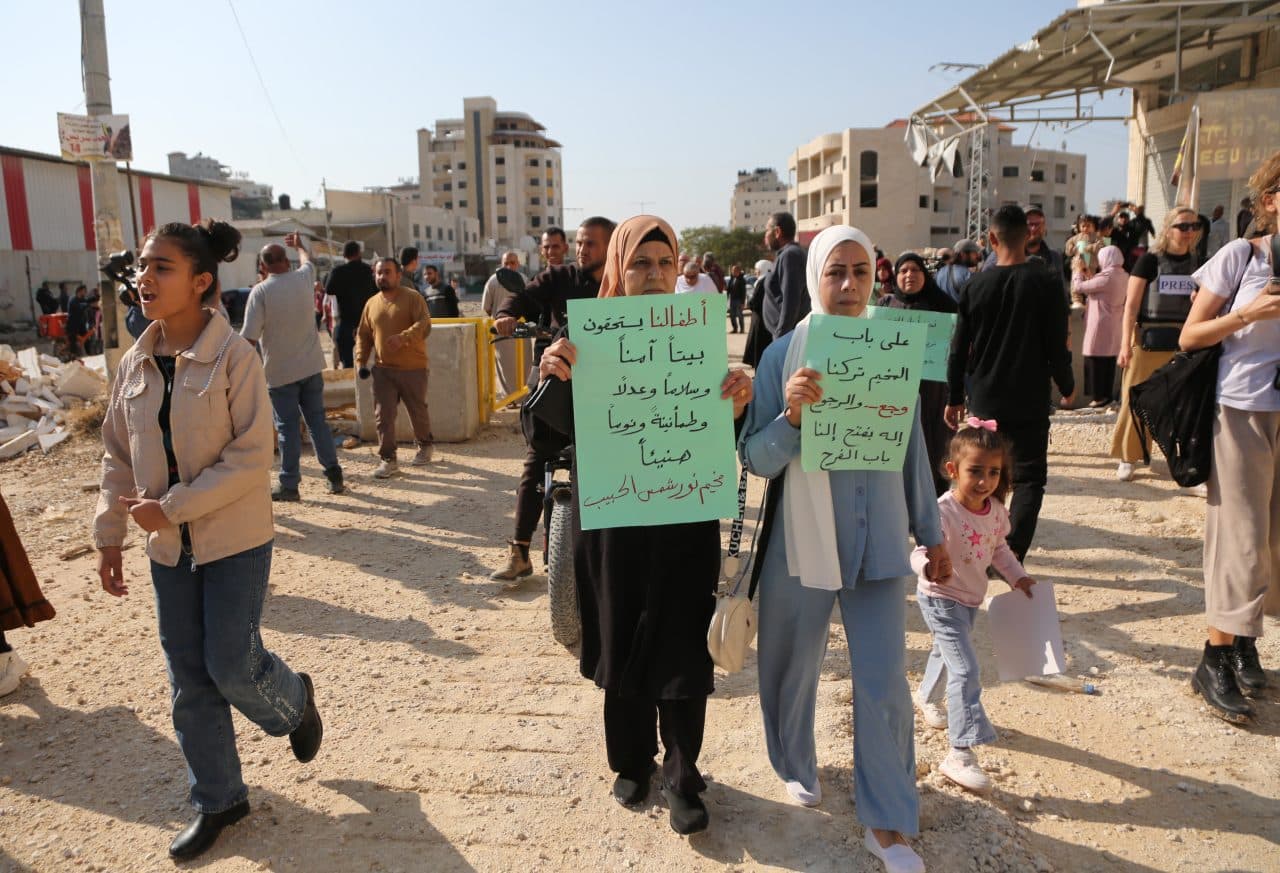
Above photo: Displaced Palestinians stage a protest at the entrance to the Nur Shams refugee camp in Tulkarem, calling for their right to return to their homes in the camp, November 18, 2025. Mohammed Nasser/APA Images.
As displaced Palestinians wait to return to their homes.
Palestinians displaced from refugee camps in the northern West Bank are demanding to return to their homes after an Israeli military takeover of the camps, and they fear that proposed U.S. plans for rebuilding the camps will completely erase them.
It has been well over 200 days since the people of the Tulkarem, Nur Shams, and Jenin refugee camps were forced out of their homes by the Israeli army during its offensive in the northern West Bank dubbed “Operation Iron Wall.” Over 40,000 Palestinians from these camps have been displaced for the past eleven months, many of them living in deplorable conditions, and without a clear return to their homes on the horizon.
These thousands of families have been displaced within their own cities, and are totally reliant upon community resources for survival. Israeli forces are now stationed in the now-depopulated camps, and has kept them empty as it aims to uproot armed Palestinian resistance groups, which were based in the camps before the Israel’s operation.
Last Thursday, Human Rights Watch released a report based on its analysis of satellite imagery, concluding that about 850 buildings in the three refugee camps were destroyed or sustained heavy damage within six months of the start of the Iron Wall offensive in January. Human Rights Watch stated that “Israeli forces committed forcible displacement in violation of the law of occupation under international humanitarian law that amount to war crimes.”
The conditions imposed on Palestinians from these camps impact every aspect of their daily lives, adding to the humanitarian burden on the limited resources of the cities and their community.
“The most obvious impact is currently on the education of children, who used to go to the UNRWA schools in the camps, which have now been closed down,” Hussein Sheikh Ali, a social activist in Tulkarem, told Mondoweiss. “Thousands of children haven’t attended a day of school for 10 months.”
“After a lot of waiting, some children in primary school age were relocated to government schools in the afternoon, but not middle or high school students,” he added. “This is creating a growing crisis of young people without school in the city.”
Another side of the crisis is health, Ali continues. “Thousands of chronic disease patients depended on UNRWA health centers, and they have lost that support, especially the elderly,” he added. “But beneath the obvious sides of the crisis, there is the increasing poverty of hundreds of families from the camps, who depend on working permits in Israel and whose permits have been revoked by the occupation, as well as those who had small shops and businesses in the camps who also lost everything.”
“In our association, the Wadi Al-Hawareth Charity Association, we have been distributing over 1,000 hot meals to displaced families every day,” Ali noted. “We rely on donations from the community and local donors, but the need is much greater than our resources, and recently we reduced our distribution to once every two days to cover as much need as possible.”
Ali stresses that the current response by local civil society to the needs created by the displacement of the camps “is not sustainable in the long term, and all local associations act in the hope that there will be a solution soon.”
Meanwhile, displaced Palestinians continue to struggle to maintain their social cohesion while responding to their needs. Najat Butmeh, a displaced Palestinian from the Jenin camp, who is a school teacher and the director of the “Warm House” women and children’s center in the camp, told Mondoweiss that “the most important thing that displaced people from Jenin refugee camp are holding onto is their sense of community, staying in touch with each other, and trying to help each other out.”
Demanding return
“Although the ‘Warm House’ center in the camp has been closed by the occupation army, as with all of the camp, we have maintained our activities from a new location in Jenin city,” Butmeh said. “We continue to organize psychological support for women and children, and support classes for children of displaced families.”
“But there is a lot of need, especially for families who have lost their source of income and also many of their belongings, and who, in addition to everything, have no place to go, except back to the camp, which is why we all continue to demand to be allowed back,” she said.
Last week, hundreds of displaced Palestinians protested at the entrances of the Tulkarem and Nur Shams refugee camps, demanding to be allowed back into their homes. Israeli forces opened fire to disperse protesters, injuring a journalist. Speaking to Palestinian media at the protest, the head of the representative committee of displaced families, Nihad Shawish, said that “people not only feel the difficulty of returning [to their homes], but also feel that the camps have been completely erased.”
“No Palestinian side has been able to force the [Israeli] army to leave the camp,” Shawish said. “This is pushing people to protest, to affirm that return is a right, and not a gift from anyone.”
On Thursday, the director of UNRWA affairs for the West Bank, Roland Friedrich, said in a statement that the Israeli army had issued orders last week to completely demolish 12 buildings in Jenin refugee camp and partially demolish 11 more buildings.
The UNRWA chief said that “systematic destruction goes against the basic principles of international law, and only serves to tighten the control of Israeli forces over the camps in the long term,” adding that “the camps need to be rebuilt — not further destroyed — and their residents allowed to return and restore their lives.”
‘Reconstruction’ as destruction
Talks of reconstruction had already begun last summer, with a U.S. proposal to start rebuilding in the Nur Shams refugee camp in Tulkarem. In July, the U.S. coordinator for the West Bank, Michael Enzel, visited the northern West Bank camps to discuss reconstruction possibilities, especially in Nur Shams. He was accompanied by Tulkarem’s governor, Abdallah Abu Kamil, who considered the U.S. plan “the beginning of a comprehensive solution for the question of refugee camps in the northern West Bank.” Kamil added that Fenzel told the Palestinian Authority (PA) that the Israeli army had finished their operations in Nur Shams, which would allow it to be the starting point for reconstruction in the rest of the camps.
The governor stressed that reconstruction would guarantee the restoration of all destroyed infrastructure, including water and electricity networks. She then affirmed the PA’s disposition “to talk with any side” in order to ensure that reconstruction actually goes through, all while affirming that the PA’s priority was “the rebuilding of the camps and the return of our people to their homes.”
But not everyone was quite so eager to receive Fenzel with open arms. The representative committee of the displaced families refused to participate in Fenzel’s visit, rejecting the U.S. plan. Nihad Shawish, head of the committee, told Palestinian media at the time that the U.S. reconstruction plan was “dangerous,” because it seeks to pave streets in place of many of the demolished homes. This, Shawish said, would “transform the camp into a neighborhood of the city, ending the concept of refugee camps” in the West Bank.
Shawish stated that displaced Palestinians “are the ultimate decision-makers regarding what happens in the camps,” and that “they want to have their homes and their belongings as they had them before.” He stressed that Palestinians “want the rebuilding and the return of all of the camp and its people, not a part of them only.”
In addition, there is a fear that this reconstruction model, if carried out, would become a precedent for Palestinian refugee camps elsewhere in the West Bank. And possibly serve as a precedent for Gaza refugees today.
Refugee camps, which have historically and contemporaneously been fertile ground for the Palestinian national movement and resistance, have always been at the center of Israel’s crackdown efforts.
The refugee camps’ high density and poverty conditions have created a special community culture, which has provided the basis for all sorts of political affiliations. Most importantly, refugee camps continue to represent for Palestinians the continuity of the refugees’ plight. This reality underlies Palestinian skepticism towards reconstruction plans that would change the spatial configuration of the community they have lived in for 77 years.
Three months after Fenzel’s visit, reconstruction hasn’t begun, and the Israeli army hasn’t withdrawn from any of the northern West Bank camps. As reconstruction plans are drawn to create a new reality where Palestinian refugee camps would no longer be the living embodiment of the right of return, displaced Palestinians continue to wait to return to the homes where they lived as refugees.