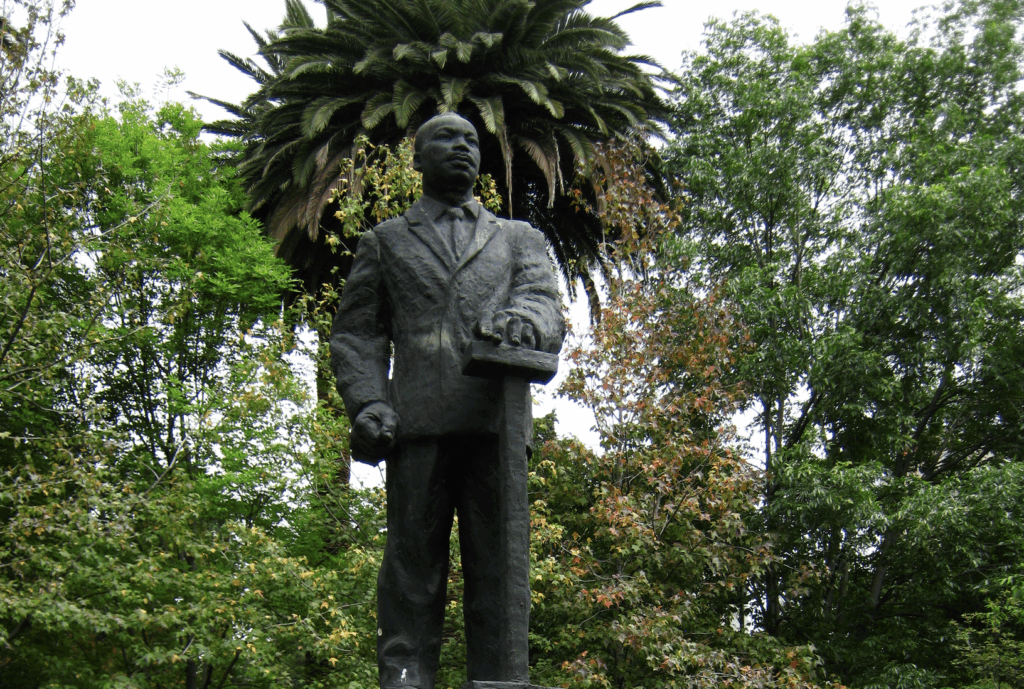
Above photo: A Martin Luther King statue in Mexico City’s Lincoln Park. Wikimedia / Carlos Perez Chavez.
Almost undetected, Martin Luther King’s radical revolution of values crossed the U.S. Border into Mexico.
Quietly, Martin Luther King Jr.’s commitment to Gandhian nonviolence, his effort to end poverty, and his push for a “radical revolution of values…from a thing-oriented society to a person-oriented society” crossed the U.S. border despite the walls. While the U.S. is mired in deep democratic decay, division and chaos, the Mexican people have given King’s ideas and actions new life south of the border. What can we learn from this grassroots democratization movement that from 2018-2024 lifted 13.4 million people out of poverty and significantly reduced inequality despite the challenging pandemic years?
Dr. King’s last book asked, “Where Do We Go from Here: Chaos or Community?” Since King’s death, the U.S., despite the national King holiday and monuments in his honor, has clearly chosen the violent path of “chaos.” Meanwhile, key Mexican leaders embraced King and chose to nonviolently organize “community.” This unity in community is seen most clearly today in the around 80% approval rating of the first woman president of Mexico, Claudia Sheinbaum, who since October 2024 has been leading the “second floor” of the democratic nonviolent Fourth Transformation of the country. Sheinbaum, at the G20 summit in November 2024, has even advocated for the international expansion of her domestic “Sowing Life” program by reallocating 1% of global military spending to reforestation to reduce rural poverty and environmental degradation. She said her “proposal is to stop sowing wars and instead sow peace and sow life.” The program has already spread to Belize, El Salvador and Honduras.
This current organized nonviolent Mexican movement arguably goes back to 1968, the year of King’s assassination, when 10 days before the opening ceremony of the 1968 Summer Olympics in Mexico City, a student movement was massacred in the Tlatelolco district. The military killed students from the National Autonomous University of Mexico, or UNAM, the National Polytechnic Institute, or IPN, and other universities. Immediately upon taking office as president, in her first morning press conference, Sheinbaum noted the importance of this tragedy, calling herself “a child of 1968,” and issuing a government apology for the Tlatlelolco massacre.
Sheinbaum was in elementary school in Mexico City when the Tlatelolco massacre took place. Her mother, Annie Pardo Cemo, participated in the 1968 protest movement as a university professor at IPN. The institute expelled Pardo for her involvement. Like King’s experience in the U.S, records now reveal that the equivalent of Mexico’s FBI, the National Center for Investigation and Security, or CISEN, was spying on Sheinbaum and her family since she was a young child. Regardless, Sheinbaum has continued to carry on this family legacy of nonviolently fighting for social justice as a young student until now as president.
Since 1968, various movements of students, workers, women, farmers, Indigenous people, small businesses, retirees, and other civic groups have been fighting to democratize the country and against neoliberal policies that only brought violence, poverty and inequality. This includes multiple efforts to oust the 70-plus years of one-party rule by the Institutional Revolutionary Party, or PRI. Initially, reform was sought in the 1970s internally through the PRI and then later through new political parties in 1989 and in 2014. Election fraud by the PRI and their allies prevented a real transfer of power in the 1988, 2006 and 2012 presidential elections. These last two elections, in 2006 and 2012, helped to coalesce many of these separate movements into a more coordinated movement that has nonviolently transformed the nation radically in only seven years since it won the presidency in 2018.
The Four Transformations Of Mexico Toward Democracy And Morena
The first Mexican transformation toward democracy was the War of Independence from Spain (1810–1821), which not only decolonized the country but importantly declared the abolition of slavery and fought for the equality of rich and poor. The second transformation was the Reform War (1858-1861), which was a civil war won by progressive forces that separated the church and state and ultimately ousted the French rulers the Mexican elite brought in to recolonize the country. The third transformation was the Mexican Revolutionary War (1910-1920), which was one of the first revolutions for social justice in the 20th century. The revolution resulted in a more progressive constitution than that of the U.S. Mexico’s 1917 constitution, for example, included the right to education, workers’ right to form unions, strike, a minimum wage, an eight-hour workday, restrictions on child labor, and land reform. The Fourth Transformation (2018-present) is being led by Sheinbaum, who is from a new “movement-party” officially registered in 2014. It is called the National Regeneration Movement (Movimiento de Regeneración Nacional, which is known by its Spanish abbreviation MORENA and simultaneously means “a dark-skinned woman”).
Sheinbaum explicitly says she is building the second floor of the Fourth Transformation after Andres Manuel Lopez Obrador, or AMLO, built the first floor when he was elected for a six-year term as president in 2018. Fraud prevented AMLO from taking office in 2006 and 2012. Obrador is the founder of MORENA and has shared in his daily press conferences that King and Gandhi have been his “examples,” his “teachers.” As candidate, opposition leader, and president, AMLO has demonstrated his commitment to nonviolent social change. Consider the following quote from July 2019:
We want to carry out the Fourth Transformation of Mexico’s public life without violence, peacefully. The three transformations our ancestors made, due to circumstances, were carried out with weapons; but now we have the good fortune to be able to carry out true change, a peaceful transformation. That is very important…it will be as profound as Independence, the Reform, and the Revolution.
Morena Has Had Great Results In A Short Timeframe
The nonviolent movement-party, MORENA, has had great results in a very short timeframe. After only 11 years since registering the MORENA movement as a political party, it now controls the presidency, both branches of congress, the Supreme Court and most state governorships. Since governing in 2018, MORENA has implemented efforts to end corruption and use those funds for an array of universal social programs like senior pensions, stay-in-school scholarships for young people, and paid apprenticeships for young adults. It has more than tripled the minimum wage, passed workers’ rights legislation that helps even domestic workers, independent Uber-like workers, and all workers to obtain a union more easily. The movement-party has passed constitutional amendments ousting corrupt judges through elections and strengthened the previously privatized and weakened state sectors of energy (both electricity and oil), healthcare and education. It has banned genetically modified corn and restricted water concessions for private companies. MORENA has built housing, hospitals, schools, universities, roads, airports and landmark public works projects like the Train Maya and the Interoceanic Corridor of the Isthmus of Tehuantepec. The CIIT connects the Atlantic and Pacific oceans and offers a new trade route similar to the Panama Canal. None of this was easy as the small but powerful privileged elite in Mexico and beyond, including the United States, has sought to block MORENA’s efforts.
Why Has Morena Been Successful?
AMLO, who grew up in the southern, more impoverished part of Mexico where more Indigenous people live, studied other nonviolent movements, learned from them and applied those lessons to the Mexican context. Here are four strategic nonviolent organizing principles that were key to MORENA’s success and are consistent with King and Gandhi’s movement experience:
1. Demonstrate commitment and perseverance. Like Gandhi and King, AMLO and the MORENA movement-party have faced great obstacles and unjust attacks for decades. Despite these enormous challenges from the elites to protect their privileges and the inevitable setbacks, AMLO, Sheinbaum and MORENA have demonstrated their commitment and perseverance. This courageous commitment, based on the ideals and principles of democracy through nonviolence, is ultimately contagious and necessary to gain the respect of the people and build a mass movement.
2. “For the good of all, first the poor.” Both King and Gandhi emphasized helping the most vulnerable first. King, for example, said, “Ultimately a great nation is a compassionate nation. No individual or nation can be great if it does not have a concern for ‘the least of these.” MORENA’s Mexican Humanism economic model begins by helping the poor and every Mexican knows AMLO’s famous saying, “For the good of all, first the poor.” The incredible poverty reduction results published in August 2025 by the respected National System of Statistical and Geographical Information, orINEGI, proves that MORENA’s approach works.
3. There is no transformation without organization. Gandhi sought to organize India by traveling to its many villages and creating bottom-up local organizations that could participate in transformative efforts to make the Indian National Congress more responsive to the needs of its people and thus change and free the nation. Obrador’s organizing similarly built a grassroots movement that eventually led to his election as president in 2018 by famously visiting each of Mexico’s 2,477 municipalities. AMLO, Sheinbaum and MORENA repeatedly remind Mexicans that there is no transformation without organization. They declare that “Only the people can save the people, and only organized people can save the nation.”
4. Real change requires a revolution of values/consciences. Much like King’s call for a “Revolution of Values,” AMLO, Sheinbaum and MORENA have been successful because they have implemented a “Revolution of Consciences” by transforming and educating people. Both AMLO and Sheinbaum have effectively educated the Mexican people through their daily morning press conferences, which are then spread throughout the nation via social media by MORENA and supporters. These “mañaneras” regularly explain Mexican history, MORENA’s principles and programs, and the elites’ efforts to halt the Fourth Transformation. The movement-party has also created and distributed a remarkable Gandhi-like “100 Postulates [truths]” document summarizing its understanding of history and its principles to educate and guide the Mexican people in its democratic transformation.
What Challenges Does Morena Face?
As we approach the one-year anniversary of Sheinbaum’s time in office and MORENA’s seven years in office, the movement-party understandably still faces many challenges after decades of neoliberalism. These challenges are internal and external.
Internally, the movement-party faces the challenge of effectively dealing with “grasshopper” candidates who switch to MORENA from other corrupt parties for a better chance at winning but who have not had a real “Revolution of Conscience.” The new movement-party, whose strength is at the national level, also needs to strengthen its candidates and governance at the municipal and state levels. MORENA additionally needs to continue working to strengthen the independent democratic labor movement, so democracy and economic fairness is experienced every day in the workplace across the nation. In 2024, only 12.8 percent of workers had a union in Mexico and many of those unions are undemocratic company unions. This must change so the movement-party can continue to be a movement and not just a political party. MORENA has relied on the military and the National Guard to build its public works projects, fight corruption and reduce crime. While public security is improving some and MORENA is seeking to address the root causes of crime by reducing poverty and increasing opportunities, there is a legitimate question of whether use of the military and the National Guard will be able to secure peace in the long run. Is this means of reliance on military forces to secure peace contradictory, especially when the United States is the main consumer of drugs and the source of the vast majority of guns that arrive in Mexico?
Externally, MORENA faces the historic challenge of its almost always antagonistic neighbor, the United States. This antagonism has worsened with the Trump administration. Mexico is the U.S.’s biggest trading partner so its economic destiny is deeply tied to its neighbor. As a rapidly declining empire, the U.S. could drag Mexico down with it if it does not make quick adjustments. Fortunately for MORENA, Mexico is becoming more self-sufficient in essential sectors like food and energy, and it is strengthening its economic relationship with other countries. However, the key question is: Can they do it fast enough, and can they delicately balance its actions with the United States.
Ultimately, both Mexico and the United States will be in a deep crisis if they do not have a mass movement with a real revolution of values as advocated by King. Unlike the United States, Mexico seems to be headed in the right direction. Maybe we can learn something from Mexico’s nonviolent Fourth Transformation?