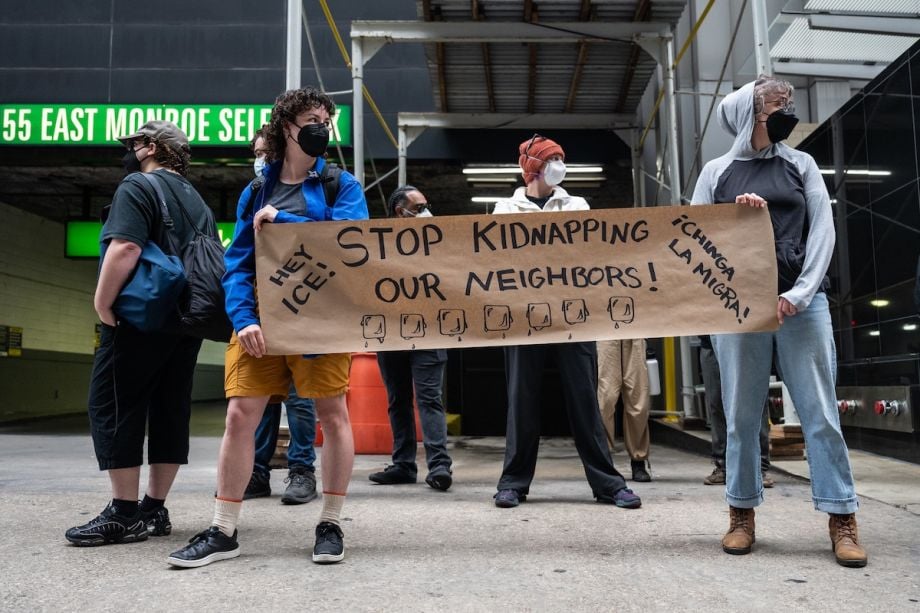
Above photo: Protesters block both the entrance and exit to the underground garage for an immigration courthouse in Chicago on June 13, 2025, in an apparent attempt to prevent federal agents from arriving at the courthouse to detain individuals showing up for hearings. Paul Goyette.
This Legal Guide Can Help.
Thousands of nonprofit leaders have turned to New York Lawyers for the Public Interest’s recent guide to protect the vulnerable people in need of their services.
As immigration authorities continue their relentless arrests of tens of thousands of Americans, from undocumented immigrants to U.S. citizens, nonprofits across the country are facing a difficult question: What can they do to help the already-vulnerable people they serve when accessing their services means risking detention and deportation?
It’s a challenge that New York Lawyers for the Public Interest, a nonprofit civil rights law firm that provides free legal services to nonprofits and individuals in need, has been considering for years.
And through a brief, jargon-free legal guide, they’re working to equip more nonprofits in New York City and beyond with the knowledge to protect their communities from the violence of Immigration and Customs Enforcement (ICE) sweeps.
“It’s a scary time for nonprofits. It’s a scary time for the clients that we’re serving,” says Heidi Kim, assistant director of pro bono programs. “And sometimes there isn’t a great answer that we can give people about what to do, but [helping them be] prepared is something we can do. So that’s the idea,” she adds.
Since its publication seven months ago, the ICE guide has been viewed more than 16,000 times, and a January webinar on the topic pulled in more than 2,000 nonprofit representatives, making it the organization’s most highly-attended webinar.
“Under the first Trump administration, because of our unique role as a capacity builder and service provider, we were getting calls from nonprofit organizations that were really concerned about what to do if ICE shows up at your nonprofit’s doors,” Kim says.
“They wanted to know how to best protect their community members and their clients. We were talking with these organizations that were bringing these concerns to us.”
That’s why they created Guidance to Nonprofits Regarding Immigration Enforcement. In partnership with the Lawyers Alliance for New York, NYLPI originally created the guidance under Trump’s first term. When Trump was reinstalled, NYLPI knew that immigration was a major concern again and wanted the guide to be up to date, so they re-released it in December 2024.
In clear, simple, legalese-free language, the guidance addresses both the federal and New York State legal landscapes when it comes to ICE. The document provides thorough yet accessible answers to common questions like what to do if ICE agents question staff members, whether or not nonprofits can deny entry to ICE, and more.
“Because most of the analysis [in the guide] is constitutional analysis [stemming from] the Fourth Amendment, it’s broadly applicable,” Kim explains. “There are sections in our guide that are specific to New York City and New York State, because we’re a sanctuary city … but most of it is really widely applicable.”
In just a few weeks between the election and late December, NYLPI was able to re-engage the experts like those who are directly providing services to immigrants and include their input. One such organization is Make the Road New York, which works to build power in immigrant and working class communities.
“The guide itself already had a lot of really good information that was grounded in really fundamental rules and rights that people have under federal law, including the Constitution,” says Harold Solis, Make the Road’s co-legal director.
During that 2024 review, “an additional layer that we thought it would be helpful for the public to be aware of concerned some of this local law that we have here in New York City.” That law is New York City Administrative Code 4-210 which, in this case, limits ICE’s ability to detain immigrants while they’re receiving city services.
While the code echoes protections that exist in the constitution, “it sort of explicitly sets forth the requirements that city officials and city staff — even private individuals who are contracted by the city to provide city-based services — should follow whenever any law enforcement agency seeks to enter those spaces,” Solis notes. “The rule of thumb, which is not super controversial, is that law enforcement has to have a judicial warrant for the most part.”
Helping nonprofit leaders understand the difference between ICE’s self-generated warrants and an actual judicial warrant is one of the central things the guide does. Its Appendix B shows a visual sample of an actual judicial warrant, which is a written court order signed by a state or federal judge that authorizes law enforcement entities like ICE to make an arrest, seizure, or conduct a search of a private area. When ICE brings a judicial warrant, it has to be obeyed.
However, sometimes ICE will come armed with an immigration warrant — different from a judicial warrant — an example of which is found in Appendix C of the guide. Immigrant warrants, the guide explains, do not allow agents to search non-public areas of facilities, buildings, organizations, businesses or other premises.
In addition to the Q&A section and the sample warrants, it also contains sample policies and procedures that organizations can adapt to their individual needs and use cases.
“I think that that sample piece has really been, maybe the single thing that people have really identified as being most useful for them,” Kim says. “We’re also hearing from organizations in other states that are saying that they’re going to use this or asking us if they can use this to adapt it for their state.”