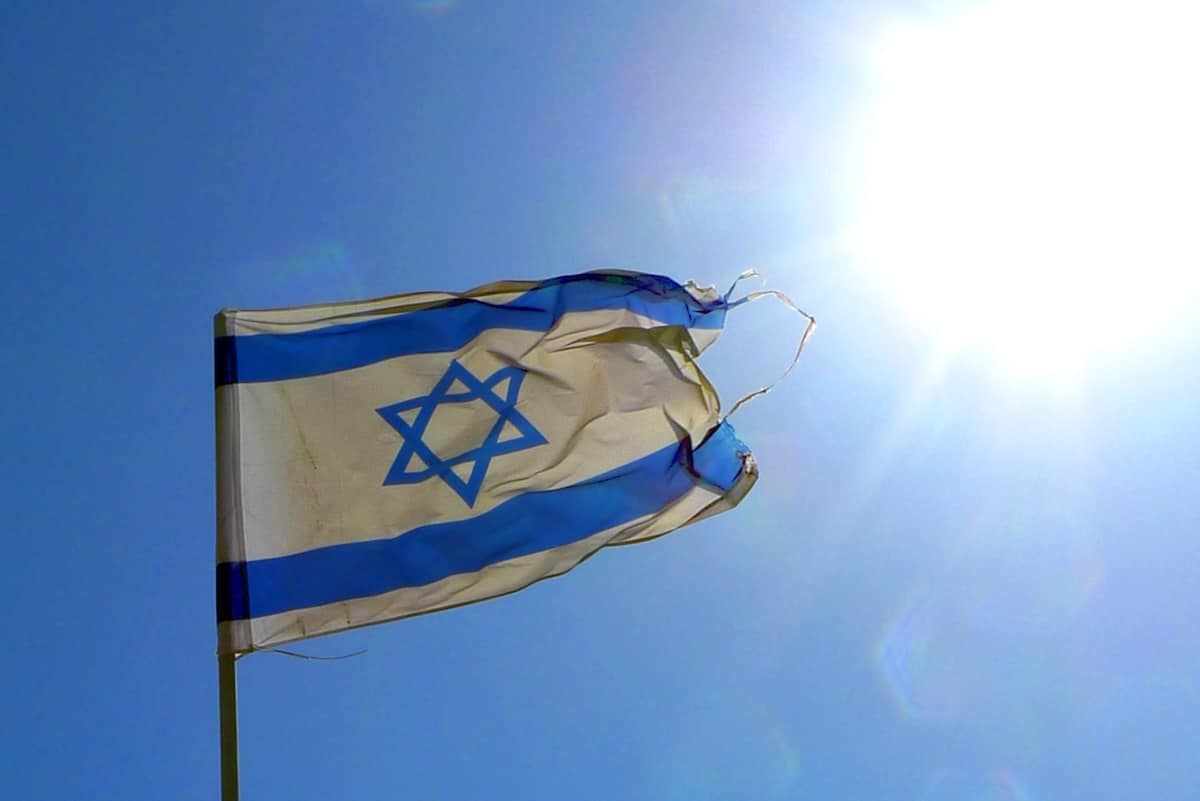
Above photo: An Israeli flag flying in the sun. Justin LaBerge / Flickr.
We Must Oppose This Normalization Of Genocide.
This summer, 1,500 Israeli soldiers will attend Jewish summer camps across North America. They will act as ambassadors for Israel as it carries out ethnic cleansing across Palestine. The Jewish community must reject this normalization of genocide.
It’s June, which means a similar scene is playing out at tens of thousands of Jewish houses across the continent. Duffel bags dug up from basements. Toiletries laid out on carpeted floors, emergency trips to the drug store for one final item. Last-minute clothing decisions. Bags of carefully curated candy. Tearful midnight goodbyes to school friends. For so many of us Jewish North Americans, the summers of our younger years mean one thing: sleepover camp. Unfortunately, it’s not just Jewish kids, teenagers, and twenty-somethings getting ready to go to one of the hundreds of Jewish camps in North America. At a not insubstantial number of these camps, Israeli soldiers will also soon be in attendance, sleeping in cabins, giving guitar lessons, and telling their rapt, doe-eyed campers stories of heroic daring and the importance of maintaining Jewish power at all costs.
Called shlichim, the more Zionist camps on the Jewish camp spectrum—because, to be clear, this is far from all summer camps, some of which are proudly progressive, others just secular and not interested—invite these Israeli soldiers (or Israelis who have just finished in the IDF, a very thin distinction) to act as ambassadors to Israel, and to further the ideological bonds between diaspora and ethnic nation-state. According to The Jewish Agency for Israel, the organization responsible for recruiting and placing Israeli soldiers at the camps, in 2023 around 1,500 shlichim worked at 158 camps. As Jacob Gurvis explains in an April 2024 article in the Times of Israel, “While the number of roles has remained steady, the Jewish Agency for Israel, which runs emissary placement, says more Israelis applied to work at camps this summer [the summer after October 7] than in any previous year.” An article in The Canadian Jewish News from July 2024 states plainly that some of the Israeli soldiers arriving at Camp Northland B’Nai Brith in Ontario, Canada, were “on a navy warship or in Gaza only two weeks before starting camp.”
What’s so shocking about all this is how proud the Jewish Agency and the Jewish media are of this mutated version of the deadly exchange, how out in the open it all is to anybody willing to do a Google search. What is a meaningful moment of cultural transmission and Zionist-diaspora outreach for some is, for the rest of us, an unfathomable crime: fifteen hundred IDF soldiers spread over 158 camps across Turtle Island. How many of these fifteen hundred were on the ground in Gaza? How many demolished universities and schools and hospitals as they yelped with glee? How many sniped children in the head from afar? How many paraded on their tanks in pilfered women’s lingerie? How many danced in destroyed and looted houses with a Torah? How many dropped bombs from airplanes? How many controlled drones from a Tel Aviv office building, raining down fire and death and leaving shredded bodies and lifeless Palestinian corpses in their wake?
In my internet research, I found plenty of articles celebrating the Israeli-summer-camp connection. This is how detached from the situation Zionist camp directors and the institutions they represent are, how unable to see the reality of the genocide the Israeli state is perpetuating against the Palestinian people. I read articles celebrating Israelis detaching and detoxing from the war at placid summer camps (North America’s own settler colonial reality neatly ignored). I read articles about conferences and seminars held in Israel, where camp staff will be trained in “how to welcome Israelis in this moment,” how to help them “heal and grieve and feel supported,” as Jamie Simon, chief program officer at the Foundation for Jewish Camp, puts it. An article published on the Jewish Louisville website from this March—nearly six hundred days into the genocide—is entitled “In Israel to Train With This Summer’s Schlihim, a Declaration of Joy and Hope.” The article’s author, David Siskin, the director at Camp J, details how the visiting camp directors were taken on a tour of one of the Kibbutzes attacked on October 7, to “ensure that the stories of heroic moments inside darkness are never forgotten.” An article at jewishcamp.org states that “80% of North American overnight camp staff said camp helped them to connect to Israel and Israeli staff.” The same article has a camp director proudly state that for Israelis who lived through October 7, “five days in camp was like five years in therapy.” (Why North American Jewish camps should be providing therapy to Israeli war criminals is not addressed.) You can go to the Jewish Agency’s website right now and read profiles on a number of Israelis who have spent their summers at our camps.
I went to a number of different Jewish summer camps. Two of them had no soldiers, and no Zionist content (though apparently one of those, Northland, now does, a devastating shift in the exact wrong direction). Kinneret-Bilium, the camp I spent the longest time at, four years in total, did have Israeli shlichim; at the end of the summer, one of them gave me an Israeli Air Force pin. For a sensitive, impressionable, desperate-to-be-cool young teenager, you can imagine how I felt about those soldiers. This is the power of the Zionist narrative in the Jewish world: a people forever victimized finally fighting back. Look how cool, how competent, how comfortable these soldiers are in their bodies, with their mighty language and understanding of life and death. Of course, what this narrative buries is the cost of having a nation-state to call your own: dispossession, dehumanization, ethnic cleansing, genocide. Full and utter detachment from any ethical connection to reality.
Israeli soldiers working at Jewish summer camps is such a potent symbol of Zionism’s iron ideological grasp on the diaspora that I made it one of the central crises of my recent novel, Lake Burntshore. Set at a fictional Jewish summer camp in Ontario that had nothing to do with Israel until the summer of the novel, when the camp owner’s son brings in five Israeli soldiers to make up for an unexpected staffing shortfall. The novel’s protagonist, Ruby Shacter, an undergrad and anti-Zionist activist, is horrified by what the arrival of these soldiers will mean for her camp. This is the beginning of the novel’s exploration of Jewish belonging, settler colonialism, and relationships to land. As well-versed as I thought I was after three years researching and writing the book, it was still a shock to me when I found the trove of recent articles celebrating soldiers arriving at our childrens’ camps.
There are signs, however slight, of a shift. An otherwise positive article from The Jerusalem Post mentions that at least one camp “had a vocal donor opposed to” Israeli soldiers. An essay by an anonymous father and mother in The Forward from last February begs summer camp owners and staff to be more honest about the reality of the Occupation. Even the Times of Israel article hints at the unease growing in some Jewish camping corners: “As criticism of Israel has grown in the months leading up to the summer, some camps have faced pressure from parents or staff to scrap activities focused on Israel or its food and culture. While Young Judaea is a Zionist organization, Vaknin said he, as well as shlichim at other camps, are encountering what he deems to be anti-Israel sentiments from fellow counselors.”
Most promising is an article at the self-described Zionist TheJ.ca, which bemoans the fact that Camp Shomria has “quietly ceased raising the Israeli flag at its events and ceremonies.”
However, the time of anonymous essays and tepid phone calls to camp admin and, yes, even flag removals, has come and gone (if it was ever enough). Zionism has reached its genocidal apotheosis, and before it takes the entire world, Jewish and otherwise, down with it we have to pull ourselves out of this ideological pincer hold. Parents should pull their kids from these camps. Kids should not want to attend. A different Jewish world should be demanded, starting with admittance of guilt and reparations—endless reparations—for the Palestinians. A dream? Perhaps. But so, once, was Zionism.